
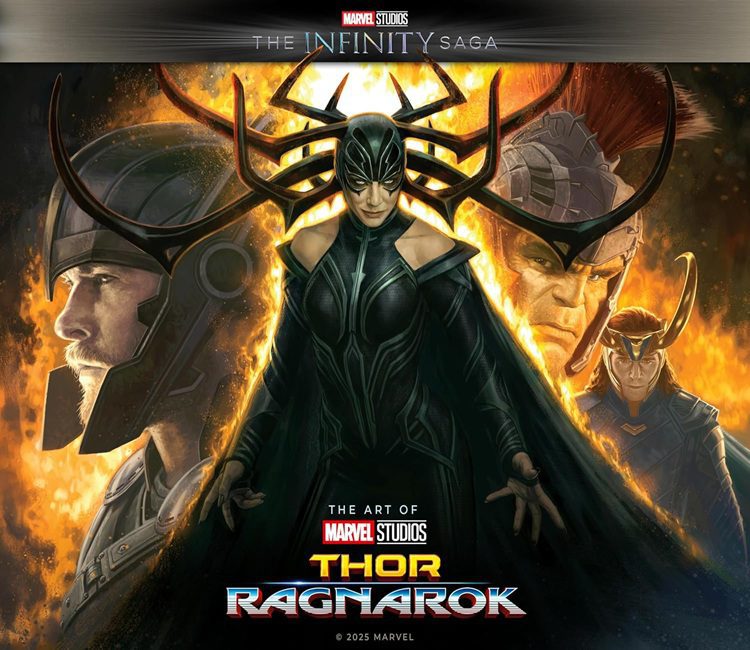
Marvel Studios: The Infinity Saga – The Art of Thor: Ragnarok is the 16th release in the 22-book Marvel Studios: The Infinity Saga series, which is republishing previously released art books as a resized matching set. In the Foreword, Director Taika Waititi credits Visual Development Supervisor “Andy Park and the other amazing artists in Marvel’s Visual Development team. Without [whom], the book wouldn’t exist.” He also mentions the work of the Production Design team and Costume Designer Mayes C, Rubeo.
Buy The Art of Thor: RagnarokChapter One, “The Signs of Ragnarok,” opens with how this fifth outing for the Thunder God was handled. Park says Waititi wanted Thor to appear road worn, dirtier, and more rugged after his “two-year journey and had not changed since he started.” The chapter also covers fire giant Surtur and the layers of visual effects required to build it, as well as the various guises for its fire-demon minions on the planet Muspelheim.
Chapter Two is titled “Hela, Goddess of Death” but it starts with the new design for her brother Loki, “using a lot of Jack Kirby shapes and colors,” including new variations of his helmet and dagger. After two pages about Odin, the creation of Hela comes to the forefront. Park described it as “definitely a huge design challenge, but probably one of the more exciting challenges in all [his] seven-plus years…at Marvel Studios.” Many images are devoted to Hela’s signature headdress, costume, hairstyle, and her minions, including Skurge the Executioner.
Also in his Foreword, Waititi “name-drop[s] one very important person: Jack Kirby.” The team decided to “run headfirst into the Kirbyfication of [the] film.” Doing so “meant…allowing [them] to unapologetically lift (steal) his designs and take them for [their] own….most of this energy [went] into the design of the gladiatorial planet of Sakaar,” which is the focus of Chapter Three. Production designer Ra Vincent explains they used Kirby’s “designs in not only an aesthetic sense, but also in a kind of whole-world ethos.” Characters highlighted in this chapter include former Asgardian warrior Valkyrie and Sakaar ruler, the Grandmaster.
For Thor to win his freedom from Sakaar, he must compete in a “Contest of Champions,” which is what Chapter Four covers. Readers get to see concept art for the arena, its catacombs, and gladiator weapons. Visual Effects Supervisor Jake Morrison and Concept Artist Tully Summers talk about the challenges of creating “the fully digital speaking rock man” Korg. There are numerous costume designs for what Thor, Hulk, and various gladiators might wear during the contest. Storyboard artist Todd Harris offers insight next to his penciled sequence of Thor and Hulk’s first meeting in the arena.
Before the actual “Escape from Sakaar,” Chapter Five opens with the designs for Hulk’s suite, which is certainly worthy of a champion and includes a bed made from a giant skull. The artists created various vehicles for the escape before deciding on the Commodore, which Vincent explains, after the director’s instructions about the mood to go for: “a Stanley Kubrick approach to Flash Gordon, but in a Taika Waititi kind of way.” Valkyrie’s ship Warsong also has a cool design but is built with a different function.
Chapter Six opens with a new look for Heimdall, who had gone into hiding. Then readers get variations of Ferris, the 35-foot long, mythical creature. Concept Artist Aleski Briclot talks about “stay[ing] close to the shape of a classical wolf…and one with a body like a black hole containing a whole universe close to exploding.” The latter looks amazing. As the title indicates, the chapter wraps focusing on the events and participants of the “Battle for Asgard.”
In the MCU, Thor: Ragnarok is the most stylistically different from its two predecessors. That’s what helps make The Art of Thor: Ragnarok so engaging as the artists got to expand beyond previous films’ parameters, tapping into their imaginations and embracing Kirbyfication. This book reveals how talented the artists involved in the pre-production were.
