
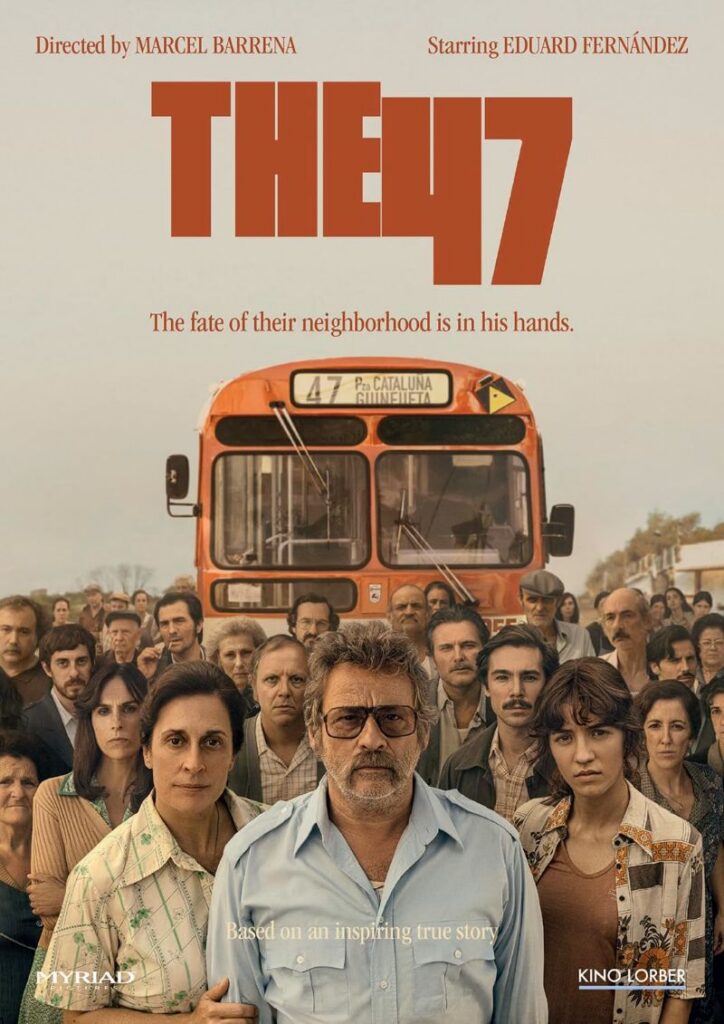
Marcel Barrena’s inspiring historical drama transports viewers back to Barcelona in 1978 for a look at how one common man integrated a far-flung immigrant community into the city. That man is Manolo (Eduard Fernández), a humble bus driver incensed by the city’s refusal to offer bus service to his immigrant community, purportedly due to unsafe roads that are deemed too narrow. After exhausting all legal remedies, Manolo takes matters into his own hands, hijacking his bus and driving it to his neighborhood to prove its viability for service.
Buy The 47The film won Best Picture at last year’s Goya Awards, the Spanish Oscars, and it’s easy to see why with its inspirational message, timely exploration of immigrant rights and dirty politics, and surprisingly light-hearted approach. Fernández is a scene-chomping lead, with his wide tinted glasses, bushy mustache, and scruffy ‘70s attire pushing him perilously close to caricature, but his humorous take on the character helps to make Manolo a deeply relatable, sympathetic individual. Manolo’s long-suffering family and fellow immigrants are completely one-dimensional, somber figures in the shadow of Fernández’s towering performance, but he’s more than able to carry the entire picture on his shoulders.
The plot is so slight that it’s a mystery how Barrena was able to stretch it to nearly two hours without running out of gas. We get some general history of the ramshackle immigrant community of Torre Baró as it developed organically on the hilly outskirts of Barcelona, as well as plenty of Manolo’s fruitless efforts to draw attention to their plight. Barrena wisely sidesteps needless subplots, keeping the focus entirely on Manolo and his ongoing crusade for the neighborhood. It’s not just bus service they need, as all basic services had to be fought for as the community grew, but public transport is the missing ingredient most needed to truly make Torre Baró official and integrated into metropolitan Barcelona.
There are clear parallels to the ongoing current plight of neglected immigrant communities worldwide, making it feel like this particular story could easily be happening today. Its inspiring underdog story makes for a crowd pleaser, but its best trick is Barrena’s ability to dramatize the history without making it preachy. Manolo is portrayed as a multi-faceted individual with his own foibles, not some impossibly shining knight, keeping him grounded as a relatable common man and consequently making his achievement all the more impressive.
