
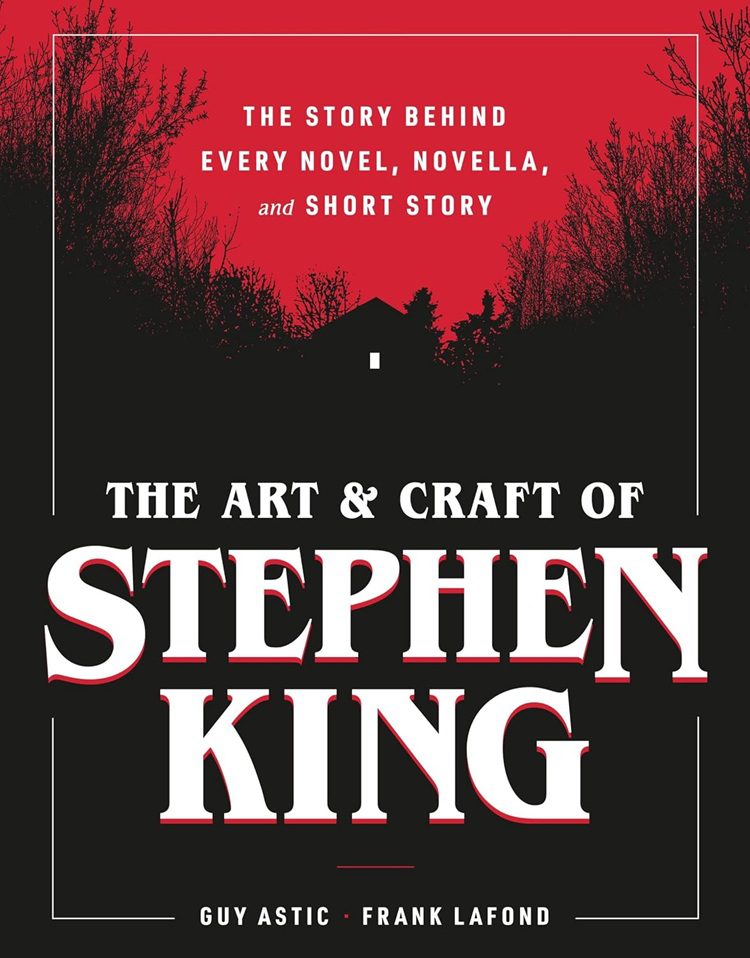
Stephen King published Carrie in 1974. In the 52 years since then, he has been one of our most prolific writers. Constant readers have rarely gone more than six months without a new short story, novella, or novel from the author. In time for Halloween and the holiday season, Guy Astic and Frank Lafond have compiled an essential guide to every written piece and the related movie, television, and streaming adaptations. The Art & Craft of Stephen King, published by Black Dog and Leventhal Publishers, covers the era from Carrie through his 2025 interpretation of Hansel & Gretel. This tome at almost 650 pages is as weighty as any of King’s longest epic novels.
Buy The Art & Craft of Stephen KingI started a full read of King’s works in 2019. I had read all of them through roughly 1985 in my youth. After that I read every third or fourth as time and my budget would allow. Reading them again in order, I thought would take about three years, but took just over four years to catch up. Along the way, I caught up with books that I had previously watched the movies, and I watched the adaptations of books and stories I didn’t realize were related. I grew in appreciation for the depth and connections of the works. This is exactly the type of book that would have been perfect for that project. The format takes the written works in chronological order, detailing some behind-the-scenes stories of the writing of the book, connections to other works, and details of the different media adaptations. It’s a logical approach to such a huge body of work.
The Dead Zone (1979). Film adaptation: The Dead Zone (David Cronenberg) (1983). TV Series: The Dead Zone (2002-2007). This is a good illustration of the excellent entries. There’s a synopsis of the story, which takes place from 1970-1979. There’s a bit of backstory about the genesis of the story. There’s a little history of Castle Rock included that’s helpful to the connection to future stories. There’s twice as much page count dedicated to analysis of the film as the book. There’s some information here repeated from commentaries on the DVD, but I thought it was a well thought-out comparison.
There are plenty of illustrations and sidebars to break up what could be an overwhelming amount of text. It’s a large book, and I feel like it’s going to be one I would not read in a single reading event. It’s one that I would use as reference after reading the book, much like I would listen to the commentary on a film only after watching the movie. There are still some King novels that have not been adapted to screen. I’m mostly just taking about The Dark Tower series. It’s possibly his most impressive and important series of books. The entries for these are the biggest drawback of the analysis. It feels like the film adaptations get the larger percentage of pages.
Skeleton Crew (1985). It’s complicated to cover collections of short stories. There are nineteen short stories, two poems, and a novella in this book. The authors give a decent short summary of the stories without getting too in the weeds of each story. I appreciate the basic info of where each story first appeared. Trying to keep the entry to a reasonable length means glossing over television adaptations like “Gramma” (The Twilight Zone – 1986) and Mercy (2014). I like the breakdown of The Monkey (2025) which only resembles the short story for portions of the first half of the film.
The problem with many of the books I read that are based upon the works of an actor, author, or director is that they often have a bias towards either the early years or the most recent years. This book has a fair balance, although there could be more pages to some of the more minor works like Revival (2014) and Duma Key (2018). These are good books that don’t have adaptations. When the ideal series comes along, it would be nice to already have a decent entry into the themes and characters.
This is going to be a book that fans of Stephen King, be it books, films or series, will love to receive this holiday season. It’s a valuable reference book that’s has a pleasing presentation. The old joke is probably that Stephen King will have released a couple of books and had a few movie adaptations by the time that any book gets printed. This should take up some space on any Constant Reader’s bookshelf.
