
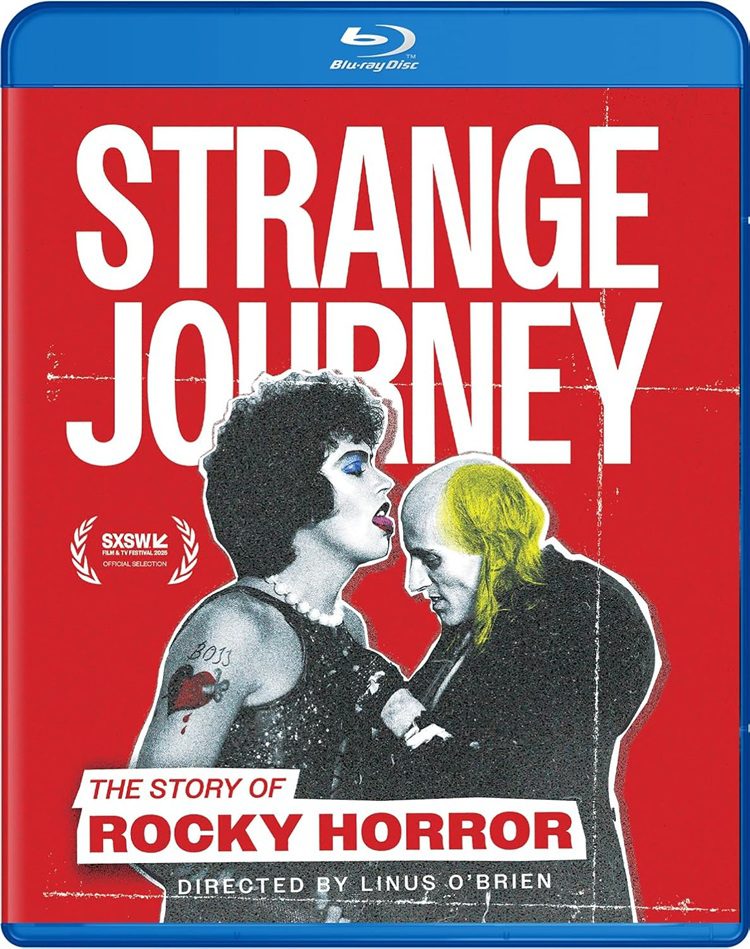
Richard O’Brien is the legendary creator of The Rocky Horror Show and the lesser-known co-creator of Linus O’Brien, who directed of Strange Journey: The Story of Rocky Horror, which tells through many of its participants of how a fringe musical went on to become, and continues to be as packed theaters across the world can attest, the most successful cult movie of all time.
Buy Strange Journey: The Story of Rocky HorrorIn addition, the documentary also tells of Richard’s own strange journey, who at the age of 22 in 1964 left New Zealand and traveled five weeks by ship to London. Then in 1967 a transformation occurred in different parts of the world as the counterculture came to the forefront of pop culture. Richard took a drama class and became a working actor. He performed in a UK touring company of Hair where he met Linus’ mother. He was set to take over the role of King Herod in Jesus Christ Superstar but after two rehearsals, producer Robert Stigwood didn’t care for his performance and he was fired. The director was Jim Sharman, who was disappointed at what happened and told to work again
Richard, not sure whether to stay in the theater because of his family obligations, began working on a rock musical, which was commonplace in early ’70s. Sharman came to listen to some songs and helped bring the musical to the stage, starting at the 60-seat Royal Court theater, moving onto the bigger King’s Road Theater, and then music producer Lou Adler brought it to the Roxy Theater in Los Angeles. It was a success at every stop. Adler’s attorney became the Head of 20th Century Fox so he had an inroad to the studio, although with a paltry million-dollar budget, Sharman felt he wasn’t making a Hollywood film but rather an underground film in the vein of Andy Warhol and Derek Jarman.
After production ended, Adler brought the musical to Broadway where it bombed and got terrible reviews. The Rocky Horror Picture Show was released and it also flopped. A few months later, on April Fool’s Day 1976, a midnight screening was held at the Waverly in New York and the movie found its audience. Each weekend, people came and returned not just for the movie but also to be with like-minded, non-judgmental folks, particularly when it came to sexuality, which is what made the screenings a haven for queer kids as some of the fan interviewees reveal. More prints were made and more screenings were added across the country.
In 1977, Sal Piro started a fan club that helped spread the word about the movie and matters associated with it. Then the screenings morphed into an interactive experience because of the fans who are the focus of the last third of the movie. People shouted at the screen and what worked would be repeated at the next show. Props were used to mimic what was occurring on screen, such as water guns replicating rain. Then the first shadowcast happened, credited to the 8th Street Playhouse in New York, where they recreated what was taking place on screen, returning Rocky to its theater roots.
The video has been given a 1080p/MPEG-4 AVC encoded transfer displayed with a varying aspect ratio. The modern-day interviews and the footage from the film have strong colors as well as a sharp focus that reveals texture detail. The archival footage presents video and photos of varying degrees of quality.
The audio is available in DTS-HD MA 5.1 Surround. As a documentary, it’s got a lot of interviews and the voices sound clear out the front center channel. The musical numbers from the movie spread to the surrounds and subwoofer.
There are no extras.
Strange Journey: The Story of Rocky Horror pays tribute to the musical, the film, and the fans that have kept it alive. Linus elicits wonderful stories from those involved in the productions and gets insight into its ongoing appeal. “Virgins” who haven’t seen the movie in a theater can enjoy the show-business stories and appreciate the passion of those who have. And fans will find themselves wanting to do the Time Warp again at a local showing.
