
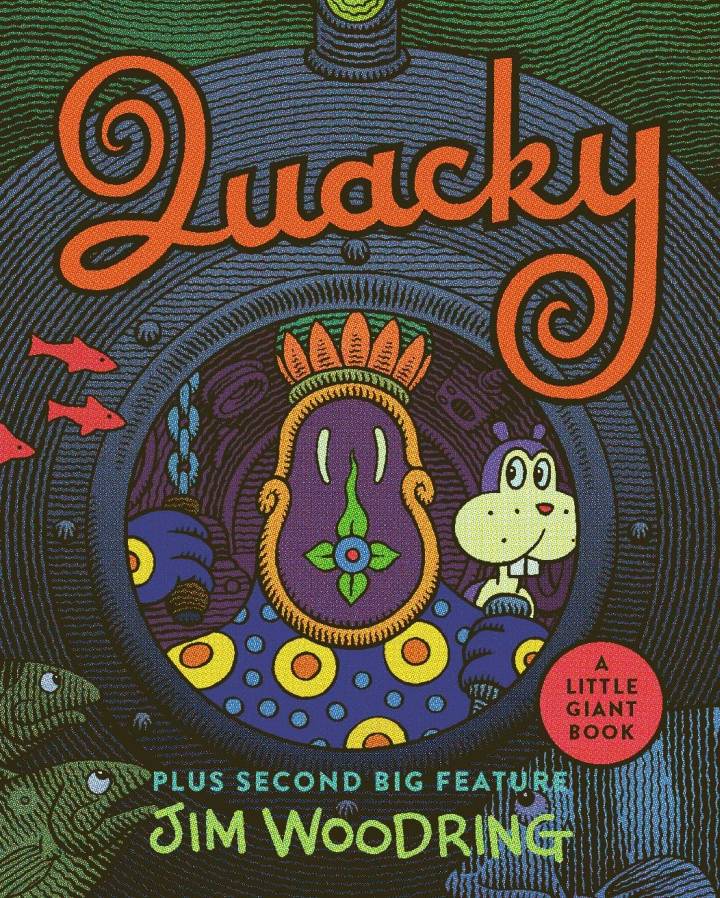
Jim Woodring, who has been cartooning for longer than I’ve been alive, is a unique voice in American comics. Since 1980, his mix of anthropomorphic animals and surreal, dream-like imagery have created a high personal cartooning story landscape.
He’s published in various formats, including his self-published personal magazine (eventually picked up by Fantagraphics) and large-format comic collections. His newest work, Quacky, is in the format of a Big Little Book (here called a Little Giant Book). This was a format used for children’s books in the ’30s, with a page of prose complimented by an illustrated page opposite. The book is very physically small (3.5″ x 4.4″) but almost 300 pages long.
For Quacky, published by Fantagraphics, Woodring has included two stories. The bulk of the book is taken up by a new Frank story. If any of Jim Woodring’s creations are famous (and I’m not sure they are, he’s a rather niche interest) it’s Frank. He’s been the star of several of Woodring’s comics and had several stories collected in the very directly named The Frank Book. Frank is an anthropomorphic… something. Not a bunny, but looking a little rodential, Woodring describes him as “naive but not innocent.” He enjoys a care-free, but deeply self-centered life. Frank lives in a strange, invented world, the Unifactor, which is a kind of generic cartoon landscape that occasionally sprouts entirely malevolent factors. There are frogs and newts and some normal animals, but also odd flying polyps and twisting dream things that assault a man’s (or whatever Frank is) mind.
In this story, Frank is contacted by Quacky, an old friend whom he kind of likes, but who has an adoration akin to worship for Frank. This suits Frank fine, and he enjoys it when Quacky (who looks like a duck run through the mind of a ’60s psychedelic artist) brings him to his immense mansions and takes him along on adventures.
It would be pointless to describe these adventures in detail since the experience of a Woodring comic is the point. Never incoherent or irritatingly opaque, they still do not operate on normal story logic. Events move in a logical progression, but do not connect to cause and effect like a traditional story would. The first 100 pages involve a small puppy turning into an enormous building, after which Frank commences on a submarine tour and reads the comic strip of his life. These events aren’t exactly random, but they do not progress like a normal story might, connecting into a larger whole.
The format, as described, is half prose, half comic. The left-hand pages have a short passage of story, illustrated on the right side. The illustration always has an accompanying caption, sometimes taken directly from the text, sometimes not. Frank is drawn with very simple lines, like a typical cartoon character, while the world and most of the other characters around him typically have more detail, cross-hatching, and much more complex designs. Quacky himself is a duck, but he’s decorated like a spotted tree frog. There is never any progression in Frank’s stories – they all begin in the same place. Even if a character has been killed and eaten in one story, they will be back again in the next. The point isn’t an over-arching narrative, but a more contemplative look at various aspects of life and existence. It is very much like reading a semi-coherent dream.
The back up story, credited to Slim Davenport but written and illustrated by Woodring, is called “Hoggy Goes Hogwild.” It takes place in a world of anthropomorphic pigs, where a former childhood star goes on a violent rampage. Despite the pig protagonists, this is actually a more straightforward story than the Frank tale. It shifts from a melodrama into something like a Twilight Zone episode, where reality begins to turn in on itself. “Quacky” has the quality of dreams. “Hoggy” feels more like a growing nightmare.
Jim Woodring’s writing and illustration are of such a consistent quality that to like one of his stories is kind of to like them all. They have a very specific, very strange wavelength. The illustrations for the Frank story look kind of like woodcuts that have an animated cartoon character wandering through them. “Hoggy Goes Hogwild” is consistently cartoony, weirdly grounding its pig-led story into a more realistic world. I’m on the wavelength, so I find this a very welcome addition to Woodring’s bibliography. Quacky’s bizarre format, (published by Fantagraphics) both the size and the prose/illustration storytelling, fit right into his unique world.
