
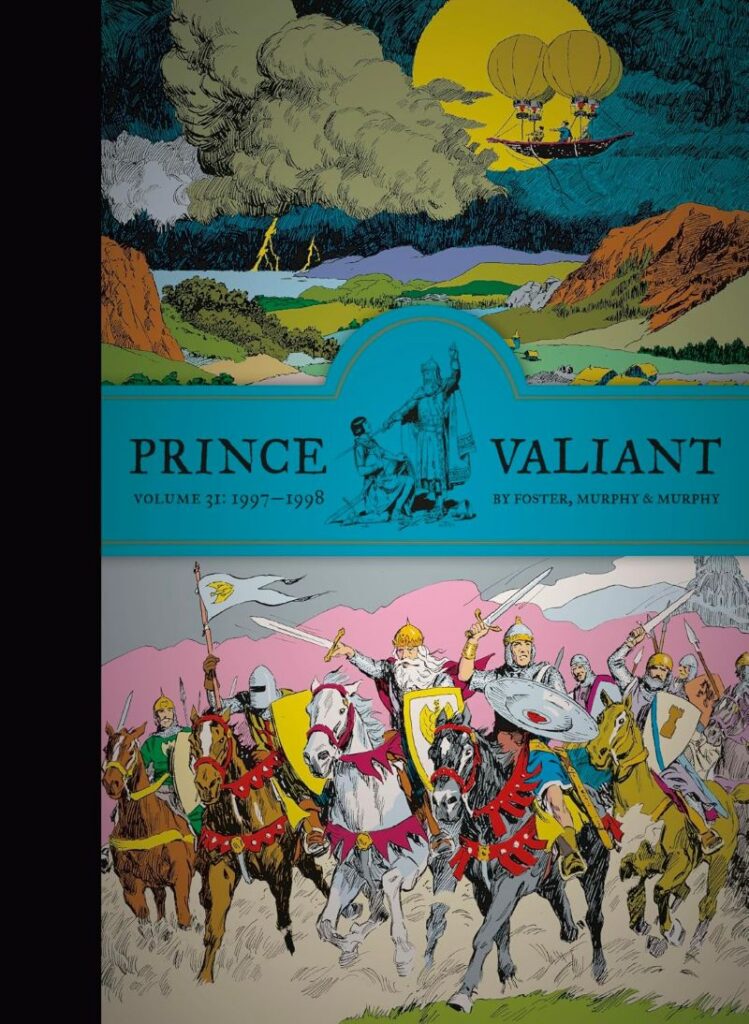
The latest two-year run of Prince Valiant strips kicks off with a royal abduction, as Val’s wife, daughter-in-law, and granddaughter are held captive and transported north from Camelot into the land of the blue-painted Picts, aka Scotland. This precarious situation for the ladies launches right into a rollicking adventure spooling out through a half year of strips. One of Val’s old enemies is pulling the strings, using both Picts and Swedes to carry out his diabolical plan of revenge against Val and his pursuing forces.
Buy Prince Valiant Vol. 31: 1997-1998That impressive storyline makes way for a brief comical outing where Val reunites with his son Galan and discovers that human flight is no longer an impossibility. This light-hearted respite is just a palate cleanser to prepare for the epic tale that takes up most of 1998’s strips. The action begins when Val returns to Camelot only to discover that Sir Gawain has a mysterious new girlfriend named Cordelia, and Gawain’s lowly squire Cecil has somehow established an unlikely reputation as a war hero. All is not as it seems, with the two new arrivals having significant roles in the fall of Camelot, exile of King Arthur, and usurpation of the throne by a villainous new ruler. It’s shocking to see how quickly the seemingly indestructible kingdom falls, with survivors retreating to Uther’s derelict castle and Arthur wandering the lands solo, disguised as a peasant.
Writer Cullen Murphy again intersperses an abundance of historical fact into his narrative, forever negating the idea that comics aren’t educational. The strips are a bit overwritten at times, revealing Murphy’s passion for detailed historical research and verbose character interactions. However, his plots in this collection are superb, especially the gripping and expansive fall of Camelot story.
As for his father’s artwork, the veteran cartoonist John Cullen Murphy’s work is exhibiting some natural signs of his decline here as he approached 80 years of age and his final years on the strip. Lines are loose and lacking precise details, more expressive than clearly defined. There’s a simpler feel to the art, partially a reaction to shrinking strip dimensions but surely also related to Murphy’s advancing age. And yet, there’s no denying the continuing throughline in the artwork from Hal Foster’s early contributions in the 1930s right up to closing days of the century, an unbroken track record of excellence that persists to this day. Murphy still has the goods overall here, but it’s clearly latter days and nearly time to start the search for his eventual replacement, Gary Gianni.
The supplemental material in the latest volume launches a new spotlight series on some of the most well-regarded art pieces in the entirety of the strip, as selected by “prominent experts, appreciators, and creative associates of Prince Valiant.” It’s a noble experiment, even as this volume’s singular focus on masterful early Foster pieces offers further evidence by comparison of Murphy’s diminishing returns.
