

The birds are telling him a story.
Pop Culture Ephemera
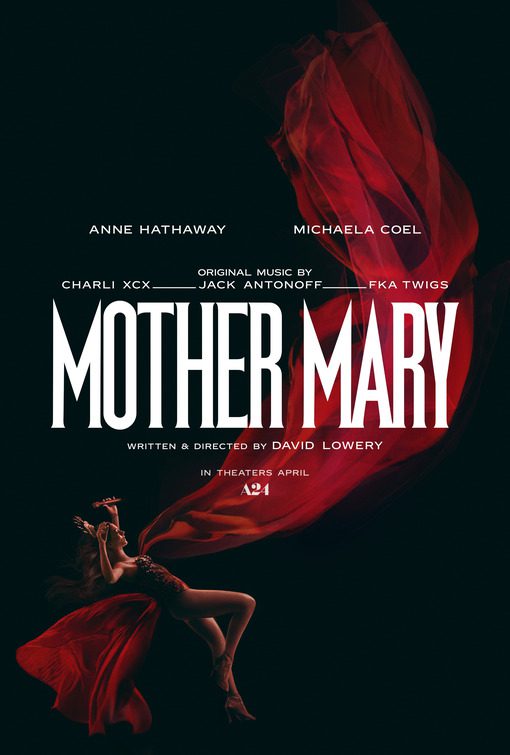
- Mother Mary (2026) (Directed by David Lowery): “The transubstantiation of feeling… that’s what we’re doing here.” – Sam Anselm. Director Lowery has shown us these elements before. I loved The Green Knight (2021) for the elements of magic that existed parallel to our world. The story felt like a dream that kept intersecting with reality. This film isn’t keenly different. There are metaphors built upon metaphors. That’s the reason this film probably won’t ever find a wide audience.
Mother Mary (Anne Hathaway) is a successful female musician. She’s an icon on the level of Madonna, Tina Turner, Beyonce and any that become a metaphor themselves, She returns to her former costume designer, Sam Anselm (Michaela Coel) to have a costume made for what might be her final performance. The first half of the film plays out like a two woman play, something we might have seen in the Seventies. It’s an important prelude to build the different themes because the second half turns into a ghost story that borders on a possession story. This isn’t your Father’s Blumhouse production though. Lowery doesn’t let a chance to build the symbolism go by the wayside. I’m sure multiple viewings would allow further introspection on the lyrics of songs and the religious meanings behind the symbols. It’s got the feel of a film that aims to be bigger, but it’s filmed and cast like a smaller production.
- Family Guy – “Disney’s Hulu’s Family Guy’s Hallmark Channel’s Lifetime’s Familiar Holiday Movie” (S.24 Special #2) (Disney+) (2025): “Lois, this is Joe. And this is Cleveland in a scene that can be cut without loss of continuity in certain red states.” – Peter. When you don’t follow a show outside of their normal run and you don’t frequent their streamer often, these exclusives can get past you. The algorithm is set to promote these for about a month and then nothing. I’m catching up on the two Hulu Exclusive episodes. This episode is an illustration of what I love about the show that also turns off many. They commit to a bit unlike any other show (see their Star Wars parodies). They don’t stray far from the Hallmark-movie format. The parody rushes from one joke to another (as the show does), but when they aren’t constrained by the FOX time frame, why didn’t they use another ten to fifteen minutes to include more of the favorite characters? It’s not one of their best, but it is a reminder of why this show has stuck around. Now to catch up with the dang streaming exclusive The Simpsons episodes I missed.
- Paul McCartney & Wings – “With a Little Luck” (from London Town) (1978): “We can make this whole damn thing work out / With a little love we can lay it down.” This song came back into my consciousness after reading the Wings book last month. For a #1 Billboard hit, it’s one of the least celebrated of McCartney’s top-charting singles. This hit has never been performed live by Paul. I love the album version of the song because it’s got the synth bridge that was cut for the much shorter radio version. This single broke the string of Bee Gee and Barry Gibb written hits that dominated 1978. Paul still had juice.
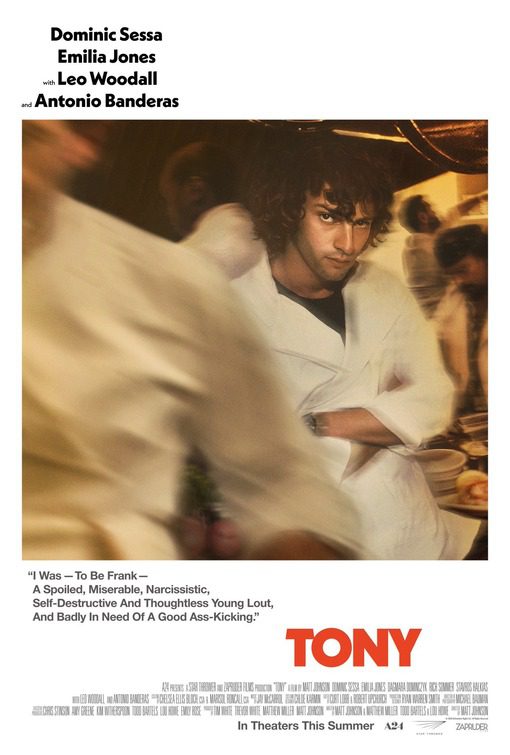
- Tony (2026) (Directed by Matthew Johnson): “I was — to be frank — a spoiled, miserable, narcissistic, self-destructive and thoughtless young lout, and badly in need of a good ass-kicking.” – Tony. This is a film that somehow navigates a number of razor-thin lines that could have doomed it. A biopic that only focuses on three months in the life of a person before they became famous is usually a tough choice if we don’t all know the story of who they will become. It’s a story that starts to veer off the road towards being a romantic comedy before consistently being brought back into the lane. A film that tells us right out that it’s a Bildungsroman story of a boy coming of age over the course of a summer, fits a certain set of tropes that this movie refuses to lean into. All of those things make this an entertaining film that at times confuses the viewer with the overall intentions, but by the time it’s over, I didn’t have a complaint about how any of those things were handled.
The casting brings together actors I’ve loved in other works, and it gives them what feels like the next logical step. Dominic Sessa will get most of the press, and this is a great evolution from The Holdovers (2023). Emilia Jones has become one of my very favorite actresses, from her worthy nominations in CODA (2021), her fun character in Locke & Key (2020-2022), and last seen in The Running Man (2025). Leo Woodall needs more film roles, something I’ve thought since his The White Lotus (2022) appearance. The person that holds this film together is Antonio Banderas, and I wonder why he didn’t get more coverage in the trailers. His character is more than just a mentor. He’s the spiritual advisor that centers Tony in a way that we will later know him in later life. There are thematic pieces that are incomplete here, but it’s beautiful to look at (thanks, Michael Bauman), has a great soundtrack, and the young folks in the cast will certainly have great futures.
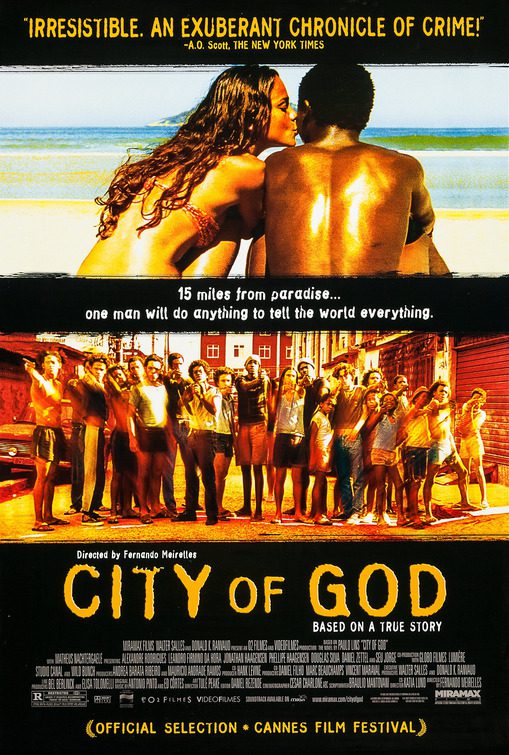
- City of God (2002) (Directed by Fernando Meirelles): “Why return to the City of God, where God forgets about you?” – Barbantinho. I watched this film a number of times when it first debuted here on DVD to teach it for my World Cinema class at Lansing Community College. I moved to Texas and never had a chance to present it in a classroom. It moved back into my mind when it made #15 on the NY Times Best Films of the 21st Century.
The film shows its debt to Scorsese from the first moments with a narrator, gangsters, and the use of music over the transition montages. I’m struck by how well this has aged. The direction and cinematography are exquisite. It would be easy to get lost in all of the different character stories happening, but it’s balanced and each pays off with a satisfying (or tragic) conclusion. City of God is more than just a city. It’s a prison in the same way that London served as an anchor for so may Dickens’ characters. Making our narrator a photographer gives justice to his observations. His camera shows off a layered city where the rich live literally on top of the poor. It’s deserving in every way of the #15 ranking, and I would love to go back and teach the storytelling elements.
Best of the Rest
- Based upon my reading for the past two years, I’m going to click a link to a story that lists Best Crime Books of All-Time. The Parade list was actually close to the reading list that I had already developed. I’m less concerned about the actually slotting of the books as much as who makes the list. I can’t argue with their #1 pick of Raymond Chandler’s The Long Goodbye (1953). Other lists seem to prefer his The Big Sleep (1939), which I agree with these writers is just too confusing of a plot with too many holes. The other book always near or topping these lists is Hammett’s The Maltese Falcon (1930) is on my list to read again, but Hammett’s writing is less observational.
- There is a reason that you should read the stories all the way through. On the surface, it’s a story about the classic ITV series, Agatha Christie’s Poirot playing for free on Amazon earlier in August. Then there’s mention of the upcoming Hercule Poirot series! There’s plenty of material to adopt in the early cases that were changed when previously adapted. I am not familiar with Edward Bluemel, cast as the younger Poirot. A quick IMDB search of his work makes me feel more comfortable about the choice. He has the look that I imagine of a younger Poirot, and a couple YouTube clips show potential. This type of announcement excites me.
- I feel like there’s a rotation of NY Times, Indiewire, PBS, Hollywood Reporter, etc. yearly publication of a Best Documentaries list. This year seems to be Hollywood Reporter‘s time. It’s a surprisingly deep-cut list of documentaries. They favor docs that tell personal stories over just flat out history lessons. There’s more of a focus on biography over events (think WWII or the Dust Bowl). Props for having docs that stretch back 100 years and not just a list that’s heavy on the past couple of decades. I’m using this to fill in some holes the rest of this year.
Sunday Morning Tuneage Flashback
- Sunday Morning Tuneage from 9/5/2010, I finished up a 60-hour week and was able to relax with some football (win for Caleb, loss for Christian). The college season had started, and it gave me a good reason to sit in the couch hole. Season Three of Sons of Anarchy (FX) was starting, and I knew I would like it. It was still three years before I would binge it and prove that I was correct. True Blood (HBO) was ending Season Three, and I was sad that they had deviated so much from the books that Season Four wouldn’t match the best book of the series. My list of the week is one that I feel I have done before and that I make a new one each six months, since he’s my favorite comic book writer.
My #50 Top TV Show of All-Time was Family Guy (FOX) (1999-2002, 2005-Present): I don’t know if there’s a more unlikely show to make this list. The show was dead in the water for three years before coming back to the same network. Today it’s hard to understand how the DVD release of a show could bring it back to life. The other story here is that this show didn’t have a precedent. The Simpsons (FOX) was an evolution of The Flintstones. This show pushed boundaries without having a mainstream equivalent. Like The Simpsons, this show has made it over 20 seasons by having a strong cast of supporting characters, in-jokes, and clever pop-culture references. I don’t question this ranking when I start thinking of some of their classic bits. This has been renewed through 2028-2029. Now that’s some Animation Domination. - BEST ALAN MOORE STORIES OF ALL-TIME (2010)
- 10. Saga of the Swamp Thing Vol. 1 (DC Comics) (1982)
- 9. 1963 (Image Comics) (1993)
- 8. Tom Strong’s Terrific Tales (DC Comics) (2005)
- 7. The League of Extraordinary Gentlemen Vol. 1 (DC Comics) (1999)
- 6. Top Ten Book 1 (DC Comics) (2000)
- 5. Supreme: The Story of the Year (2002)
- 4. V for Vendetta (DC Comics) (1990)
- 3. From Hell (Top Shelf) (1999)
- 2. Watchmen (DC Comics) (1987)
- 1. Batman: The Killing Joke (DC Comics) (1988)
- BEST ALAN MOORE STORIES OF ALL-TIME (2026)
- 10. Superman: Whatever Happened To The Man of Tomorrow (DC Comics) (1985): It’s just a two-issue collection, but it’s Alan Moore teamed with Curt Swan. Two legends that tell a story that effectively ends the Silver Age.
- 9. The League of Extraordinary Gentlemen Vol. 2 (DC Comics) (2003): This type of storytelling is right up my alley. Take established literary characters, randomly mix them together, and just see what happens. The first book set the tone, and then this one managed to tell a great tribute to War of the Worlds.
- 8. Top Ten Book 1 (DC Comics) (2000): Moore’s America’s Best Comics line was an amazing outlet for Moore. This is a cop story at heart, but Moore is never content to tell stories on just an obvious level. Of all of his Universes, I get the feeling that he was building one of his biggest here with potential for so many more stories.
- 7. The League of Extraordinary Gentlemen Vol. 1 (DC Comics) (1999): I think that Vol. 2 has the better story. This volume keeps your attention for the creative construction of this Universe where logic is stretched to pull together so many literary and historical character. I was more engrossed with the progress than the plot, but it’s still fun.
- 6. V for Vendetta (DC Comics) (1990): Depending on the day of the week, this book can be my second or sixth favorite Moore graphic novel. V is a terrorist, but since he’s fighting fascists, the reader is challenged ethically. This is a subtle flip of the Batman persona as a more ruthless vigilante. It deserves a miniseries more than a single film.
- 5. Swamp Thing Vol. 2: Love and Death (DC Comics) (1985): There is a good argument that Alan Moore’s second storylines when he takes over a title are better than the first stories. We know the characters and the author is freed up to tell a little deeper story. This story is made stronger by Stephen Bissette’s art.
- 4. Batman: The Killing Joke (DC Comics) (1988): The fact that this came out in 1988, and DC hasn’t done anything as shocking or daring to the character (including breaking his back) since then should say something. I really want to read it again (maybe for the fourth time). Tying what seemed like just a simple Joker origin story to the shooting of Barbara Gordon and the real-world consequences of that, is brilliant. Alan Moore put himself in a very small pantheon of writers like Frank Miller who would change the direction of superhero comics in the late ’80s.
- 3. Swamp Thing Vol.1: Saga of the Swamp Thing (DC Comics) (1982): Any writer could take the assignment of telling an adult story of what had been a fairly simplistic superhero. Moore took the assignment and thought about it seriously. What he came up with is a true deconstruction of what it means to have a superpower. The Swamp Thing realizes he isn’t a cursed man but a gifted God. Frank Miller might have taken the graphic novel concept to an adult level a few years later, but this is my Year One for that transformation.
- 2. From Hell (Top Shelf) (1999): The teaming of Eddie Campbell and Alan Moore is more like a trebling of talent instead of doubling. This isn’t for the faint of heart. This isn’t simply a telling of a Jack the Ripper story. It’s the creation of the world, the crimes, and the characters in detail that rarely goes into a comic book. You are welcome to view this as the writings of a madman, while I look at the same material and see an obsessive genius at work.
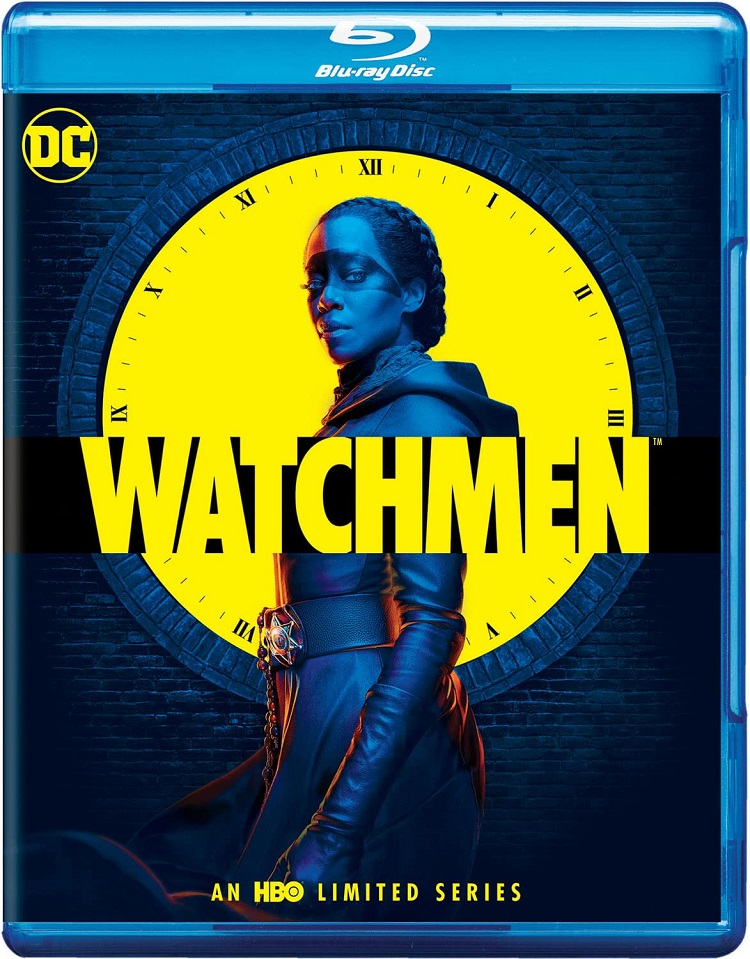
- 1. Watchmen (DC Comics) (1987): Consistently ranked in the Top Five Graphic Novels of All-Time and usually in first place. This is the smart and intellectually stimulating type of literature that convinces your non-comic reading friends that there are a few illustrated novels that would appeal to them. It’s also got enough nods to the superhero tropes that it turns on their heads that it appeals to hardcore comic fans too. Adaptations as motion comics, videogame, film, television mini-series, and animated films have all struggled to latch onto the breadth of the themes. In their own way, each has contributed to the Watchmen Universe and made this a must-read.
1976 in Review
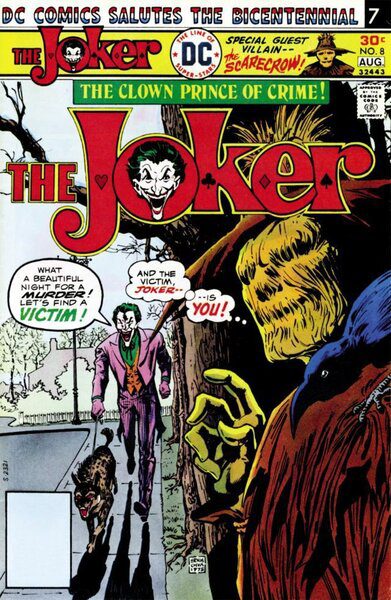
- August – The Joker #8 (DC Comics): Cover by Ernie Chan. Written by Elliot Maggin. Art by Irv Novick. The series only had one more issue left after this. I only remember it from comic bins 20 years later. I can’t imagine if this had been on the newsstand that I wouldn’t remember the cover. I don’t think this is any part of continuity. The Joker has never had a hyena up to this point. The story has the Joker impersonating Scarecrow and their battle. There’s very little Batman appearance in the title as a whole. It was a fine line to tell a story of two villains and still meet the Comics Code rules.
- August 28 – Soccer Bowl ’76 was played at the Kingdome in Seattle, WA. Toronto Metros-Croatia had defeated the Tampa Bay Rowdies to reach the NASL Finals. The Minnesota Kicks won the Western Division regular season and cruised into the Finals. Toronto won 3-0 in a match broadcast on CBS with Jon Miller as the announcer.
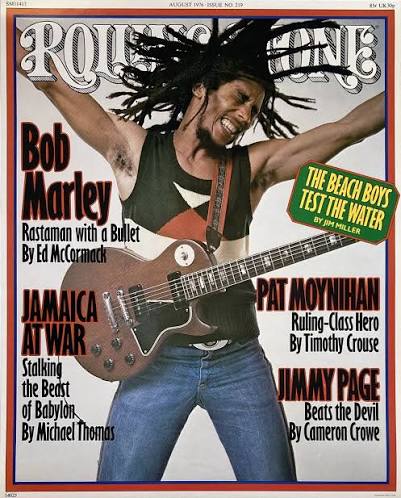
- August 12 – Rolling Stone. Bob Marley and reggae music were having a moment. Marley’s Rastaman Vibrations album was climbing the charts in an era when disco and punk were dominating the headlines. As good as it was going for Marley, the politics in Jamaica were deadly. This issue also has an excellent article about Jimmy Page and Led Zeppelin by Cameron Crowe. It’s an article that has been reprinted in a number of other sources and worth your time.
What the Hell Did I Put in My Mouth?

Mug: Floats – Vanilla Howler
The title here confuses me. I’m a fan of the Mug line of Root Beer. It’s not in my Top Three, but it’s dependable and a good float option. This would appear to fall somewhere between the root-beer float and the root-beer, dirty-soda option with vanilla creamer. There’s not a huge difference in that flavor profile. It’s all a basic root beer with vanilla notes to mimic the melted ice cream. This isn’t as good as the A&W similar variations, but it made for a refreshing drink on a hot summer evening. The vanilla smells better than it actually tastes. There’s a slight sweetness to the aftertaste that isn’t present in other brands.

Wonderful Pistachios: Chocolate Toffee
There is only one logical complaint about these. The cost to serving ratio doesn’t live up to other similar snacks. The Wonderful company has a trustworthy line of high-quality pistachio snacks. Take a salty nut and cover it with chocolate and toffee and you don’t have to ask me twice. They are simply extraordinarily good. They also cost more than most bags of chips, and you’d be lucky to have more than three snacks out of the bag. I’m saving up to get another bag of these.
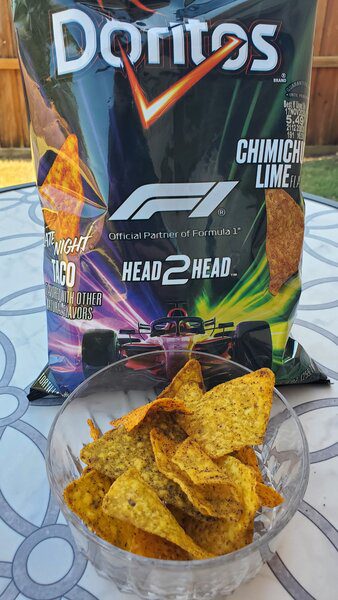
Doritos: Head 2 Head – Late Night Taco / Chimichurri Lime
This is an interesting combination bag. I applaud Doritos for doing these on the regular, even though they don’t always pan out. The Late Night Taco has already proven to be one of their best chips of the past few years. It’s nice to see another appearance. The Chimichurri Lime by itself is a little too tangy and not enough garlic for me. The lime in these chips only works when you eat one with a taco chip. That’s a little more attention to snacking than I want to be while watching a game with this bag. I hope the sales are enough to keep Doritos mixing up flavors in the future.
“There is no end to what we can do together (Together)
There is no end (There is no end, there is no end)
The willow turns his back on inclement weather
We can do it, just me and you” – Paul McCartney
