
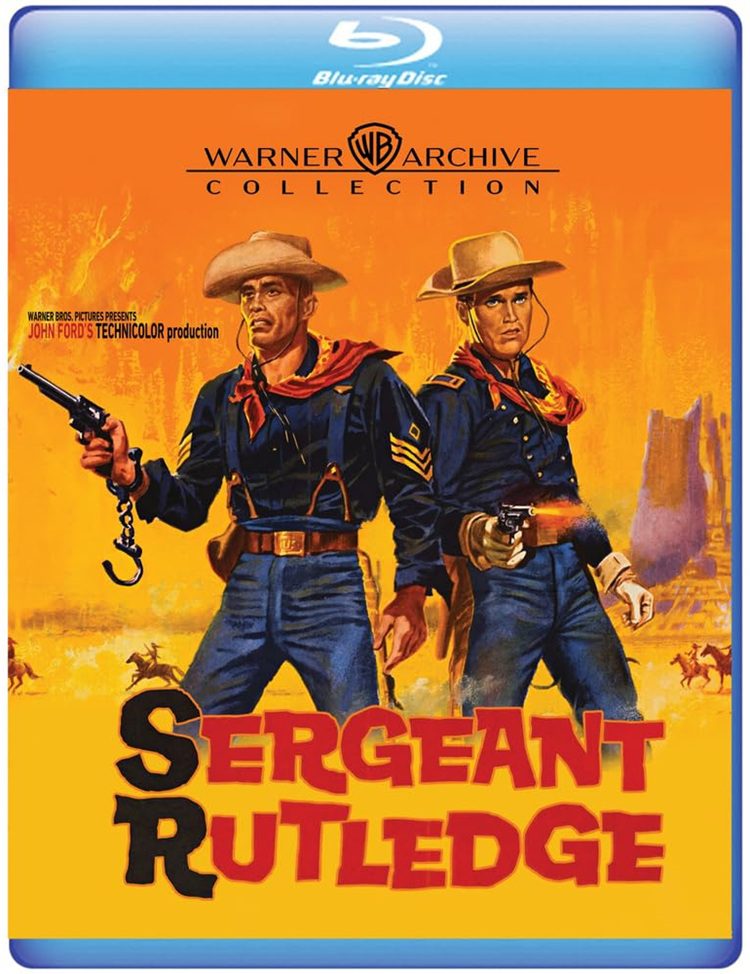
John Ford had started directing films in 1917. By 1960, including short features, the release of Sergeant Rutledge would mark his sixth decade of work and over 120 films to his name. Starting notably with The Searchers (1956), the aging director started challenging stereotypes he had played into earlier in his career. The stories Ford was telling didn’t glorify violence and masculinity in the same way as he did in the post-WWII period. The Warner Archive Collection release of Sergeant Rutledge on Blu-ray allows a new look at this important entry in Ford’s filmography.
Buy Sergeant Rutledge from Movie ZyngSergeant Rutledge unfolds in flashback during the court martial trial of First Sergeant Braxton Rutledge (Woody Strode) for the rape and murder of a young woman and the murder of her father (a commanding officer) when Rutledge was discovered over the body. It isn’t the first time that Ford has used the courtroom in his films. The setting offers an arena for controlled presentation of arguments and an excuse for characters to tell their backstories. Ford had a climatic courtroom scene in Judge Priest (1934), starring Will Rogers, but it was used to reveal the morality of a character and didn’t use flashbacks. He remade his own film as The Sun Shines Bright (1953) with the same effect. It’s hard not to compare this courtroom to that of Young Mr. Lincoln (1939). In that case, it is late information brought by Abraham Lincoln (Henry Fonda) that turns the case, much as is attempted in the trial of Rutledge by his lawyer, Lt. Cantrell (Jeffrey Hunter).
The trial portion of the courtroom drama is a frame to allow for the flashback scenes. The trial is a military court martial, the difference being important to take away the jury component and makes the military panel more intimate because of their familiarity with the individuals involved. The flashbacks that piece together the story happen in a linear fashion to bring us from the initial scene of Braxton over the body to his arrival in town for the court martial. The story told in the flashbacks combine the John Ford elements of his military and Western themed films.
Sergeant Rutledge knows he won’t get a fair trial, because as he tells his troops, he got involved in “white-woman business.” His plan is to escape and head North to gain his freedom. He is being escorted back to the trial by the 9th U.S. Cavalry, his own unit, when they are attacked by the Apache. He gives up his desertion to save the lives of his brothers in the Cavalry. This Ford theme of the brotherhood and honor of soldiers has been present for decades. In this film, the choice isn’t made solely out of bravery. Rutledge knows that to warn the troops of an ambush, he will be recaptured and have to face trial for the accused crimes.
These scenes take place in Monument Valley and take up a major portion of the second act of the film. It’s easy to get lost in the story and forget that there’s still a trial to get back to completing. Ford is at his best in framing these outdoor shots. The action of the battles with the Apache and the dangers inherit in crossing the Western landscape are the strongest parts of the film. It feels like Ford is directing a film within the film, and it overshadows the remaining scenes. The courtroom scenes are often played for the comic relief of the film. The older ladies of the town treating the trial as a social event, and the men taking breaks from the trial in order to smoke cigars and play poker are all cute but seem out of place in what feels like a film trying to make a serious point.
The last act takes the story back to the courtroom where the ultimate innocence or guilt of Sergeant Rutledge is going to be proved. The tone and pacing doesn’t match the vibrant action of the outdoor scenes in Monument Valley. There are a few clever twists in the conclusions given by each side in the trial, but the introduction of the racial elements of the trial feels like explaining out loud the message that was already conveyed in the action. This might be judging a 66-year old film by today’s standards, but saving the power of weighing the crime against a white woman against the accused Black man’s life is an argument better placed in the first act. I don’t think it’s an accident that Ford ends the film back in Monument Valley. It’s his comfort zone, and it has the depth of stories he has told going back to Stagecoach (1939).
The original theatrical trailer is included on the Blu-ray. Normally that feels like the least important extra on a disc. In this case, it’s an interesting view into how a film starring a black man in a Western aimed at talking about racial prejudice. The trailer doesn’t contain any footage of the film. It doesn’t talk about the plot of the film. It has quotes from the Ford troupe of actors about his talents as a director, it sells the film on his past accolades and asks the viewers to trust that this will be his best film yet. Posters and even the Blu-ray lighten Woody Strode’s features and often give him third billing in the cast.
This isn’t Jeffrey Hunter’s story, although the film tries to create some interest in a romance between him and Constance Towers that never manages to get any emotional traction. The story is that of Woody Strode as Rutledge. The studio may have wanted Harry Belafonte or Sidney Poitier to play the lead role, but Strode is tall, strong, and commands attention on the screen. The role calls for a silent presence for a majority of the film. His few outbursts and his testimony are more powerful because of that ability to convey emotion under the calm exterior.
The film doesn’t end with the idea that racial tensions in the country can be easily solved. It’s an uneasy solution at best. The world may return to a calm stasis, but there’s an accurate observation for 1960 that these tensions are still bubbling under the surface. The world was going to have a turbulent decade in regard to race relations, and this is an important film for seeing how they inform so many ancillary issues in our world. It’s not as celebrated as dozens of other John Ford films, but it deserves the same attention as any of his post-The Searchers films.
The Blu-ray disc contains an audio conversation between Ben Mankiewicz and film historian Donald Bogle about the film, a Road Runner and Coyote cartoon and a Speedy Gonzalez cartoon, along with the trailer. The Road Runner cartoon, Hopalong Casualty, is interesting because of the influence of Monument Valley on the backgrounds. The star in the presentation is the transfer that looks and sounds better than any of the streaming or other video versions that I’ve seen in the past. The heat of Monument Valley practically oozes off the screen. I hope these later John Ford films all get similar treatment.
