
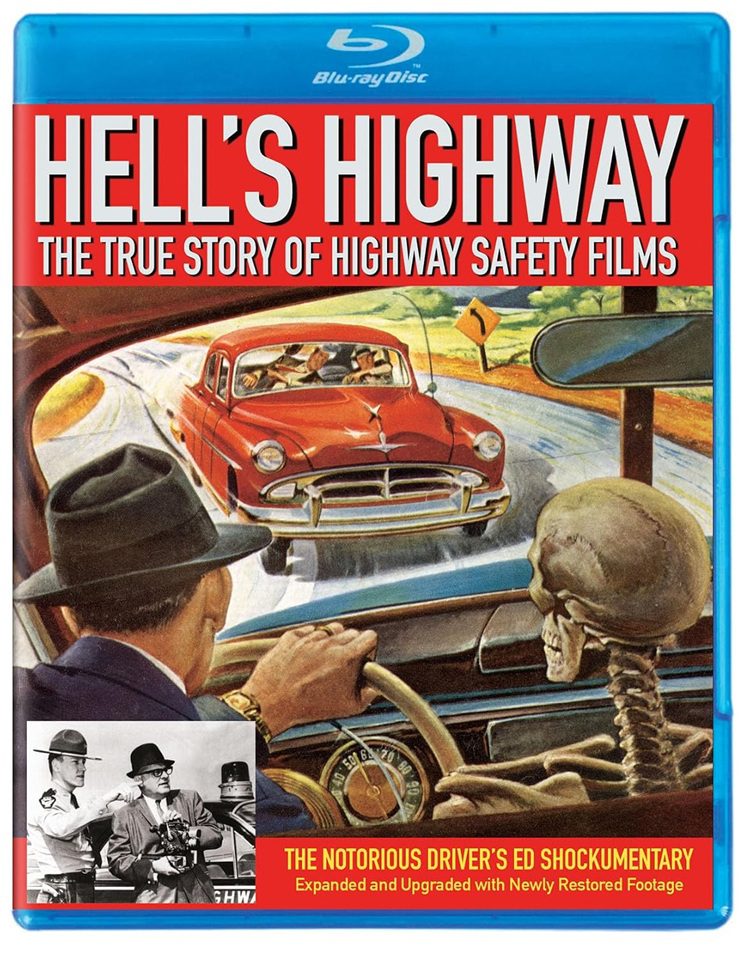
Hell’s Highway: The True Story of Highway Safety Films written/directed/produced by Bret Wood, tells the story of those bloody drivers ed films shown in classrooms to wide-eyed teens from the 1960s to the ’80s. Much like the films it chronicles, a cult following quickly sprang up upon its theatrical release in 2003. Now, Wood has revisited his masterpiece, cleaning up the film and making some cuts while adding a few new things for this “second edition” Blu-ray from Kino Lorber’s Kino Cult branch. The picture looks sharp and clear, which just means all that auto wreckage and human carnage (bloody, beheaded, burned bodies) land with a bigger impact.
Buy Hell’s Highway: The True Story of Highway Safety FilmsFor 92 minutes, Bret Wood puts the viewer in the driver’s seat as he takes us on a tour through those legendary highway-safety films of the 1960s. Through an interview with Educational/Industrial Film Archivist Rick Prelinger, we get a brief history of the educational/safety short films that would lead to the blood and guts, shock shorts produced in Mansfield, Ohio by Highway Safety Films Inc. (HSF). Since the 1930s, short films had been produced to make people aware of traffic safety and how reckless driving can be deadly. Post WWII, the focus switched to teens and advice for social settings along with speed-kills films, which would lead to the term “teenicide,” a real cornball attempt to get kids to slow down their roadsters and jalopies. Those films would hint at violent tragedy and disfigurement but the films shot in Ohio would pull back the curtain and show the whole bloody aftermath of unwise choices made behind the wheel.
Through interviews with John R. Domer, the photographer/cameraman who took the actual footage, and Earle J. Deems, who helped produce the movies, we hear about what it was like to be at the scene of those horrific accidents. Along with them and John F. Butler, a prominent police officer from Mansfield, we learn about Richard “Dick” Wayman, founder of HSF Inc., and his interest in safety and that he very much enjoyed being in the company of cops. Butler also provides further insight on what it was like working on those fatal collisions. Private investigator/journalist Martin Yant fills us in on the darker side of HSF and the allegations that they branched off into making porno films and being involved in the death and potential murder of Wayman’s co-founder, photographer Phyllis Vaughn. Between those four, we get a fairly complete picture of how HSF rose and how they fell by biting off more than they could chew when they launched a nationwide telethon featuring Sammy Davis Jr. Providing more insight on the social effect these movies had, Mike Vraney, founder of Something Weird Video, discusses the legacy, mental scars, and fascination the films would have for generations.
The Kino Cult two-disc Blu-ray release is loaded with Special Features, which include a commentary track by Wood, three restored original Highway Safety Films, and the complete 2003 theatrical version of the movie. Wood discusses the differences between the two versions, why he chose to add and subtract what he did, as well as what the restoration process was like. Wood reveals certain aspects about Wayman’s life that he chose to leave out of the movie altogether, like the fact that he and Vaughn were actually having an affair that Wayman had moved on from before her death. Wood also gives more details on the allegations of HSF producing pornographic movies. He expands on the fact that HSF had made a couple of (explicit) movies, again using real footage, intended to aid law enforcement in learning and identifying habits of shoplifters and sexual deviants of all sorts.
Along with the three restored short films from HSF are unrestored versions of Go, Sober and Safe; The Shoplifter; and the disturbing The Child Molester. The latter, though allegedly filmed for police officers only, was made available to the public and met with creepy and disastrous results. Also included are a handful of other shorts highlighted throughout the film, like Last Date, Teenicide, and the Suicide Club’s Death on the Highway, which was made to outdo the gore and shock of HSF.
Hell’s Highway: The True Story of Highway Safety Films does a great job in presenting the history of those legendary safety shorts. Bret Wood gives us a good look at what they actually are: mostly silly, gory, graphic movies intended to shock those watching. This Blu-ray delivers just about everything one would need on the subject. It’s interesting to compare both versions of the documentary and note key differences between them while having the original shorts to view is needed should one want to see what all the fuss is about.
After all that bloody devastation, one can’t help but wonder were those films effective, should they have been shown to children or did they just create meaningless ghosts on the highway of our minds? Did they work to help prevent tragedies or did improvements in vehicle safety like seat-belt laws and crash-test dummies accomplish that? Vraney makes a great point that even though he loved gory horror films from the ’70s, there’s just something different about real blood, real carnage, real death, real pain, and the real loss captured at the scene of those accidents and shown in classrooms throughout the nation.
