
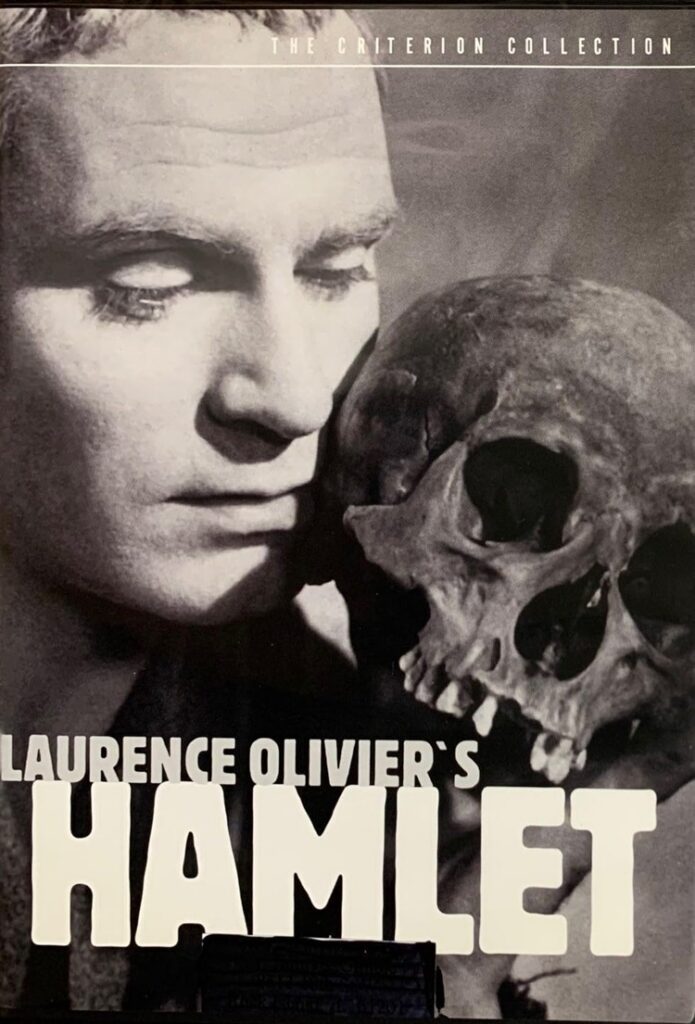
Laurence Olivier’s Hamlet is one of those movies that arrives carrying an enormous reputation, and in this case, the reputation is deserved. Olivier’s 1948 adaptation of Shakespeare’s tragedy won four Academy Awards, including Best Picture and Best Actor, and remains the only Shakespeare film to win the Oscar for Best Picture. Yet what makes the film fascinating today is not simply its prestige. Olivier makes some radical choices with Shakespeare’s play, transforming it into an intensely psychological, shadowy portrait of a man consumed by grief, suspicion, and indecision.
Buy HamletThe story is familiar. Hamlet, Prince of Denmark, is mourning the death of his father when the dead king’s ghost appears and reveals that he was murdered by his own brother, Claudius, who has since married Hamlet’s mother, Gertrude, and taken the throne. Hamlet vows revenge, but his determination quickly becomes entangled with uncertainty. Is the ghost telling the truth? Is Claudius really guilty? And can Hamlet bring himself to commit the terrible act his father demands? His increasingly erratic behavior affects everyone around him, particularly Ophelia, the young woman who loves him, and eventually leads to catastrophe.
Olivier immediately announces his interpretation with the film’s opening narration, describing it as “the tragedy of a man who could not make up his mind.” That is a provocative way of reducing one of Shakespeare’s most complicated characters, but it also gives the movie a clear dramatic center. This is not an attempt to put every corner of Hamlet on the screen. Olivier removes entire strands of the play, including Rosencrantz and Guildenstern and much of its political dimension, in order to concentrate on Hamlet’s inner turmoil.
The result is sometimes frustrating, but visually extraordinary. Shot in stark black and white, Elsinore becomes a nightmarish maze of staircases, corridors, balconies, and deep shadows. The camera frequently moves through the castle as though it were searching for Hamlet itself. The architecture seems to trap the characters, and the atmosphere becomes increasingly claustrophobic as Hamlet sinks deeper into his obsession.
Olivier’s performance is equally commanding. His Hamlet is theatrical without being merely theatrical, moving between melancholy, feigned madness, genuine rage, and moments of startling tenderness. Jean Simmons is especially affecting as Ophelia, while Basil Sydney gives Claudius an appropriate mixture of charm and guilt. Eileen Herlie’s casting as Gertrude also emphasizes the complicated, almost unnervingly intimate relationship Olivier sees between Hamlet and his mother.
The film does have drawbacks. Shakespeare enthusiasts may understandably object to what Olivier removes, and the deliberate pacing can make the 155-minute running time feel considerably longer. Some of Olivier’s choices also make the movie feel less like Shakespeare’s sprawling tragedy and more like Olivier’s personal interpretation of it.
But perhaps that is precisely why Hamlet remains so interesting. Olivier is not simply filming Shakespeare. He is arguing with him. His version strips away much of the play’s political and comic material and leaves behind a bleak psychological drama about grief, mortality, and a man who cannot decide what to do with the terrible knowledge he has been given.
It is austere, occasionally ponderous, and unmistakably old-fashioned. It is also beautiful, intelligent, and filled with extraordinary performances. For anyone willing to meet it on its own terms, Olivier’s Hamlet remains a haunting piece of Shakespearean cinema.
