
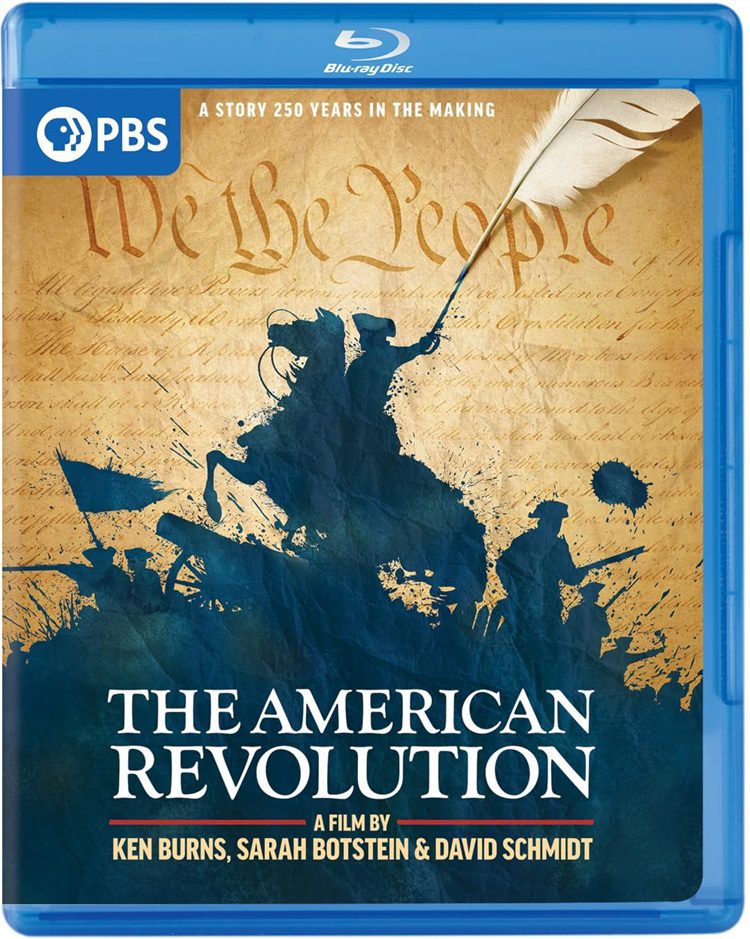
After creating The Civil War (1990), Ken Burns returned every decade with a TV miniseries documenting different wars of the United States. With Lynn Novick, he co-directed The War (2007) about World War II and The Vietnam War (2017). The 2020s are no different as last year saw the release of the war that started it all: The American Revolution, co-directed by Sarah Botstein (who had previously co-directed The U.S. and the Holocaust (2022) with Burns) and David Schmidt. Both had worked with Burns as a producer on past projects, and all three share that title here.
Buy The American Revolution from Movie ZyngOver 6 episodes and 12 hours, audiences learn, as narrator Peter Coyote explains early on in Episode One “In Order to Be Free (May 1754 – May 1775), “the American Revolution was not just a clash between Englishmen over Indian land, taxes, and representation, but a bloody struggle that would engage more than two dozen nations, European as well as Native American, that also somehow came to be about the noblest aspirations of humankind.”
The series covers numerous pivotal events, battles, and figures, examples include the Stamp Act of 1765, which helped precipitate the revolution; the Siege of Yorktown, which led to Britain’s surrender, and in between, the rise and fall of Benedict Arnold (voiced by Michael Keaton), who became a major general in the American Continental Army under General George Washington (voiced by Josh Brolin) before defecting to the British and having his name become synonymous with “traitor.” After the war, the story concludes in Episode Six “The Most Sacred Thing (May 1780 – Onward)” with people trying to normalize their lives and with the 13 colonies forming a Federal government under a Constitution to be led by three co-equal branches: legislative, executive, and judicial.
Burns is well versed on the era having already made two documentaries about men instrumental in the revolution: Thomas Jefferson (1997) and Benjamin Franklin (2022). Naturally, he gives voice to American patriots, but he also allows British Loyalists, Native American chiefs, and slaves to be heard, creating a more complete picture of the story by the talented cast he has assembled. [It’s nice he brought back Mandy Patankin to voice Franklin for continuity.]
The video has been given a 1080p/MPEG-4 AVC displayed at its original aspect ratio of 1.78:1. Colors are strong. Blacks are inky and whites look accurate. The lack of photography from the era has led to an increase in the use of illustrations, paintings, and re-enactments in comparison to previous Burns’ films. Pans across some of the artwork with fine lines leads to banding. The audio is available in DTS-HD Master Audio 5.1. The dialogue of the actors and the interviewees sounds clear in the front center channel. Composer David Cieri’s score comes through with good clarity in the surround as do the sound effects that augment the scenes. There is no bonus material.
Buy The American Revolution from AmazonIn Episode One, historian Christopher Brown says the American Revolution was unique because a disparate group of people from the 13 colonies came together “not around a culture, not around a religion, not around ancient history. It was coming around a set of purposes and ideals for one common cause.” Throughout The American Revolution, the series shows how people united and moved forward to accomplish their goal of independence against years of British pushback. It also shows where they fell short of their ideals, from not living up to the phrase “all men are created equal” from the preamble to the United States Declaration of Independence to the mistreatment of Native Americans and slaves who received nothing for their efforts in the fight for American Independence. The American Revolution presents a very important, well-told story by Burns and his team.
