
True Star Trek fans will no doubt remember the story Nichelle Nichols has told, about planning to leave the show for the promise of singing on Broadway. She’s at an event and is told a fan wants to speak with her — and the fan is none other than Dr. Martin Luther King Jr. He tells her this is a show he loves and watches with his family, but when Nichols says she’s planning to leave, King tells her she can’t. To paraphrase, he said: Star Trek may be set in the future but she and it are showing America who black people are now — not just a maid or a cook but a skilled professional, relied upon by her colleagues without any reservation. He convinces her to stay on the show.
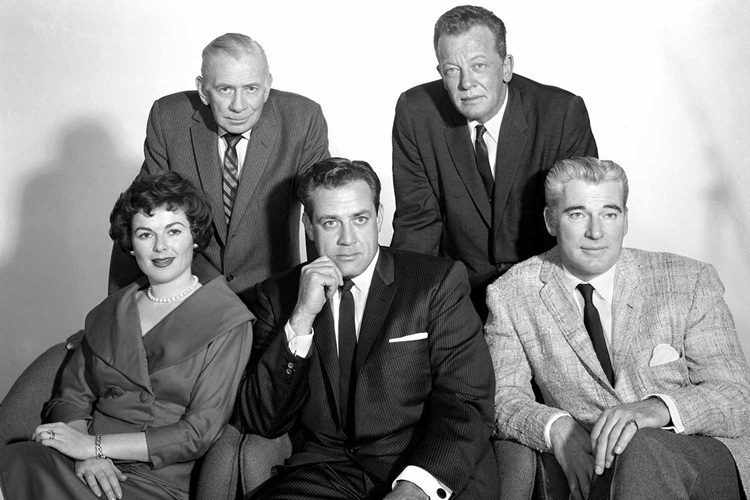
When I first became a Trekkie in the 1970s (watching and rewatching the precious 79 Original Series episodes in syndication), I thought Roddenberry’s vision of a positive future, one in which everybody got a chance to hop around the galaxy, was nice, but was essentially icing on the cake of phasers, photon torpedoes, and the coolness of Spock. I didn’t truly appreciate just how radically progressive the idea of an integrated future was when the show first aired in 1966 — until I watched a slew of the original Perry Mason TV series.
Buy Perry Mason: Seasons 7-9That show was extremely popular; it ran for nine seasons, from 1957 to 1966, producing 271 episodes (these were the three-network days when TV series produced 29, 30 or 31 episodes per season). It’s in heavy rotation on the Old People Channels — the ones that used to advertise reverse mortgages all the time and now guarantee that you cannot be turned down for life insurance.
I had been aware of the Perry Mason character and the basic situation but had never watched any episodes from start to finish. I’m happy to report that they are, as a rule, well-written, directed and acted, with a hard-to-solve whodunnit mystery and plenty of courtroom theatrics.
Additionally, because the structure of the show required multiple guest actors per episode to set up the situation that Perry must save his client from, it’s an opportunity to see a lot of interesting actors. There needs to be a murder victim, often so odious that the story can support several possible suspects, and much of the story setup is done without the main actors. Sometimes neither Perry nor his loyal secretary Della Street nor himbo private investigator Paul Drake, appear until well after the first commercial break. So the show is chock-full of old Hollywood character actors doing their patented schtick, including a few “names” (Fay Wray was in one episode, as was Margaret O’Brien), and a lot of young actors before they hit the big time.

I saw a gorgeous young Robert Redford in an early episode, and others who show up include Ryan O’Neal, James Coburn, Adam West, Burt Reynolds and at least three Star Trek regulars: Leonard Nimoy as an abusive husband and murderer, DeForest Kelley as a loser husband and George Takei as a jewelry merchant. Diane Ladd showed up as a cold porcelain beauty, a decade before she horrified Ellen Burstyn as the bawdy Flo in Alice Doesn’t Live Here Anymore.
But beyond the “where do I know that actor from?” and “Oh my god he was so young,” reactions, other curious things happened as I watched more and more episodes. Consuming them this way, essentially on demand rather than once per week at a specific time (yes, that was how people watched TV, with no chance to rewatch until it was rerun season), you see the formula at work: the rhythm of the story points repeated over and over, and the slight variations sometimes introduced to keep the viewer on his toes. But I noticed something else curious.
There were no black people in the show. I don’t just mean there weren’t any black actors involved in any given week’s story, even in a glancing way; I mean none — not among the extras seated in the courtroom gallery, not passing by on a street, not even mopping a floor. Nowhere.
Right now, please understand that I am not picking on Perry Mason or the people who worked on it, nor am I calling them racists. I really doubt that anyone was consciously hiring only white people (and the occasional Asian or Hispanic); it was just the way things were. Television, like society, was more segregated than we like to remember.
Also note that I know this show is a fantasy, because all of Perry’s clients are innocent, whereas criminal lawyers operating in the real world can count the number of innocent clients they represent on the fingers of one hand while carrying a cup of hot coffee.
But back to the all-white casts. Now: multiply Perry’s blank all-whiteness with virtually every other TV show on the air. And remember, these were the three-network days when TV was the major source of free entertainment. And also don’t forget that all the news anchors, local and national, are white and (most likely) male, as are the politicians and others they interview. Essentially, when Stephen Miller dreams, he dreams of a world like an early Perry Mason episode.
People talk today about “visibility,” about how important it is for kids who are members of some minority or oppressed group to see themselves in a positive light. Now I totally got that as a closeted teen and gay man in the 1970s and 1980s, when homosexuality was portrayed as A Terrible Problem, A Chance for a Main Character to Exhibit Empathy, or (in a drama) as a Pitiful Victim or a Killer Queen — think Clifton Webb’s Waldo Lydecker in Laura.
Being misrepresented and stereotyped is bad enough, but the invisibility of black people — an invisibility so invisible that probably no one even noticed it — seems much worse.
A Change is Gonna Come
Maybe somebody noticed. I don’t know if a formal protest or request was made specifically to the Perry Mason producers or to the network — I’d love to hear from someone who has done a more complete history of the show. (There are a lot of things that need explaining, not least how star Raymond Burr hid his homosexuality so effectively and what that might have entailed.) Or maybe somebody noticed that the civil rights movement was picking up steam and that maybe, maybe it would be a good idea to integrate the show.
And so they did. In teensy-tiny increments.
In “The Case of the Skeleton’s Closet,” which aired May 2, 1963, a black judge presided over the courtroom. Now this would seem to be not a teensy increment but a big leap. But — and there’s always a but — the judge does not utter one word during the entire episode. He doesn’t even cough.

As such, even though there’s a photo of him on the IMDB page for this episode, he is not listed as one of the actors, so I don’t know his name. Note that it’s quite unusual for the judges (inevitably white males themselves, with a couple of female judges) to be silent; at a minimum, they usually rule on Perry’s or his opponent’s objections, and there are always objections. (Sustained! Overruled!). But for some reason, whoever wrote the scene did not have either lawyer object once. Not once.
OK. Then the producers decided to actually make that big leap. Picture it: September 26, 1963 — the season seven premiere of Perry Mason, “The Case of the Nebulous Nephew.” Ivan Dixon, later one of Hogan’s Heroes, wears the heavy mantle of First Major [WHATEVER MINORITY GROUP HE/SHE REPRESENTS] Character in what can only be described as an embryonic Very Special Episode.

[For you youngsters: a Very Special Episode was a once-a-season look at a serious topic, generally but not always on a sitcom, where there could be a sharp contrast between the usual silliness and this episode’s gravitas. The VSE can be about teen pregnancy, drug abuse, whatever the hot issue of the day is, and it’s a one-off, as are the characters who have the show’s assigned Problems.]
You know the First Major BLANK type; they’re perfect. They’re nice, well-spoken and intelligent. They are not allowed to have flaws, because they are the FIRST MAJOR [BLANK] CHARACTER to ever appear on the show. They are a shining example and a credit to their people. And in this particular story, the character provides the solution that proves the innocence of Perry’s client.
That’s the key affect of First Major BLANKs: innocence and inoffensiveness. For a slightly more recent example, see Tony Goldwyn’s saintly AIDS victim in a season two Designing Women episode, “Killing All the Right People,” which aired Oct. 5, 1987. Goldwyn hires the ladies to decorate his funeral. He’s sad and resigned to his fate, and the ladies talk about what a swell person he is. He’s really a one-off (since, spoiler alert, the episode ends with his funeral), but even before he croaks, he exists solely to show the kindness, generosity and understanding of the women, and also to provoke a patented Julia Sugarbaker take-down of a bigoted, nasty bitch who provides the episode with its name.
Well, you might imagine the Perry Mason producers patting themselves on the back for solving America’s race crisis and saying “Phew! Glad that’s over.” But to their credit, the next appearance of a black actor that I’m aware of (I’ve watched a lot of episodes but I may have missed a couple) occurs just a few weeks later, in “The Case of the Drowsy Mosquito.” Archie Moore plays Jason Sparks, a bartender in a mining town saloon. Not only is he seen interacting with the white characters, but he has lines!
Since the Old People Channels show the episodes in their original airing order, I don’t know if the racial integration continues or is dropped. If the former, I’d bet it’s, shall we say, infrequent. I’ll keep you posted.
