
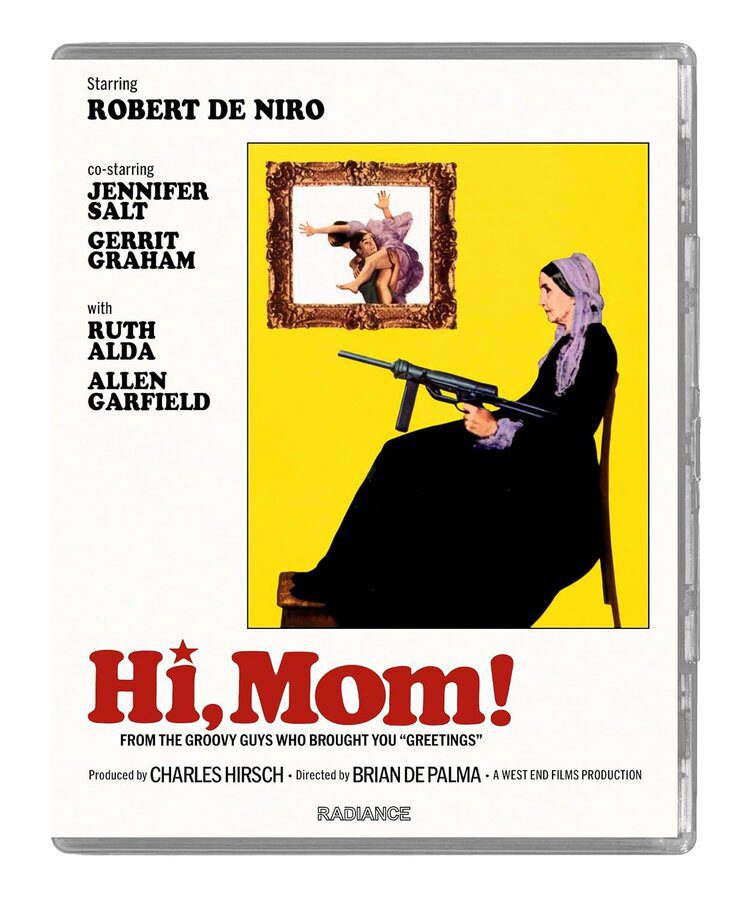
Brian De Palma’s fourth feature, Hi, Mom!, is the suspense master’s first—and arguably best—full-blown comedy. Loose, politically charged, and eager to provoke, it feels like the work of a filmmaker convinced every idea is worth trying if it gets a reaction.
Buy Hi, Mom!Vietnam vet Jon Rubin (Robert De Niro) returns from Greetings (1968), De Palma’s shaggy counterculture comedy. Hi, Mom! is a funnier, sharper, more confrontational swing at the same idea. This time, Rubin tries to make porn, and he ends up somewhere stranger. But the plot barely matters. The movie is really just De Palma’s excuse to veer into underground art, black comedy, and social satire.
It’s wildly uneven. Some of the chaos exhilarates; other stretches drift. If you’re looking for Dressed to Kill or Blow Out, this ain’t it. But for De Palma heads, it’s fascinating: a gifted young filmmaker discovering his voice and throwing cherry bombs at the screen.
Then there’s “Be Black, Baby.”
Fifty-five years later, the movie’s centerpiece still stuns. A guerrilla theater troupe subjects affluent white patrons to a simulated Black experience, and De Palma transforms the performance into one of the boldest acts of audience confrontation ever filmed. It’s funny, unsettling, and impossible to shake. For 20 astonishing minutes, it hijacks the movie. Suddenly, all that anarchic energy snaps into focus, and De Palma delivers one of the defining sequences of his career.
Hi, Mom! misses as much as it hits. But when it scores, it’s unforgettable.
Radiance’s 4K UHD & Blu-ray edition is excellent. The restoration looks great, the uncompressed mono audio preserves the film’s scrappy energy, and the Blu-ray is stacked: a commentary by writer Travis Woods, an interview with critic Ellen E. Jones, an essay by Matt Zoller Seitz, De Palma’s Dionysus in ’69, and behind-the-scenes footage from the production. Seeing a young, long-haired De Palma—clean-shaven, suited up, and clearly loving every minute of it—is almost worth the price alone. It’s a terrific release of one of De Palma’s essential early films.
