
Jack Carter, a gangster in London, goes back to his own hometown to investigate the mysterious death of his brother. He also wants to secure the safety and future of his niece, Donna. This is a very straightforward plot. Only the movie doesn’t tell us any of this and it isn’t until about 20 minutes in that we’ve pieced it together from the action.
Buy Get Carter (1971) Blu-rayGet Carter is like that – very much a ’70s movie. The significance of scenes sometimes only become clear after more information becomes known. It’s confusing because modern movies don’t do this. They tell us everything three times to make sure we get it. It’s effective because while we don’t know anything about what’s going on, neither does Carter. He might be a step ahead of the audience, but he’s just as confused.
One thing he does believe is that his brother’s death wasn’t an accident and wasn’t suicide. He was drunk on whiskey when his car plunged into a river. And Jack knows his brother didn’t drink whiskey. From this conviction, he moves through the underground like a scalpel in an autopsy. He’s going to get under the skin.
The film begins with the audience, naturally, in Jack Carter’s corner. After all, he’s Michael Caine. And he’s moving the action forward, with a genuine cause for concern. But as it progresses, we see how Carter treats the people around him. He’s calm, cool, and collected, always wearing a black suit and cutting a striking figure in the frame. But he uses people. And doesn’t particularly care how they end up after.
I thought it was striking in an early scene, when he’s sneaking into a compound, he hits a bad guy with a stick to knock him out. Normal movie stuff. But he doesn’t do that TV spy thing, hit him in the back of the head to knock him out. He slams him in the face with it, knocking him cold into a lake. It’s shallow, but there’s every likelihood the man could drown. Carter moves on.
A local, one of the few people to come to his brother’s funeral, helps Carter out. He gets beat near to death for his troubles. When Carter finally catches up with him, bedridden, he tosses him a few pounds. “For Karate lessons.”
That’s one of the few jokes in the movie. While there’s some amusing scenes, Get Carter is grim, dark, and focused. It’s considered perhaps the first proper British gangster movie, where the gangsters aren’t jokes or idiots, but dangerous men.
And the further Carter gets into the mystery of his brother’s death, the darker the movie becomes. Carter is also darker and more unhinged. His cool mask of control slips and his actions become less and less defensible, even as his cause becomes more righteous.
Get Carter tells its story in a linear, but not straightforward fashion. It moves at a deliberate, but increasing pace as Carter gets closer and closer to uncovering the mystery. There’s plenty of violence and shooting, but little catharsis. In only a few scenes does he get emotional, and the bleak and grotesque violence that results is depressing more than energizing.
Get Carter evokes a specific time and place very vividly. Set and shot in Northern England, the closed in streets and rather rundown feel of the place look like something to get away from, like Carter did. Carter coming from London to there is like taking a trip to the past, his own past. And some things, it turns out, he doesn’t want to uncover. The performances are as evocative as the setting. Every gangster seems like a nice, cheerful guy, who is ready to do horrible violence at the drop of a hat.
The film was the first feature by Mike Hodges, who was had a spotty but fascinating career. He was also responsible for the Michael Crichton adaptation The Terminal Man, and the goofy but indispensable Flash Gordon. In the ’70s, he was part of the overall movement that wanted to bring the techniques of more avant garde filmmaking into mainstream cinema. Thus, the first 20 minutes not telling the audience what the hell the movie is about.
There are also several scenes that intercut non-linearly. The most interesting might be a car ride with the sex bomb Glenda. Her reckless driving and gear shifting is intercut with their subsequent lovemaking. Ten minutes after that’s done, Carter is choking her while she’s naked in a tub. She probably deserves it, but he’s not a nice man.
Get Carter is interested in drawing the audience in and repulsing them at the same time. It reminds me a little of some of the late ’60s and early ’70s Japanese yakuza movies, particularly directed by Fukasaku, where the intent was to demystify the yakuza and deflate their romantic image. I do not think there was a British romanticism of gangsters to deflate, but the movie does make it clear these are hard, uncaring, ugly men. Even the protagonist sucks.
The Blu-ray release does not suck, thankfully. It’s an old, rather low-budget movie shot in 1970, so it’s going to be grainy and sometimes dark. The very first shot is of Michael Caine at night looking out a window, and the image was so dark and soft I thought this was going to be a rough watch. But much of the movie looks fantastic, especially the climax on a beach by a coal refinery.
Get Carter has action and thrills, but it’s primarily a cold character study. Carter is a dark man in a dark world, and he doesn’t much like that evil feeding back on him. You can see the influence of this film on several more contemporary filmmakers, particularly Guy Ritchie’s ever-expanding British gangster universe. But Get Carter isn’t fun. It’s a cold-eyed view of a cold, dark world.
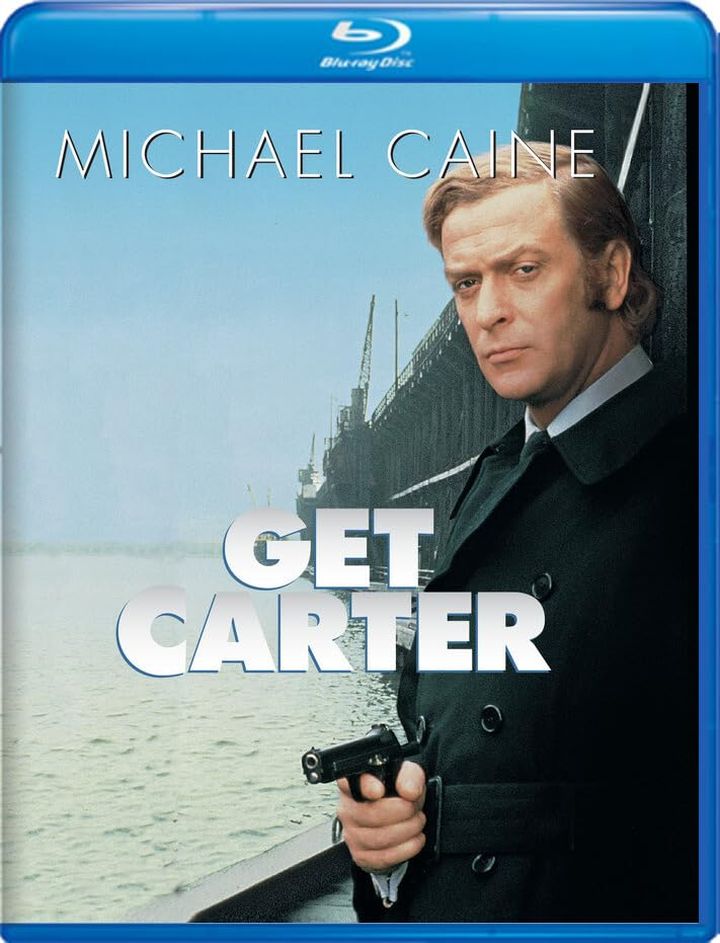
Get Carter has been released on Blu-ray by Warner Brothers. The extras on disc include an archival commentary by Mike Hodges, Michael Caine, and cinematographer Wolfgang Suschitzky.
