
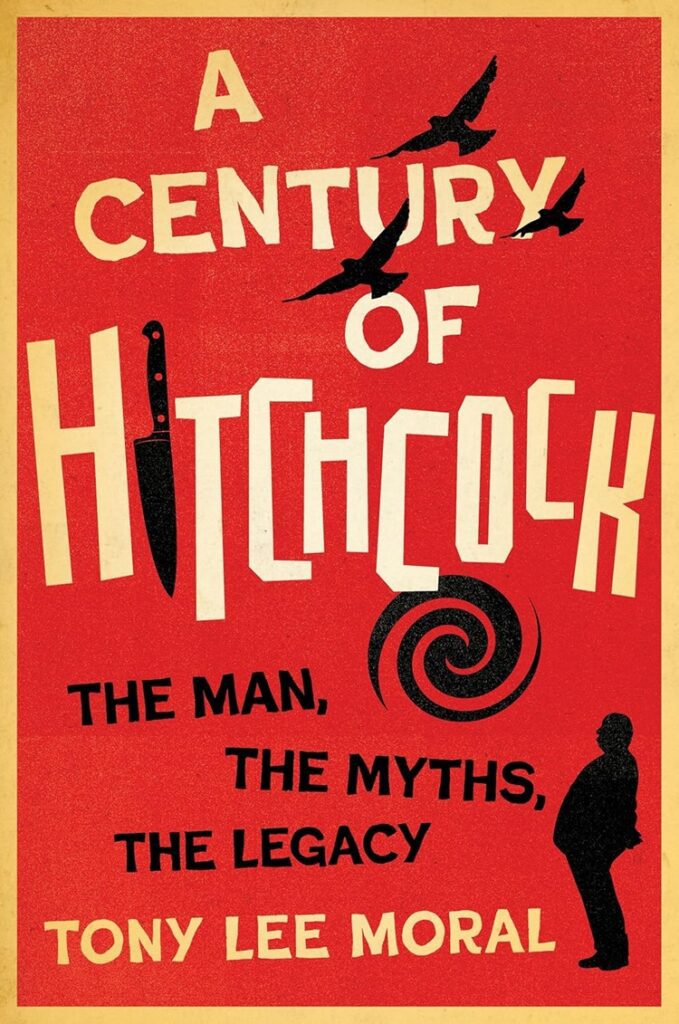
I don’t know the official statistics, but Alfred Hitchcock has to be one of the most written about and analyzed directors ever. This is at least my sixth exploration of his works and life. The author of A Century of Hitchcock: The Man, The Myths, The Legacy published by University Press of Kentucky, Tony Lee Moral, has penned a number of respected works on Hitchcock, including Hitchcock and the Making of “Marnie” and The Making of “The Birds.” The “century” in the title isn’t since Hitchcock’s birth, but measured from the release of his first film, The Pleasure Garden (1926).
Buy A Century of Hitchcock: The Man, the Myths, the LegacyThere are typically a couple of different approaches to an examination of the life of a director. I’ve read books that are not much more than a connected series of reviews of the director’s films. There are books that treat the filmmaking as a side job in order to talk about salacious details of the director’s life. The best books I’ve read combine a deeper look at the films with the perspective of how their personal life affected the work onscreen. I had just finished Donald Spoto’s The Dark Side of Genius: The Life of Alfred Hitchcock (1983) a couple months before this book arrived on my doorstep. It’s a good thing I did, because I didn’t know that would be the homework needed to understand the main arguments of this book. The fixation with Spoto’s work doesn’t just take up Part 3 of the book, but it permeates the text from the Introduction to the Afterword.
The book is written by an author who knows his subject. It’s clear from the first chapters that Moral has done extensive research on Hitchcock and his films. That can be a challenge for someone to be an expert on a subject and to try to write a book that sticks to a few themes to hold the 279 pages together without feeling that important events have been skipped. The problem for me with this book is that the theme chosen to hold together a book about a hundred years of Hitchcock is criticism of another author’s biography. Once again, this isn’t held to be outlined in a single chapter or part of the book, but the critical review of Spoto’s works permeates every single chapter.
The controversy of Spoto’s book has been his Freudian analysis of Hitchcock’s personal behaviors as they were reflected onscreen. These weren’t all new observations at the time, but I don’t believe they had all been strung together the way that Spoto did in his biography. Moral’s basic argument seems to come back to some version of Spoto’s willful misinterpretation or outright changing of stories were used to create a narrative about Hitchcock. There’s a logical issue with creating an argument that someone else is purposely misinterpreting Hitchcock’s motivations when you are also interpreting the other author’s motivations.
Moral has written extensively about Hitchcock’s early films, so I was disappointed to leave behind the early British films by the end of Chapter 2 (pg. 34). The important part of Spoto’s interpretations of later Hitchcock behavior was linking it to the childhood stories he told about Alfred early in his book. Since this begins with the first film, much of his later relationships with women is lost by not covering his youth. Moral gives more attention to The Pleasure Garden than any other biography, and I came away wishing there was even more exploration of these important British films in his development.
There is a rush through Hitchcock’s transition to American films, his relationship with Selznick, and the height of his most respected output in the ’50s. By the end of Chapter 4 (pg. 62), Moral has glossed over almost 35 years of filmmaking and leaves only six more films by the director to discuss. The book has “a century” in the title, but the pacing is all wrong. Imagine writing a book about Paul McCartney and by a third of the way through the book you’ve already covered the Beatles, Wings, solo career, and you have two thirds of the book for his work since Pipes of Peace.
The next three chapters mostly cover The Birds (1963) and Marnie (1964). They are given the same page count (along with a little about Torn Curtain (1966)) as the first two-thirds of his career. Moral has done extensive research on these two films. I’m interested enough about his thoughts on Marnie (1964) to pick up his book on the subject. The relationship between Tippi Hedren and Hitchcock is at the very core of his argument against Spoto’s book and how it has affected Hitchcock’s reputation. Too often, the need to get to a point that the author thinks Spoto was wrong affects the pacing. There are legitimate criticisms of the film, both contemporary with the film and how we view it today through our #MeToo lens. I’m always interested when someone goes against the grain for how a movie should be viewed. This doesn’t get to that point because it’s too busy trying to disprove someone else’s opinions.
Part Three of the book specifically addresses the author’s critical view of Spoto and his work. Spoto’s works were used as the basis of The Girl (2012) for HBO. Like a lawyer creating a case for the jury, Moral details the race to tell the definitive biography of Hitchcock alongside the evolving interpretation of Tippi Hedren’s stories about her relationship with Hitch. The chapters get bogged down in criticism of Spoto that ignores what would be the place for discussion of how Hitchcock’s films have evolved in their interpretations over the decades since his death.
The last chapter, “Hitchcock’s Disciples” is the most interesting of the book. It’s a perfect subject for celebrating “a century” of one of the most celebrated directors. I love reading about the influence his films have had on current directors. It’s not a difficult stretch to talk about the influence on Spielberg, De Palma and Scorsese (although I still found some of his observations to be salient). I was much more intrigued about the influences on the works of Guillermo del Toro and Park Chan-wook. I wanted another chapter on these directors and their relationship to Hitchcock’s works.
The title of this book is misleading to what it really reads like. If it had been called Why Spoto Was Wrong or A Century of Hitchcock: But Mostly Two Later Films, I might have come away with a better opinion of the results. There is room to disagree with Spoto’s conclusions or the way he told Hitchcock’s life story. It’s possible to tell your own version without continually having to point out that what you just said or are going to say disagrees with another biography. Moral could string together many of the same observations, stories, and interpretations without having to resort to dragging down another author. It shouldn’t be too much to want a book about one of the most talented directors to actually be about the director.
