
Hello and welcome to another edition of Five Cool Things, where I talk about all the fun, interesting, and yes, cool things I’ve discovered since the last time. This week I’m revisiting a movie I didn’t like the first time I saw it, a freaky manga, a creepy German television series, a thrilling French film, and an American film that visits the French New Wave.
Manhunter
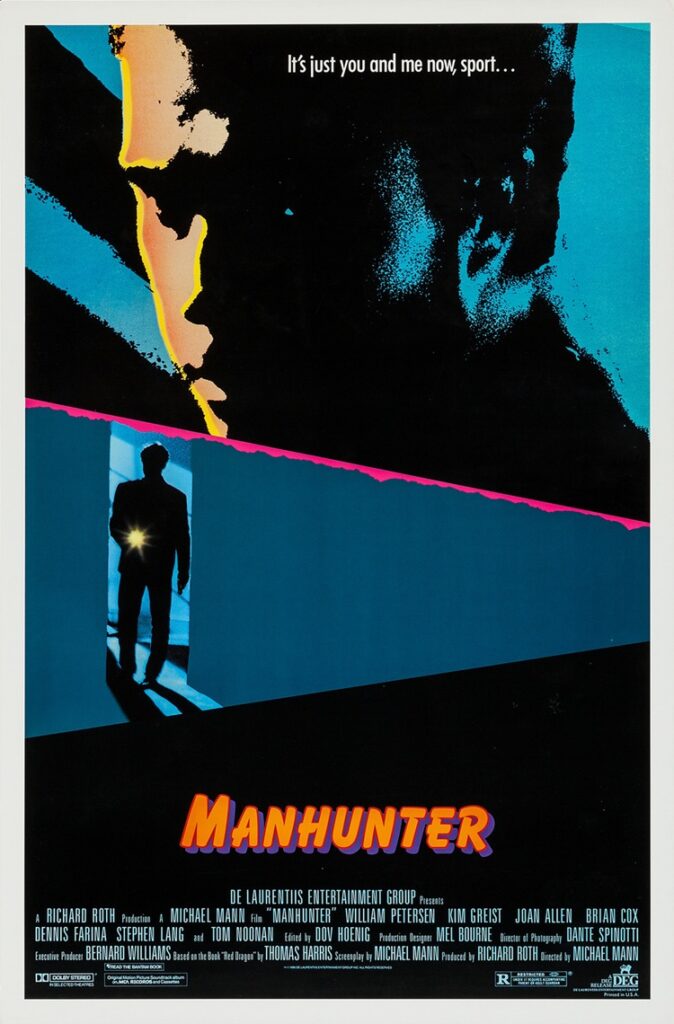
I’ve written before about how The Silence of the Lambs turned me into a reader. Growing up, I never did much reading; I preferred to watch TV and movies, play games on my Nintendo, or do something outside. Reading was boring. I loved The Silence of the Lambs movie when it came out in 1991. So much so that my mother bought me the novel by Thomas Harris. I devoured it over the Christmas holiday, and from there I started looking for other books to read. I never stopped reading after that. Somewhere along the line, I read the first book by Harris featuring Hannibal Lecter, Red Dragon. Sometime after that, I watched the Michael Mann adaptation of the book, Manhunter.
Buy Hannibal Lecter Triple FeatureI initially hated Manhunter. Mostly, I think, because it was so different from The Silence of the Lambs. But also because I had an old rental VHS copy that was likely in pan-and-scan. Michael Mann loves his widescreen compositions, and having them cut down no doubt ruined the film’s look. VHS tapes notoriously degrade over time as you watch and rewind, watch and rewind them. Watching it now with a beautiful widescreen transfer is like watching a brand new film. Whereas I thought it looked cheap before, now it looks amazing. Mann’s compositions are beautiful, and his use of color is fantastic. There are several scenes shot at night that are bathed in blue, and they are breathtaking.
I remember being disappointed in Manhunter‘s version of Hannibal Lecter. In The Silence of the Lambs, Lecter is buried in the bowels of the hospital for the criminally insane. His cell feels like it is underground in a dungeon. The walls are made of dingy stone. The lighting is poor. He’s placed behind some kind of thick glass. But in Manhunter, everything is light and white. He’s bathed in bright fluorescent, the walls are painted white, his sheets are white, even his clothes are white. The difference between the two films is night and day. Anthony Hopkins played Lecter like a well-bred Englishman who despises ill manners. In Manhunter, Brian Cox plays him more like the Joker. He’s a trickster who delights in playing games. There is one scene where he’s lying on his back in bed, his feet donned in thick wool socks, legs sticking high against the wall. I hated that moment when I first watched it. It was the antithesis of Hopkins’ version of Lecter. But as the years have passed and the books are but a memory, I find I like Cox’s version of the character. It is very different from what Hopkins does in Silence, but still affecting.
It is the same for the movie. Mann’s film is doing very different things than what Jonathan Demme did in Silence, but it is no less brilliant. Manhunter is more slick, more clinical. Mann spends more time on the forensics of the investigation. Demme finds the humanity of his characters. Mann is much more detached. I love both movies deeply, but on this viewing I might actually give the edge to Manhunter.
Homunculus Vol. 1-2
When did manga become so popular? I’m by no means an expert, but I don’t remember seeing manga anywhere at all when I was growing up. I do remember watching Robotech: The Macross Saga as a teenager on my local UHF station. That was the first piece of Japanese animation I’d ever seen before. From what I understand, talking to fans over the years, that was the first bit of Japanese animation most Americans had ever come across. And I know that’s anime, not manga, but I don’t think there was any manga making it across the sea in the early 1990s. At least not where I lived. By the time I went to college in the mid-1990s, anime was definitely something nerds enjoyed, and maybe manga was starting to become a thing in the States. I dunno, like I say, I’m not an expert.
Buy Homunculus Vol. 1-2What I do know is that for years the bookstores I went to usually had fairly robust comics sections with a very small subsection of that dedicated to manga. My local Barnes and Noble had three long bookshelves filled with comics, and not that long ago just one third of one of those shelves was for manga. Now it’s the exact opposite. Manga gets the bulk of the shelf space and regular comics get a tiny corner of it.
The thing is, for years I just sort of dipped my toes into the comic world. It felt too overwhelming to dive right in. There are so many comics, and so many of them have been around for decades. How do you decide which Batman or Spider-Man comic to start reading? Do you start at the beginning, or can you just jump into the middle of something? Comic book stores were daunting. Eventually I learned which stories were fan favorites, and I started reading more and more and got a feel for certain characters and runs.
Now manga is taking over, and I feel overwhelmed again. Like a lot of superhero comics, manga seem to have loads of never-ending stories. Go into a bookstore, and you’ll see Volume 25 or 40 of different titles. My daughter reads and collects something called Bungo Stray Dogs and Jujutsu Kaisen, both of which have many, many titles to their names, and then there are side stories with their own volumes. How does anyone keep up?
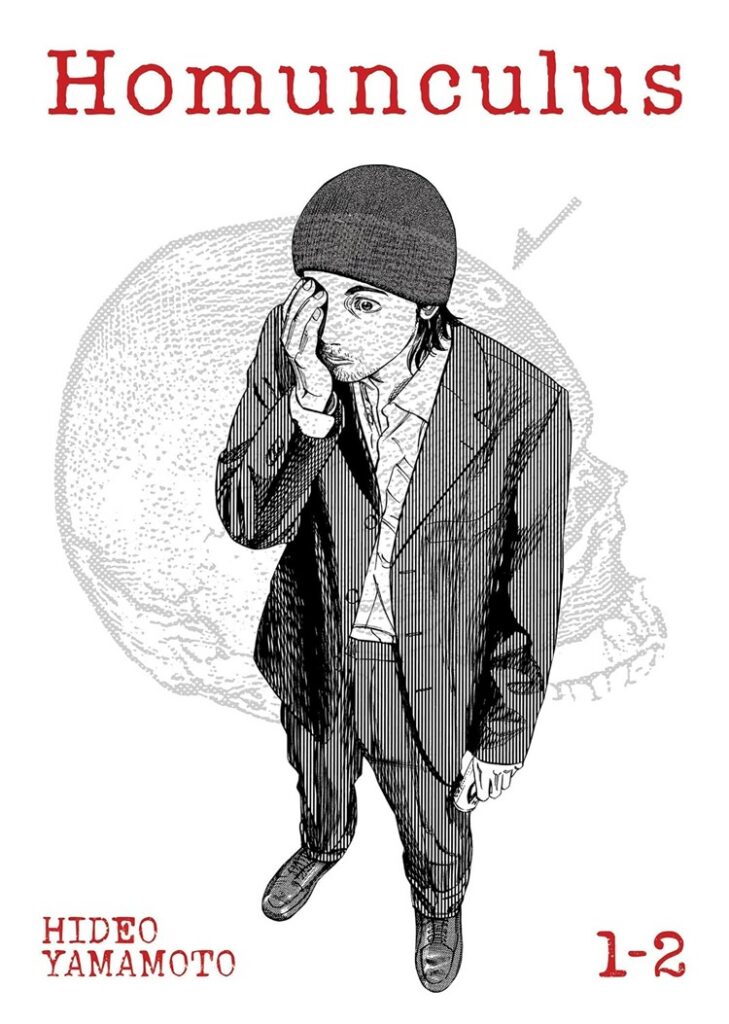
I’m slowly dipping my toe into the manga world, but it is daunting. The other day I did a little internet searching for some of the best manga titles, and Homunculus kept coming up, so I bit the bullet and bought this book that contains the first two volumes.
It follows Susumu Nakoshi, a middle-aged man who has quit life. He once had a good job, a nice home, a proper middle-class life. But he wasn’t happy. He was tired of the rat race. So he just quit. He walked out of that life and started living in his car. He made friends with other homeless people, but he was restless in that life too. He’d often drive away for days at a time, just cruising around.
One day, he is approached by Manabu Itoh, a medical student with a strange proposition. He wants to drill a hole in his head and see what happens. He’ll pay Nakoshi a lot of money for it. He believes that when we are born, we hold special powers. This is due to the fontanelle – the soft spot on a baby’s head. This soft spot gives the baby’s brain a little room to stretch. But when the skull hardens, it puts pressure on the brain, causing us to lose those powers. By drilling a hole in Itoh’s skull, he thinks that will relieve the pressure and allow him full use of his brain powers once again.
At first Nakoshi refuses, but when his car is towed away, he agrees. He could use the money. The experiment works. Nakoshi begins seeing strange things in the world around him. Certain people look alien. A gangster boss looks like a tiny child living inside a large robot. A woman looks like she has no neck, etc. Eventually they learn that Itoh is seeing into the soul’s of these people, into their problems and how they perceive themselves. The gangster was traumatized as a child, and he added strong layers of protection around himself. This is seen as the armor of a robot. The woman was abused by her mate – he often choked her – so now she envisions herself with no neck so she cannot be hurt. Maybe, they think, they can help these people. Or maybe Itoh is looking to exploit them.
Written and drawn by Hideo Yamamoto, Homunculus has a wonderful black-and-white, pencil-drawn style. He’s clearly having a lot of fun drawing all the strange people Nakoshi sees. Some of them are very strange. There is a stripper who is made of sand, and when she bends over…well, that’s best to just see for yourself. The story is an interesting one. These two volumes don’t get very far into what it all means or what these two characters will do with this new power. I’m a little worried it is going to get repetitive, but for now I’m excited by the possibilities.
Dark: Season One
This German series came out in 2017. I watched the first few episodes on Netflix back then and really liked it, but I got distracted and never came back to it until this week. It is a big, complicated, time-traveling science-fiction story, and if you get away from it for too long, you pretty much have to start all over.
Honestly, I’m not sure how to talk about it without getting lost in the weeds or spoiling everything. It takes place over a few timelines. The primary timeline is set in 2019, and it features several characters all living in a small village. A young boy goes missing, and we follow his parents, friends, and the police as they all go looking for him. They don’t find him because he’s wandered into a cave next to a nuclear power plant and transported himself back to 1986.
We’ll spend some time in that year where most of the characters we met in 2019 exist, but in much younger versions (all played by different actors, adding to the confusion). Eventually, we’ll also find ourselves in 1953 with more characters and different actors. It is all quite confusing. I struggled to understand exactly what was happening a lot of the time. But it is also really compelling. It is a bit like Lost in that the weirder and more complicated it gets, the more I want to watch. It is also reminiscent of the first season of Stranger Things and numerous Stephen King stories. I can’t wait to see where the next season takes me.
Witness in the City (1959)
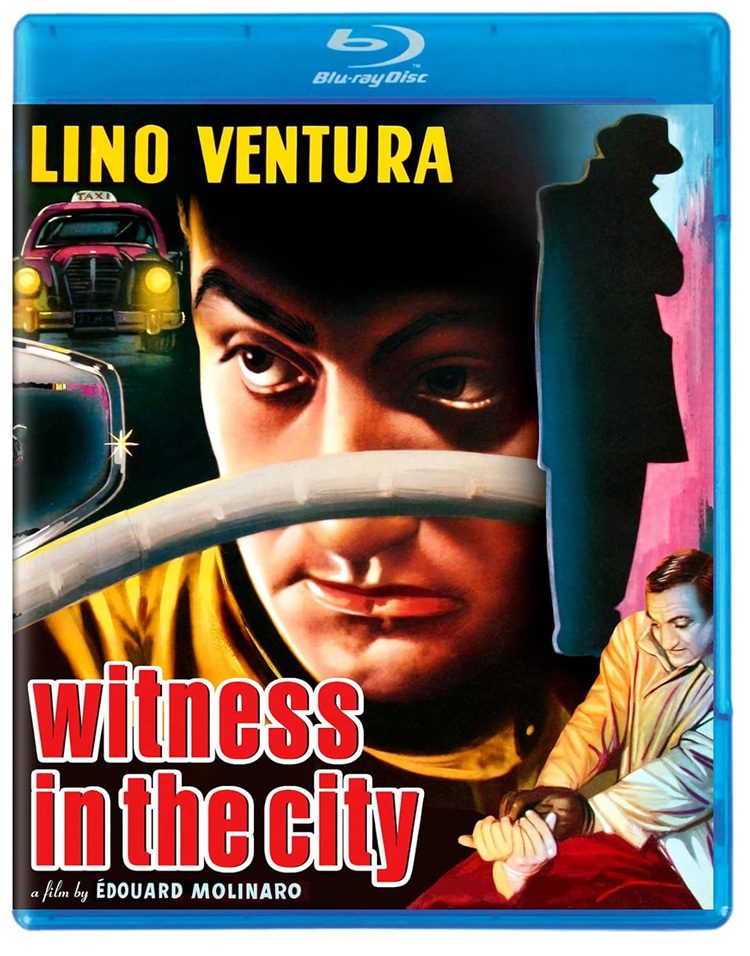
This French thriller wastes no time getting into it. The story begins with Pierre Verdier (Jacques Berthier) trying to throw his mistress off a train. She puts up a good fight, but ultimately loses, dying in the fall. There is a trial, but despite pretty much everyone knowing he killed her, he gets off for lack of witnesses and evidence.
Buy French Noir CollectionThe woman’s husband, Ancelin (Lino Ventura), plans the perfect revenge. He sneaks into Verdier’s home, plants several items indicating that he is very sorrowful over the woman’s death. When Verdier comes home, Ancelin grabs him and hangs him, making it look like a suicide. It would have worked, had it not been for the pesky taxi driver. Unknown to Ancelin, Verdier called a cab when he first came home. The taxi arrives just as Ancelin is walking out. The driver mistakes Ancelin for Verdier and asks him where he wants to go. Flustered, Verdier gives him the brush-off, but later realizes the cab driver is now a witness. He’ll spend the next half of the film looking for the cab driver, knowing he has to kill him, and when the deed is done, he’ll spend the rest of the film running from the cops.
Director Édouard Molinaro does a terrific job of blending the tension with character moments. Ventura is terrific as Anclin. He doesn’t have a lot of dialogue; mostly he’s just driving around and looking for the cab driver or a means of escape, but you understand exactly what he’s thinking by looking at his face. This is a masterfully directed, wonderful thriller.
Nouvelle Vague

Richard Linklater’s tribute to the French New Wave is an utter delight. It follows Jean-Luc Godard (Guillaume Marbeck) as he’s making his debut feature film, Breathless. Godard was a notorious iconoclast. He wanted to throw the “rules” of filmmaking in the trash and blaze a new trail. We see him frustrating the moneymen and actors alike by writing his scripts on the fly and often shutting down production for the day after only a small amount of time spent shooting. He relied on his own inspirations. That Breathless went on to become one of the all-time great films, revolutionizing cinema as we know it, is nothing short of a miracle (and a testament to the genius of Goddard)
Buy Nouvelle Vague (Criterion Collection)Linklater fills his films with icons of the French New Wave. There is Jean Seberg (Zoey Deutch) and Jean-Paul Belmondo (Aubry Dullin) of course, the two stars of Breathless, but also Francois Truffaut, Agnès Varda, Éric Rohmer, Jean Cocteau, Roberto Rossellini, Jaques Rivvete, and many others I’m not familiar with. I am by no means an expert on this period of cinema, but I am a fan, and it was wonderful seeing all these titans of French cinema portrayed so lovingly.
Nouvelle Vague, the film, isn’t nearly as revolutionary as the film it’s portraying. This is pretty standard filmmaking, but it is still full of joy and delight. Dullin and Deutch are particularly wonderful as Belmondo and Seberg. They are really channeling those actors. The greatest testament I can make about this film is that it immediately made me want to watch Breathless and so many other films from the period.
Verity
Dakota Johnson stars in this thriller as a woman hired by a man (Josh Hartnett) to finish a novel began by his wife (Anne Hathaway), a famous novelist who can no longer write due to a debilitating accident. She agrees only to uncover disturbing truths and horrifying mysteries. The trailer looks pulpy, ridiculous, and a lot of fun.
