
My wife was in labor for a good 24 hours before the doctors told us it would be better to just do a C-section. We’d been in the hospital all night by that point with her going into regular contractions, but the baby never got close enough for delivery. There was a moment when they whisked my wife away to prepare her for the surgery that I panicked. I didn’t have a chance to say goodbye or I love you, and my exhausted brain started thinking that the surgery might go wrong and she might die and that might have been the last I’d ever see of her.
Buy Die My LoveA few minutes later, they let me come into the room. They had a big curtain raised just below her neck, so all I could see was her head. For a moment, she started acting really strangely, and there was a rush amongst the anesthesiologists to adjust her meds. The surgery went well, and suddenly there was my little baby girl. They cleaned her up and let me come see her. She was being held on a table just past my wife’s feet.
After staring at this miracle for a few moments, I looked back at my wife. Her midsection was still open wide. There was blood everywhere. I could see inside her. I was looking at parts of her body no husband should ever see. That mixture of joy, exhaustion, jubilation, horror, and blood reminded me a lot of Lynne Ramsey’s latest film, Die My Love.
I was a stay-at-home dad for my daughter’s first three years. It was a delight. I’m so very happy that got to happen. It was also absolutely exhausting, terrifying, lonely, and very weird. She didn’t sleep through the night for those first few years. She’d wake up at 1 or 2 in the morning, and sometimes again at 4. I was the one who got up with her. I’d walk her up and down the hall singing to her until she fell back asleep and then pray she’d stay that way as I laid her down. Babies need constant attention. If I walked away for a minute to get a drink or grab something in the other room, she’d cry. I had to lay her in the hallway just outside the door when I went to the bathroom and talk to her, or she’d cry.
You lose any sense of self in those moments. I can remember sometimes my wife would get home, and I’d be curled up on the kitchen floor, rocking back and forth, just needing a moment to myself. These things sprang to my mind as I was watching Die My Love.
I’d heard things about this film before I put it on. That it was about mental illness and postpartum depression. That Jennifer Lawrence plays a mother who goes completely crazy.
But for most of this film, I completely understood that character. Parenthood completely changes you. I’m a dad, not a mother. I didn’t carry our daughter in my womb for nine months. I didn’t have her literally ripped out of my womb after that. I can’t pretend to know what that’s like. But I do know what it is like to suddenly have this tiny, completely helpless creature in your arms and feel an overwhelming sense of responsibility.
Lawrence plays Grace, a perfectly normal, and happy-seeming woman who moves to an isolated cabin in the woods with her lover, Jackson (Robert Pattinson). They seem to enjoy life there. They laugh and play and make love on the floor.
Then she has a baby. He is gone for long stretches of time for his work. She’s alone in the house with a baby that cries a lot. There is no indication at any time in the film that she doesn’t love her son. That she will harm him. But she is lonely. She doesn’t get much sleep, and the baby cries all the time. Jackson buys a dog without asking her. It never stops barking.
This all drives her a little mad. She fights a lot with Jackson. She begins to suspect he’s cheating on her. She starts to think that maybe the world is against her. Her behavior becomes erratic.
Jackson tries to be understanding but he doesn’t understand her behavior and often goes a little mad himself. His mother (a wonderful Sissy Spacek) understands postpartum depression and tries to help, but there is only so much she can do.
Like I said, I understand this character in many ways. When you are home alone with a crying baby, the world disappears. It is just you and this unstoppable wailing. For much of the movie, her behavior is strange, and it certainly makes sense that her family would be concerned, but I didn’t find it psychotic. Admittedly, toward the end of the film, things get taken up a notch. She destroys the bathroom, crashes through a glass door, and self-harms.
Judging how her behavior escalates is difficult because the film is fragmented. We don’t so much get fully fleshed-out scenes as snippets of moments. The film jumps back and forth in time. An early scene has her crawling through the grass, catlike, holding a knife in her teeth. But then later we’ll see her before the baby came, caring for Jackson’s father (Nick Nolte), who is suffering from dementia, with great kindness.
We can’t even be sure what is real and what’s in her imagination. Jackson calls her from a diner while out on the road. The waitress sounds flirty over the phone, and he sounds distracted. She imagines they are having an affair. But is that real? If not, why does he have a package of condoms in his glove box? A man on a motorcycle (LaKeith Stanfield) periodically drives by the house. We see snippets of them kissing. Is that real? Or is that just a fantasy of some guy she saw once at a convenience store?
All of this makes the film not an easy watch. I felt uneasy for most of it. But I was also mesmerized by it. Jennifer Lawrence gives an incredible performance. It is a fully committed and brave piece of acting. There are moments when she is in full burn-it-all-down mode, and I have to say I was right there with her.
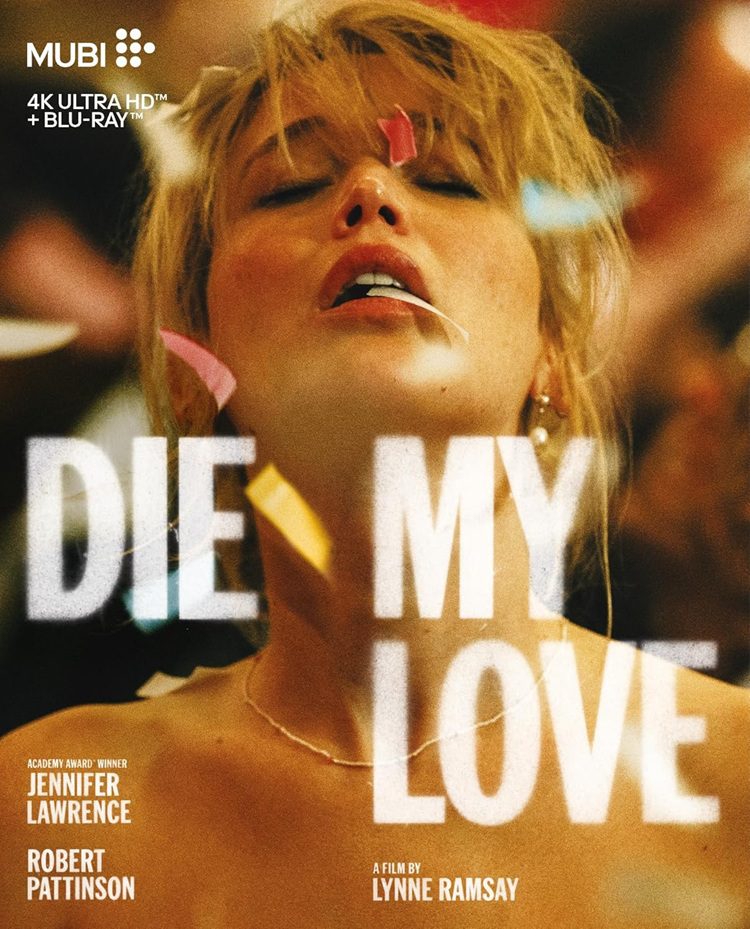
Mubi presents Die My Love in a 4K UHD/Blu-ray Dual Case. It looks magnificent. Seamus McGarvey’s cinematography is gorgeous. There are a lot of outdoor scenes set in the woods outside the cabin, and it is just lovely. There are no extras.
Die My Love is a difficult film. Watching this woman descend into madness is heartbreaking, troubling, and yet also understandable. Kids are hard. But it is also an incredibly made film and well worth watching.
