
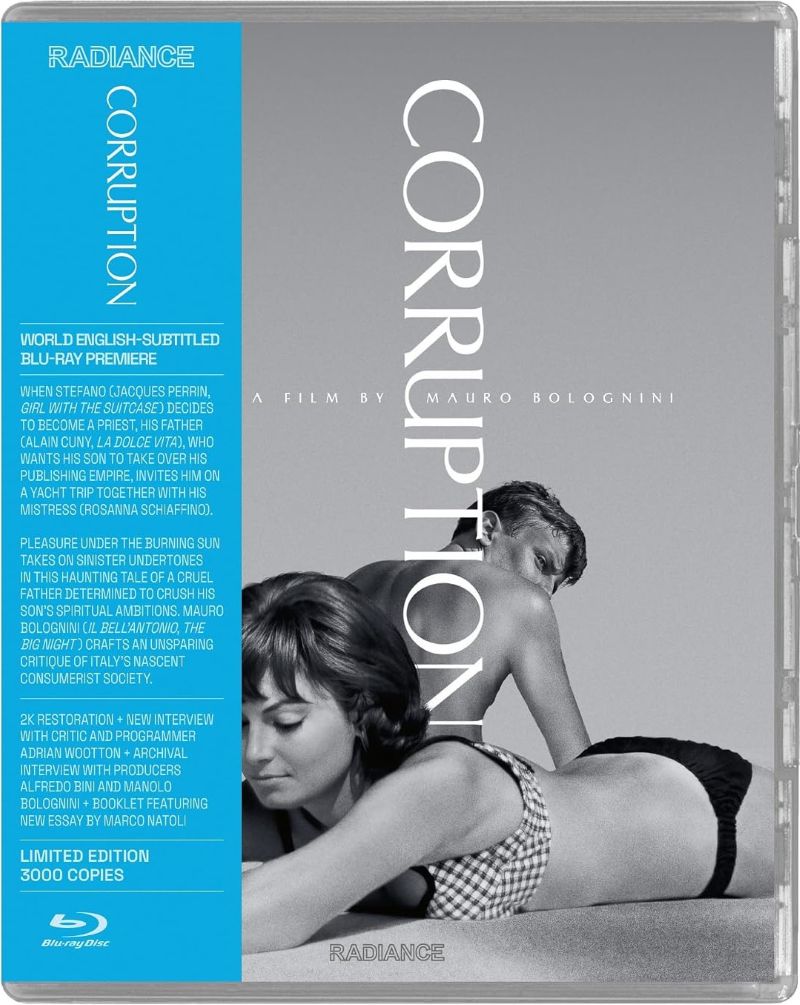
When the scion of a wealthy Italian family decides on an unconventional career path, his unscrupulous father takes steps to change his mind. Jacques Perrin (Cinema Paradiso) stars as principled young man Stefano Mattoli, determined to join a monastery instead of following in his capitalist father’s footsteps. Unwilling to accept his son’s virtuous choice, Leonardo (Alain Cuny, La Dolce Vita) enlists the assistance of a comely high-class temptress named Adriana (Rosanna Schiaffino) to lure Stefano into a life of sin and riches.
Buy CorruptionThe plot progresses as an escalating test of Stefano’s moral fiber, with each new temptation nicely sidestepped up until a defining moment. Perrin is pitch perfect as the tortured young soul, so intent to remain righteous even as he regrets defying his father and rejecting societal expectations. Cuny and Schiaffino also impress, contributing superb performances that firmly support their characters’ worldly paths. Director Mauro Bolognini doesn’t allow the story to get bogged down in religious dogma, instead framing Stefano’s struggle as a simple battle of wills between father and son.
The film’s early ‘60s era informs its exploration of shifting moral values, with Leonardo brazenly determined to make Stefano abandon religion, pursue riches, and treat women as replaceable commodities rather than life partners. A decade earlier, one would expect Leonardo to push Stefano into a quick marriage, but here the goal seems to be the creation of a wealthy playboy, emulating the father himself. Religious devotion has no place in Leonardo’s world view, putting him in seemingly endless conflict with his soulful, chaste son. Even though Stefano is the future, his extreme morality makes him seem like a vestige of the past, with the aging Leonardo’s focus on earthly pleasures a herald of the fracturing of societal norms.
The black-and-white film has received a 2K restoration and is presented in its original 1.85:1 aspect ratio with uncompressed mono PCM audio. The restoration gets off to a bit of a rough start, with plenty of specks and scratches in the early going, but gradually improves as the film progresses. The overall contrast and definition are well above par, enhancing the excellent cinematography and cool ‘60s fashion. Sound is fairly thin, but free of defects.
Bonus features include a new interview with a film critic and an archival interview with the film’s producers. The 3,000-copy limited edition also includes a booklet featuring a new essay by a film scholar. The cover art is also reversible, as usual for a Radiance release.
