
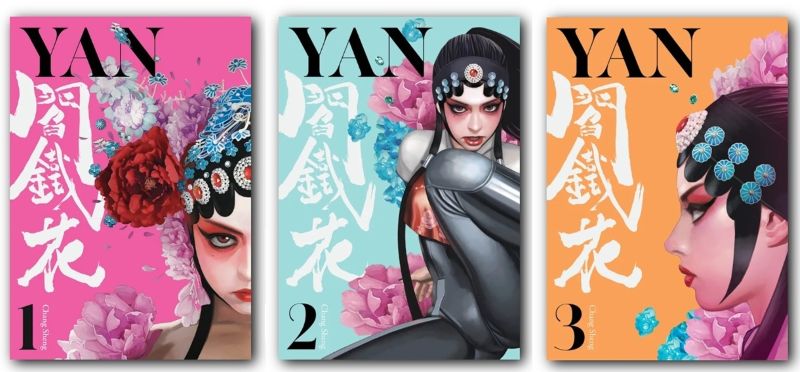
The third and concluding volume of Chang Sheng’s Eisner-nominated manhua epic was recently published, making this an ideal time to read the entire 1000-page series at once. I originally read the first two books as they were published starting last summer, but welcomed the chance to revisit and complete the series in conjunction with this review. That’s because Chang’s work is exceptional, particularly his superbly polished art. Titan Comics wisely rewarded his efforts with an unusually large format of 7” x 10,” as opposed to typical manga dimensions around 6” x 8,” allowing readers to savor his immaculate linework.
Buy Yan Vols. 1-3The story originated when Chang got the idea to mix a Peking Opera performer with superheroes, surmising that both genres utilize masked heroes, so it would be interesting for a powered actor to retain her performance makeup and costume. That actor is Yan Tieh Hua, introduced in Volume 1 as a bored teen actor already tiring of performing Peking Opera for handfuls of drowsy fans. When tragedy strikes her opera troupe, resulting in the deaths of all of her family, she’s charged with murder and sent to prison for a 30-year term.
Flash forward 30 years to a shocking livestream murder of the crooked son of a top crime boss. The executioner: Yan Tieh Hua in her original opera attire and makeup, seemingly barely any older than when she was locked up, and also seemingly back from the dead since she reportedly perished in a fire that destroyed her prison facility 10 years prior. Chang stretches out the mystery of how she has returned without aging, introducing other interesting characters along the way.
The first volume introduces the spirit of Yan’s ancestor, currently back in the physical world thanks to inhabiting various origami animals. We also meet a Japanese teen phenomenon at the game of go, who falls into Yan’s orbit and becomes something of a sister. A washed-up detective from Yan’s original arrest also joins Team Yan as he investigates her return. On the enemy side, an icy middle-aged blonde named Flora teams up with an emerging AI cheekily named Mr. All-Powerful to hunt down Yan, as well as a massive mecha kaiju tearing up the city to conclude the book.
Volume Two introduces time travel and the multiverse in the form of Rabbit Herlock, a young man from a parallel world who was responsible for the tragedy that destroyed the prison facility. Yan continues her fight with the mecha at the start, and battles the AI in its terrifying new robotic form at the end, with more fights in between as well.
In the final volume, Chang immediately addresses the question of how Yan appears nearly the same age 30 years later, and it’s a whopper of a reveal that defies expectations. Other than that, the storylines for all of the characters get wrapped up, even the origami ancestor, and good triumphs over evil. If there’s one shortcoming in this and the second volume, it’s that fight scenes are too frequent and too long, taking away from character development. We get broad ideas of each of the characters without getting into any real details, making the story feel at times like an exercise in inference.
The writing offers interesting perspectives on the emerging influence of AI, the struggle between tradition and modernity, and the power of familial ties, for both actual and found family members. There are shades of Ghost in the Shell, Gantz, and the AI’s physical form closely resembles an unskinned Terminator robot, but Chang’s story feels fresh from beginning to end.
Above all, his black-and-white artwork shines, with particular attention paid to detailed facial expressions and kinetic fight scenes. He doesn’t spend much time on background details, preferring to keep focus on his players, but that focus is so exacting that they seem nearly 3D. Panel layouts are nicely varied and never cramped, with occasional splash pages providing thrilling emphasis of his masterful lines. There are occasional slight touches of fan service, but nothing too tawdry, and the violence is likewise never too gruesome, making the books suitable for discerning teens, although suggested by the publisher for mature readers.
