
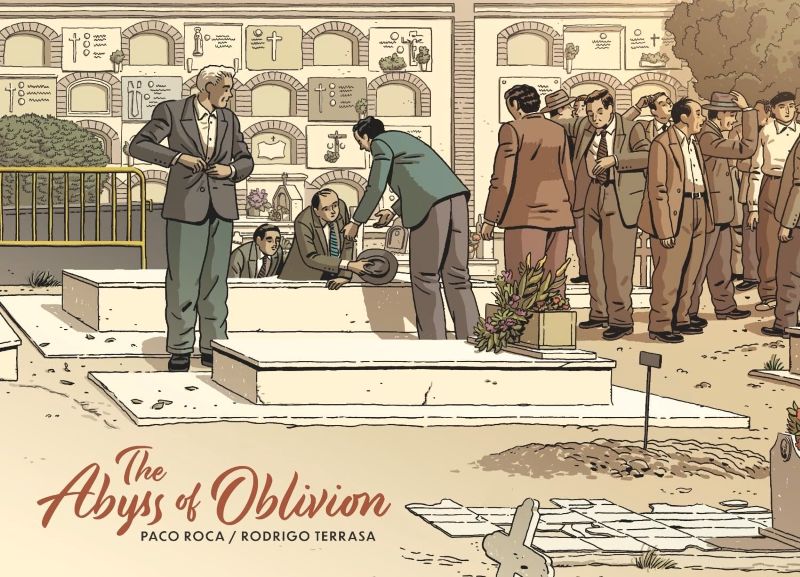
Paco Roca’s latest graphic novel lifts the veil on a shameful time in Spanish Civil War history: the Francoist government execution of tens of thousands of Spanish civilians. Working in conjunction with writer Rodrigo Terrasa, Roca details the horrific past, as well as the decades-long crusade to exhume mass graves, identify remains, and restore dignity to the murdered civilians.
Buy The Abyss of OblivionThe story centers on Pepica, the daughter of an innocent victim named José Celda who was executed in 1940. Her mission to reclaim her father’s remains from a mass grave spans over 70 years as she battles changing political regimes, indifferent local lawmakers, and the incredibly small odds of locating her father. Those odds are only improved by the kind actions of her father’s original gravedigger, Leoncio Badía, who worked in great danger to his own safety to leave clues for future identification. When possible, he carefully laid corpses in the graves rather than piling them in, keeping notes on the position of names he knew and removing small corners of clothing and locks of hair to give to the grieving families.
Terrasa’s story moves between the past and present, alternating harrowing glimpses of the original incarceration and execution of civilians with the valiant efforts of young archeologists called in to assist with the exhumations finally approved by the federal government in 2007 but not subsidized until 2011. Those archeologists face a peculiar challenge in their identification work as they face onsite scrutiny by surviving family members such as Pepica, an aspect not present in their usual centuries-old dig sites. The focus on one father and daughter helps to ground the story, even as the spirits of other victims and their families swirl around the periphery, exposing the massive scale of the Francoist crimes.
Roca generally works solo as both writer and artist, but Terrasa’s story is so tailor-made to Roca’s recurring interest in Spanish history that it feels like it was destined for Roca’s involvement. Roca maintains the sepia-tinted hues of his most recent prior book, Return to Eden, giving the work a warmth akin to flipping through old photographs. He also maintains the landscape orientation of his prior book, adding a cinematic touch to the presentation. His artwork is typically stunning, with his crisp, fluid lines adding vibrancy to the varied characters, period fashions, and background details.
Roca continues to be one of the most fascinating and accomplished cartoonists in the world, with the new book further benefiting from a heart-breaking but intriguing chapter of Spanish history virtually unknown to Western readers. As one of the characters states, “democracy was erected atop oblivion,” but Roca’s masterful art and Terrasa’s insightful story help to shine a light through that oblivion to reveal long-concealed truth.
