
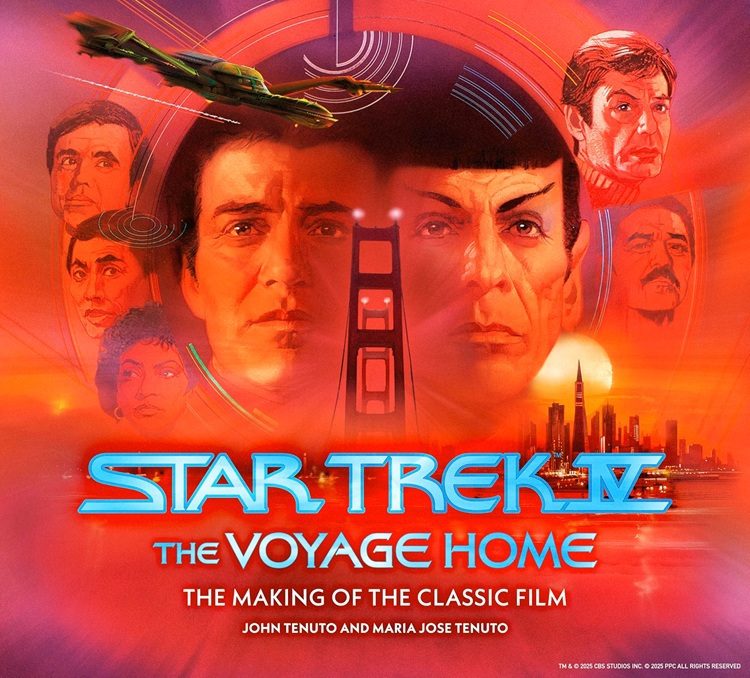
Following their behind-the-scenes books about The Wrath of Khan and The Search for Spock, authors John and Maria Jose Tenuto return to the Trek universe to complete the Genesis Trilogy for Titan Books with Star Trek IV: The Voyage Home: The Making of the Classic Film.
Buy Star Trek IV: The Voyage Home The Making of the Classic FilmFor those not familiar with the story, Michael Nazarewycz provides a brief synopsis in his review: there’s a “threat caused by a mysterious and monolithic cylinder that is simultaneously wreaking havoc on Earth’s atmosphere and sending a loud signal that no one recognizes…When Spock determines that the signal is identical to the song of the humpback whale, a species that has long been extinct, Kirk and company travel back in time to 1986, where they plan to capture a pair of whales and bring them back to their present day to save Earth.”
Chapter 1, “Working on All Thrusters: Greenlighting Star Trek‘s Return,” opens with Leonard Nimoy “wanted…back at the helm” by Paramount Pictures President of Production Jeffrey Katzenberg. Reteaming with producer Harve Bennett, “one thing they both immediately agreed upon was that the next film needed to be more lighthearted.” They also concluded a time-travel story would benefit them as they were popular among fans, created a conflict without nead for an antagonistic villain like the previous two films, and would allow for location filming.
The book works its way through the various script drafts, which received notes from creator/executive consultant Gene Roddenberry and for a time included Eddie Murphy as a college professor. It introduces “New and Returning Faces” with Catherine Hicks, Brock Peters, Jane Wiedlin, and John Schuck in the former category. Fans will recognize the following in the latter: Jane Wyatt and Mark Lenard, Robin Curtis, Grace Lee Whitney, and Majel Barrett.
The Tenutos profile various crew members and guide readers through different departments, such as costume and makeup, art and camera, and the effects team at Industrial Light and Magic that created the whales. In addition to shooting on the Paramount lot, including in the Blue Sky Tank (which gets its own chapter), the crew went on location, shooting on the USS Ranger CV-61 in San Diego, at a variety of locations over Los Angeles and Orange County, on the streets of San Francisco, and at the Monterey Aquarium. John reveals a wild connection to the film thanks to his parents. While on vacation to California, they visited the Aquarium as Star Trek IV was being filmed there. In a much different time, they recorded the rehearsal and filming on VHS, which they brought home for their son to view.
The book continues through different areas of post-production, from effects to music. There are 2 pages featuring 13 pages of Illustrator “Ralph McQuarrie’s original art visualizing the time travel sequence.” It’s a shame the art isn’t given more space to be better viewed and appreciated. The book wraps with a chapter on the film’s premiere and reception.
Trek fans should enjoy the deep dive provided by the Tenutos in Star Trek IV: The Voyage Home: The Making of the Classic Film. It’s an engaging book that provides great insight into the film’s creation from archival and new interviews as well as the authors’ research. It’s especially fun to learn about what almost was from deleted scenes and ideas like Saavik’s pregnancy, a scene with Sarek and Chapel, and Sulu meeting a family relation, and why they weren’t included.
Here’s hoping the Tenutos are willing to learn what a God needs with a starship and take on Star Trek V: The Final Frontier next, even though it’s not considered a “classic film.”
