
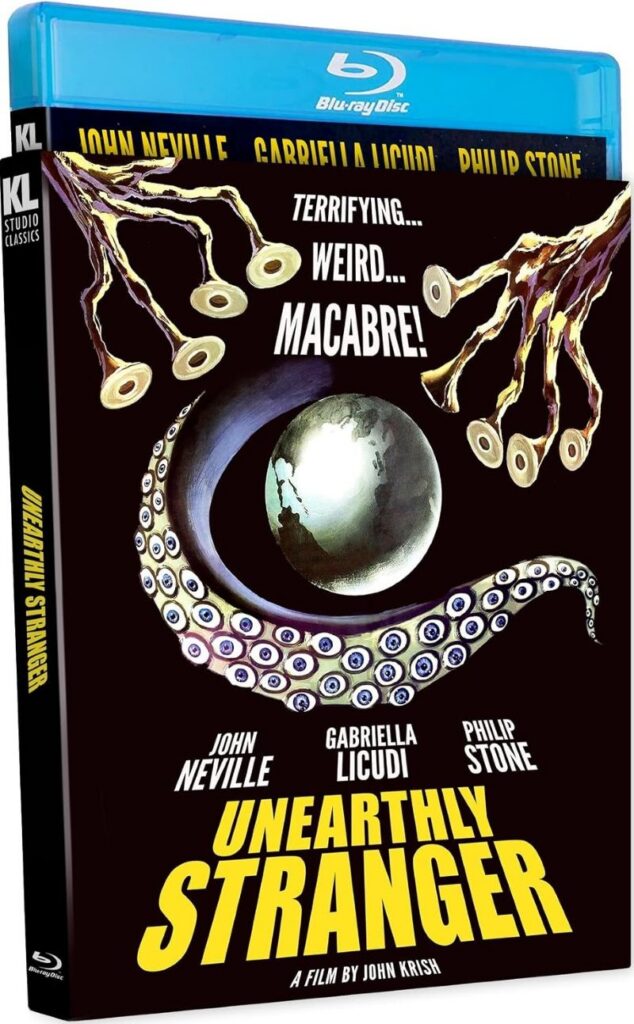
This 1963 British sci-fi film ratchets up tension by keeping alien threats completely hidden, with the increasingly stressed characters racing to save their lives from seemingly imminent doom. If you’re looking for a matinee creature feature with cheesy effects, be aware that there are exactly zero creatures or effects in the film, regardless of the misleading slipcase artwork. Instead, the film plays more like a high stakes mystery where the lead characters try to determine if aliens are among us.
Buy Unearthly StrangerJohn Neville stars as uptight scientist Dr. Mark Davidson, basically C-3PO without the costume. He’s newly married to a beautiful young woman (Gabriella Licudi) seemingly far out of his league, leading to suspicion among his colleagues when he reveals that he first met her by chance on the side of the road near his home. His lab partners are worried about nefarious outside agents because they’ve made breakthroughs on a revolutionary formula enabling men to travel through time and space, but the prior lead scientist was found dead in his office before he could pass on his results.
The film plays on Cold War fears about enemy agents in our midst, but eventually the scientists begin to believe the threats are from out of this world, not just across international borders. This puts Mark in the hot seat when his cohorts notice peculiar aspects about his wife, such as her failure to ever blink her eyes and her ability to handle hot dishes directly out of the oven. Confrontations and accusations abound, with Mark stuck between his career and his love.
At just 79 minutes and with a small cast and no effects, the film is more akin to an extended low-budget episode of The Twilight Zone or The Outer Limits than a theatrical event. Neville is great as the increasingly sweaty and perturbed lead, his eyes constantly darting in search of an escape from his situation, but his stress about unseen threats can only take the film so far. With no tangible enemies or action scenes, the story is an exercise in scientist freakouts rather than alien invasions.
The black-and-white film is presented in its original 1.66:1 aspect ratio with DTS mono sound. While no restoration notes are provided, the picture quality exhibits excellent contrast and precise focus, although scattered specks occasionally pop up. Bonus features consist of the theatrical trailer and two different commentary tracks, one by a film historian and the other by a pair of entertainment journalists.
