
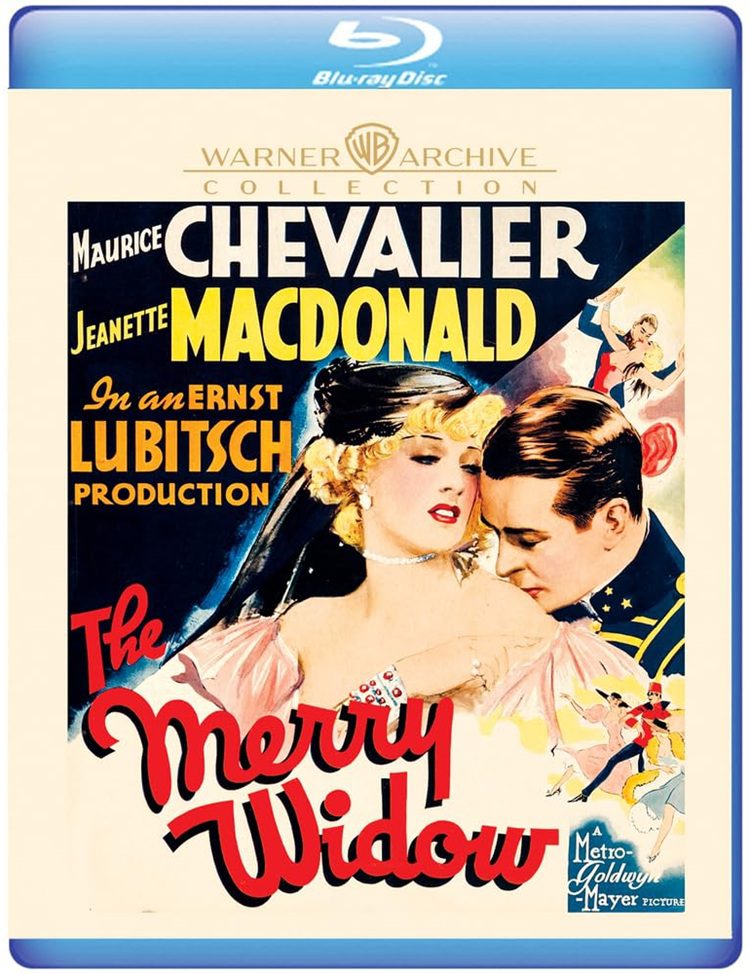
Based upon an operetta of the same name, The Merry Widow is a musical romantic comedy directed by Ernst Lubitsch. It contains much of what his fans call “the Lubitsch Touch” – sophistication, elegance, a sly sexuality that slips past the censors, lavish sets, impeccable costumes, and a wonderful sense of camera movement. There is a scene that comes late in the film where our two stars begin to waltz together all alone on a balcony. Then, out of nowhere, come a hundred other couples all dancing the waltz in perfect time. In a moment, our stars are lost in the crowd of choreography. It is a sublime moment. It is breathtaking. The film knows it, too, as we then repeat similar moments in different rooms several more times. There is another scene in which a group of can-can dancers, wearing matching striped skirts, dance and kick their legs to dizzying effect. Moments like that are just dazzling.
Buy The Merry Widow from Movie ZyngAnd yet, I didn’t love this film. Call it a lack of depth of emotion. This is a romantic comedy, and I never cared whether our main characters got together or not. I do like a good musical, but I’m not much for opera, and this leans into its operatic source material.
Jeanette MacDonald stars as Missia, the merry widow of the title. She is still in mourning when the film begins, and very rich. So rich that if she were to leave, the small, fictional, European country in which she lives would fall into anarchy. When she does move to Paris, King Achmed (George Barbier) hatches a plan to send Captain Danilo (Maurice Chevalier) after her in order to seduce her, marry her, and bring her back home.
The two have actually met before. Missia wears a black veil whenever she is in public to prove that she still mourns her late husband. Danilo becomes obsessed with her. He follows her home, sneaks over her garden wall (even going so far as to give her dog meat so he won’t bark), and watches her through her window, hoping to catch a glimpse of her face. He pretends to be a messenger with an important note so he can finally talk to her. Then begs her to reveal her face. She refuses but is intrigued by him.
In Paris, they meet again at a cabaret where he is well known as a playboy. They dance and kiss and almost fall for each other. But she is put off by his declaration that he cannot fall in love, that he cannot see past tonight’s simple pleasures. He still does not realize she is Missia, for she calls herself Fifi.
They will meet again at a ball. He will admit that he was wrong and declare his love for her. She agrees to marry him. The Ambassador (Edward Everett Horton) overhears and announces it to the crowd. Missia cannot understand how he learned so quickly about their plans; then she overhears Danilo talking to the Ambassador and learns it was all a plot to gain her riches for their homeland. And the relationship is off again.
It is all basic romantic-comedy stuff, plot-wise. But Chevalier is good, and MacDonald is charming. There is a precision to Lubitsch’s direction that has never been matched. There is so much I liked about this movie. But that central relationship and the whole business about saving the country didn’t really do it for me. It is too frothy to garner any real emotion. But the filmmaking more than makes up for that.
Buy The Merry Widow from AmazonExtras on this new Blu-ray from Warner Archive consist of the following:
- New 4K Restoration from the original camera negative.
- La Veuve Joyeuse: A French version of the film featuring Chevallier and MacDonald, directed by Lubitsch with an alternate supporting cast including Fifi D’Orsay.
- The original theatrical trailer.
The Merry Widow is truly delightful. Despite my misgivings about the story, this is very much worth the purchase.
