
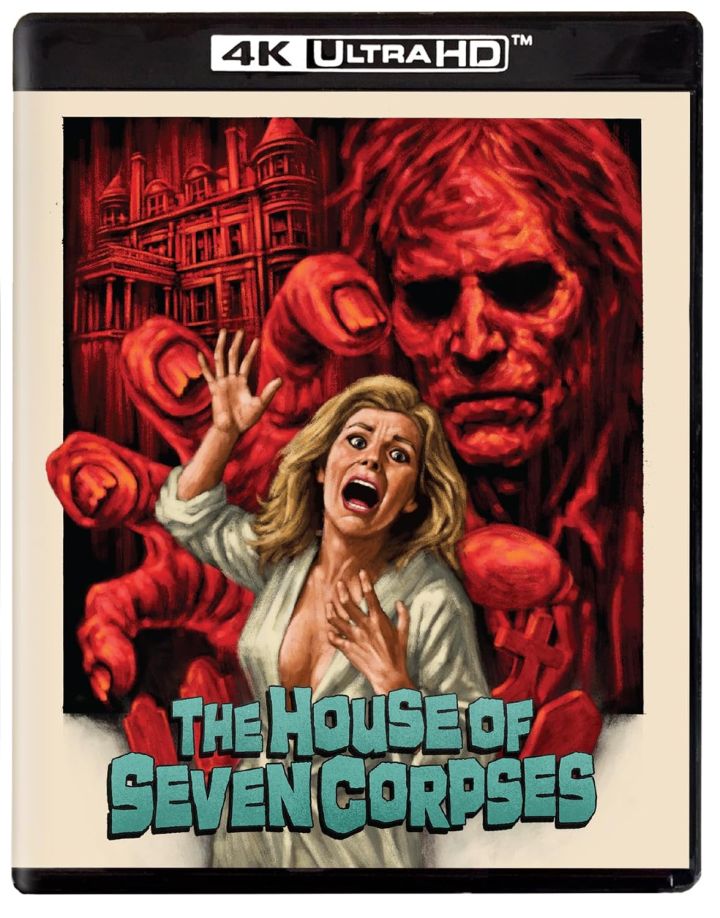
There are many variations on genre movies, but there is a basic split of creators working in genre that is worth noting. Those can be basically called: those who get it, and those who don’t. The ones who get it understand why people like the genre. Sci-fi directors have a sense of wonder. Action-movie directors love kinetic energy. And horror directors get the thin line between awe and disgust that makes horror come alive for the audience.
Buy The House of Seven CorpsesJohn Harrison, directing his only feature film with 1973’s The House of Seven Corpses, doesn’t get it. He tells an intermittently interesting story of a movie within a movie, where a film crew work inside a house of murder to recreate the horrors it holds. There are deft portraits of the actors, and the film crew who can barely tolerate them. There’s a kind of cool story about the fading fortunes of Hollywood actors and directors.
Unfortunately, there’s this pesky horror aspect he has to deal with. The reason the film got financed. And it’s the least interesting part of the movie, both to the audience, and it feels for the filmmaker. The Beale mansion has been the home to seven murders or suicides. In-film director Eric Hartman (John Ireland) uses it as the basis for a hokey devil movie. His actor and producer David found the location. It’s a small production; everyone wears a lot of hats. The house is abandoned except for a caretaker, Edgar Price (John Carradine). He’s a nuisance who likes to interrupts shots to complain about historical inaccuracies.
It’s a decent premise and a decent cast. I’ve seen innumerable terrible movies with John Carradine, but this is one of the few where he seems to give a damn. He has some scenes with John Ireland that actually have some sparks. Ireland is the most dynamic character, a director who seems to hate everything, especially his actors. This movie seems like a last desperate shot at not being a has-been.
It’s a great foundation for a story. Unfortunately, the story sucks, at least in this telling. Because there essentially is no story. No real mysteries are uncovered. Most of these movies have a growing sense of horror, each incident worse than the last. The House of Seven Corpses has exactly one before the finale. There’s a “shocking” twist, which isn’t that twisty and makes so little sense, it’s more confusing than thrilling.
What works best and is most interesting are the smaller details of filmmaking that take place. The movie’s about making a movie, and watching the crew load up their Arriflex cameras and plug in their lights is more intriguing than the undercooked boilerplate Satanism excuse for a plot indulges in. And the horror climax is neither horrifying nor terribly climactic.
It looks fine. The direction and cinematography are nothing special, but this 4K release reproduces them admirably. But the movie probably doesn’t deserve it. Except for some blood (almost all of it from the movie in the movie), this could have been a haunted house movie from the ’30s. All it lacked was somebody in a gorilla suit wandering around.
I liked the actors and the set up and setting. It was shot in a fabulous-looking mansion in Utah that is now the governor’s mansion. The behind-the-scenes movie stuff is fun. But the final horror act feels reluctant and almost tacked on, like this horror movie wanted to be anything but.
The House of Seven Corpses has been released on 4K and Blu-ray by Kino Cult. This release has both discs. Extras include three audio commentaries: one by film historian David Del Valle with producer David DeCoteau, one by associate producer Gary Kent and a “Savage Track” by Demon Dave and Joe. Commentaries are on both discs. On the Blu-ray there’s an archival interview with John Carradine.
