
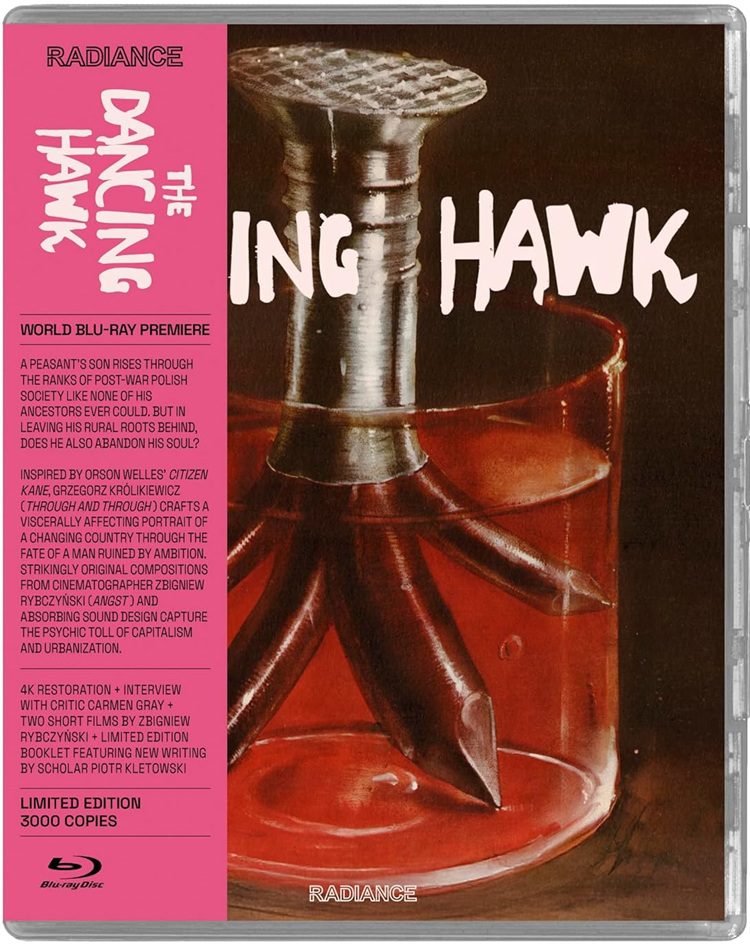
Nearly every review of The Dancing Hawk will tell you that the narrative of the film is fairly straightforward and simple, but that the filmmaking, the visual storytelling, is avant-garde, obtuse, and confusing. I guess technically that is true. If I were to write out the basic plot outline (something I will do in just a moment), it would come across as fairly uncomplicated. But I would argue that the filmmaking is so intentionally difficult that parsing out that plot is nearly impossible. At least for me anyway. Were it not for some of those other reviews, I doubt I’d be able to tell you what happens in this film in any coherent way.
Buy The Dancing HawkI’ll give it a shot anyway. Michal Topolny, (Franciszek Trzeciak) comes from a poor, rural, farm family. Through a mix of ambition and the States need for someone like him, he rises through the ranks of the newly formed Russian-sponsored Communist government. His ambition and the State’s constant desire for results cause him to become cruel and uncaring, and in the process he loses his soul. The higher he rises, the more ruthless he becomes, the more people he hurts, which eventually leads to his downfall.
That does make it sound fairly simple. But I cannot express how difficult the filmmaking makes comprehension of that simple plot. It takes a good 30 minutes of the film’s 98-minute runtime to get anywhere close to something that resembles a narrative.
This is a film that seems to ask, before each scene, “What is the most complicated and obscure way we can shoot this?” The camera will often focus on some small thing – leaves, objects on a desk – while allowing the important things to remain unfocused in the background. It often seems like they attached a GoPro camera (long before they were invented) to some solid object and then moved it about the set. It has that same focused-yet-confusing feel to it.
There are scenes where the camera is attached to the top of a tree, and we watch events unfold far below as the tree sways in the wind. Another scene shows a man’s arm get amputated, and it is seen from the arm’s point of view. A moment later someone buries the arm and plants a tree on top of it. There are several scenes where Topolny looks in a mirror, but his reflection does something slightly different. Or he’ll walk down a hallway, and the CCTV monitor will show him moving differently. Toward the end, several scenes repeat themselves. Characters will talk to each other, then suddenly go back and repeat the same lines. It is as if the actors were running lines over and over and the film just kept it all in.
All of this may have some greater meaning. Smarter people than me will probably take a look at all this and dive into how the director was using those CCTV shots to reflect on the duality of man. Or some such thing. Clearly the film is demonstrating how Communism chewed people up and spit them out. I think you could extend that metaphor towards anyone with too much ambition within any type of governmental system. But I’m not sure how that amputated-arm POV shot fits into that.
I’m not sure how much of it fits into anything at all. But the thing is I’m not mad I watched it. I appreciate when a film stretches the boundaries of what it can be. Even if I’ll probably never watch this again. There’s a certain film-nerd bragging right that comes with watching a film like this as well. When talking to my cinephile friends, I can now ask if they’ve seen The Dancing Hawk and about how weird it is.
Radiance Films now gives anyone interested those bragging rights. It has been given a beautiful-looking restoration. I may not know what all those obscure shots mean, but I did enjoy viewing them. Extras include a 16 minute overview of the film and director Grzegorz Królikiewicz’s filmography, plus two short films from cinematographer Zbigniew Rybczyński.
The Dancing Hawk is not for the faint of heart. Not that there is anything too grotesque happening, but there is so little narrative to latch onto, and almost nothing one can passively enjoy that it takes a lot of concentration to watch. And more brainpower than honestly some of us have to understand. But if you enjoy obscure, arthouse films where each frame demands being taken apart and deciphering, then there is a lot for you to unpack in The Dancing Hawk.
