
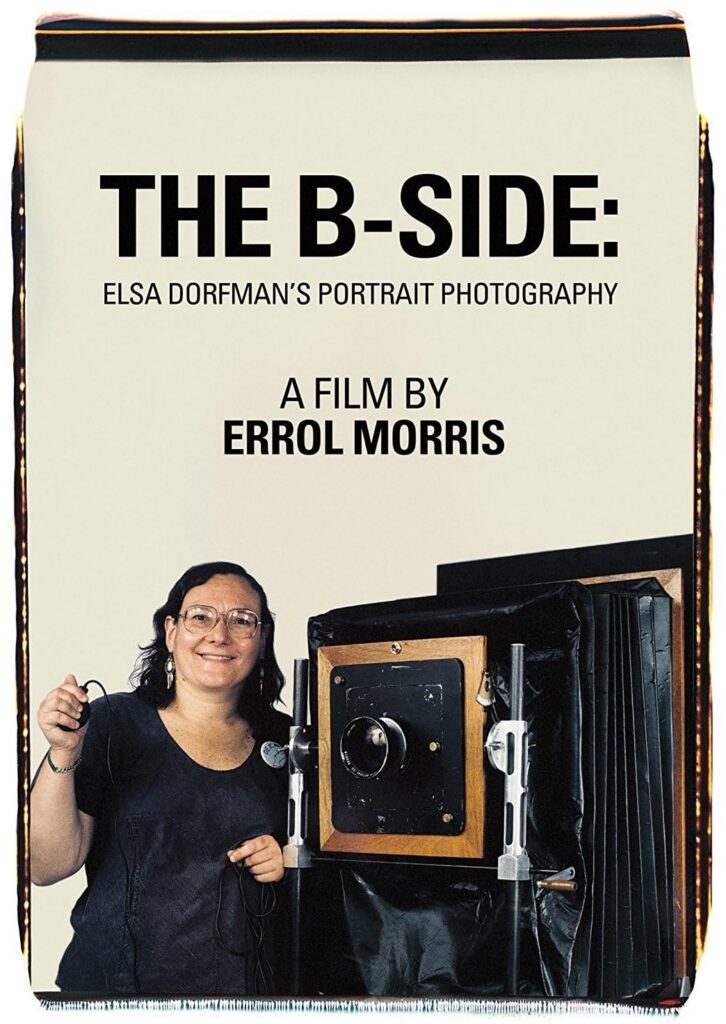
Errol Morris’ The B-Side: Elsa Dorfman’s Portrait Photography is a small, unusually kind film from a director better known for turning documentary subjects into investigations. There are no crimes to solve here, no political mysteries to unravel, and no grand argument to settle. Instead, Morris spends 76 minutes with his longtime friend, photographer Elsa Dorfman, as she looks back on a career built around an enormous Polaroid camera and the people who sat in front of it.
Buy The B-SideDorfman is an appealing subject precisely because she seems to have little interest in presenting herself as an important artist. After working at Grove Press in New York, where she became acquainted with Beat writers including Allen Ginsberg, she returned to Massachusetts and began photographing the literary and artistic figures who passed through her world. Her subjects included Ginsberg, Bob Dylan, Joni Mitchell, Jorge Luis Borges, Anaïs Nin, Audre Lorde, Anne Sexton, Lawrence Ferlinghetti, Jonathan Richman, and Steven Tyler.
Ginsberg, in particular, became a close friend, and the photographs of him give the film some of its greatest emotional weight. Morris also uses recordings of Ginsberg’s voice to evoke the friendship after his death. Dylan, meanwhile, appears almost like a movie star making a brief cameo, his familiar silhouette recognizable before his face is even shown. Yet Morris is less interested in celebrity than in what happens when these famous people sit down in front of Dorfman’s camera.
In 1980, Dorfman found her calling when she began working with the enormous Polaroid Land 20-by-24 camera. For the next 35 years, she used the cumbersome machine to photograph writers, musicians, families, friends, and strangers. The photographs are enormous, but Dorfman’s approach to her subjects is intimate and unpretentious. She wanted people to feel comfortable enough to reveal themselves, rather than trying to penetrate their personalities or “capture their souls.”
The title refers to the photographs Dorfman kept when her clients selected an alternate image. Like the neglected second side of a record, these pictures were not necessarily inferior; they were simply the ones that did not make the final cut. Morris turns that modest idea into the film’s central theme. The discarded photographs become evidence of the unpredictable nature of art, where an image that seems perfect to the photographer may mean less to the person being photographed, and an apparently secondary picture may ultimately prove more revealing.
Morris allows Dorfman’s personality to remain the center of the film. His usual interviewing technique can make his subjects seem as though they are being interrogated by an exceptionally patient detective. Here, however, the relationship is warmer and more relaxed. Dorfman wanders through her memories, examines old photographs, and discusses the pleasures and frustrations of her profession. The result feels less like an examination than a visit with an unusually perceptive friend.
That informality is also the film’s principal limitation. The B-Side occasionally feels slight, particularly when compared with the intellectual density of Morris’ greatest documentaries. His affection for Dorfman sometimes substitutes for analysis, and the film could have explored more deeply the questions it raises about portraiture, memory, celebrity, and the relationship between an artist and her technology. The famous subjects are intriguing, but most receive only passing attention; Morris is ultimately more interested in Dorfman herself.
Yet the film’s modesty becomes part of its charm. As Polaroid’s 20-by-24 film disappears, Dorfman’s career becomes a record of a photographic process that technology has effectively rendered obsolete. The fading images in her archive are more than souvenirs. They are reminders that photographs preserve moments while the materials used to preserve them—and the people who made them—remain subject to time.
The B-Side may be a minor Morris film, but minor does not mean insignificant. It is an affectionate portrait of an artist who photographed some of the most recognizable cultural figures of her era while finding her deepest satisfaction in ordinary people, imperfect photographs, and the peculiar machinery that made both possible. Like the photographs Dorfman keeps, the film asks us to pay attention to what might otherwise be overlooked. In doing so, it makes a persuasive case that the so-called B-side can sometimes be the more interesting one.
