
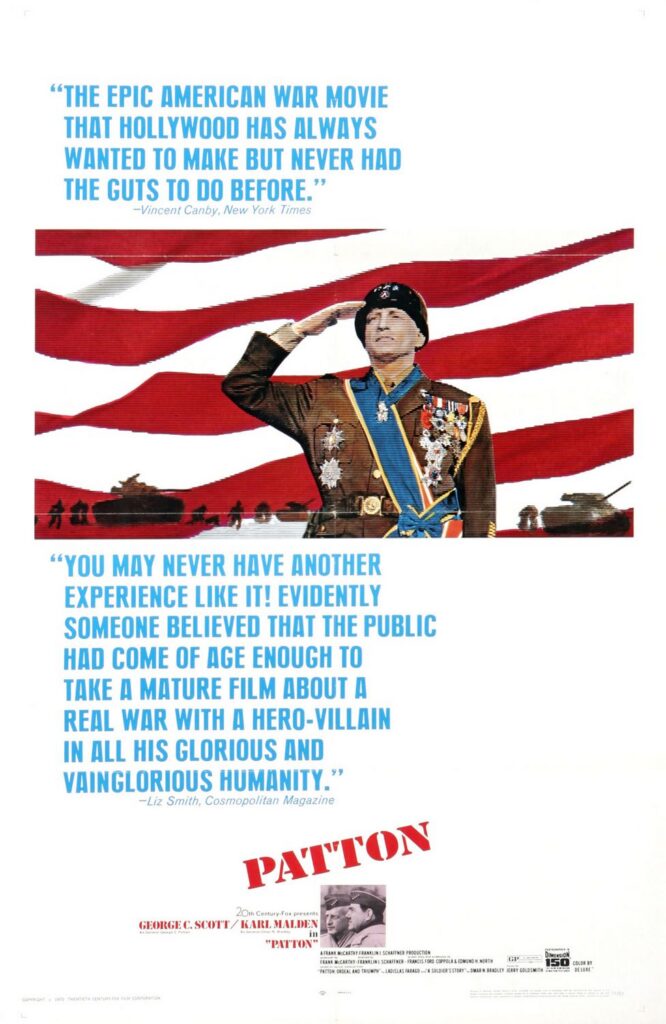
There are plenty of war movies that want us to admire their heroes. Patton is more complicated. It wants us to admire George S. Patton while making damn sure we understand why this particular hero could be such an unbearable human being.
Buy PattonReleased in 1970, Franklin J. Schaffner’s Patton follows the controversial general through the North African and European campaigns of World War II, beginning with his command of American troops in Tunisia and continuing through Sicily, the invasion of France, and the final push into Germany. Patton wins battles, alienates allies, slaps a hospitalized soldier, gets sidelined by his superiors, and eventually finds himself racing across Europe toward the war’s conclusion. Through it all, his greatest opponent may be his own inability to stop being Patton.
The movie opens with one of the most famous images in American cinema: General Patton standing before an enormous American flag, delivering a profanity-laced speech to his troops. It is pure theatrical swagger, and George C. Scott owns every second of it. He doesn’t simply play Patton. He seems to have been forged out of the same strange alloy of arrogance, discipline, theatricality, and barely contained violence.
It is fascinating that the movie never entirely settles on whether Patton is a great general, a dangerous egomaniac, or both. Usually, it’s both. He is brilliant on the battlefield, particularly when pursuing the retreating German forces across North Africa and Sicily, but spectacularly bad at navigating the modern military bureaucracy surrounding him. He believes war is an art, generals should be warriors, and glory belongs to the man willing to seize it. He also believes, with astonishing confidence, that he is that man.
Scott’s performance won the Academy Award, and it is easy to see why. Patton could have become a cartoonish portrait of military bluster, but Scott gives him enough intelligence and vulnerability to make the contradictions compelling. The character is vain, superstitious, deeply competitive, and obsessed with history. He believes he has lived before, or at least that he has been destined for battle across the centuries. Yet beneath all that bombast is an almost childlike fear of being forgotten.
That insecurity becomes one of the movie’s most interesting threads. Patton doesn’t merely want to win wars. He wants history to remember that George Patton won them. His rivalry with General Omar Bradley (Karl Malden) helps reveal just how alien Patton’s worldview is. Bradley is practical and politically savvy. Patton is a human tank that occasionally has to be steered away from running over his own side.
And then there is that ending. After all the speeches, victories, humiliations, and grand visions of immortality, Patton is left contemplating a much quieter possibility: that history may simply move on without him. It is a surprisingly melancholy conclusion for a movie that spends much of its running time shouting.
Patton remains a terrific showcase for George C. Scott and a remarkably unsentimental portrait of military heroism. It gives us a man who seems born to command, then spends nearly three hours demonstrating why that might not be such a wonderful gift after all. Patton wants to be remembered as a great warrior. The movie Patton makes sure we remember the complicated man behind the legend.
