
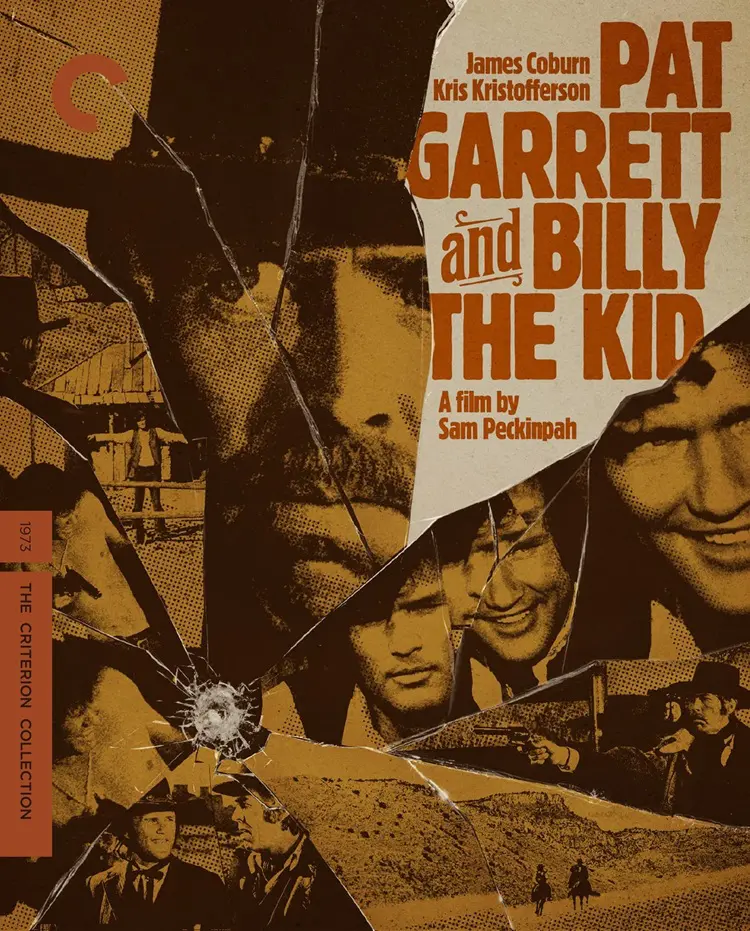
It’s notable when a producer and/or studio takes a film away from the director before they have completed it. One such infamous incident occurred when MGM studio chief James Aubrey took Pat Garrett and Billy the Kid away from director Sam Peckinpah during post production. Other editors were brought in, but the Theatrical Cut fared poorly with critics and at the box office. Over the years, there have been various edited versions of the title released.
Buy Pat Garrett and Billy the Kid (Criterion Collection)Criterion’s Pat Garrett and Billy the Kid release makes available three versions of the film on two discs. Disc One contains the new 50th Anniversary Cut (117 min) of the film restored digitally in 4K supervised by editors Paul Seydor and Roger Spottiswoode (who previously worked on the Theatrical Cut) and a 4K digital restoration of the Theatrical Cut (106 min). Disc Two contains a 2K digital remaster of director Sam Peckinpah’s Final Preview Cut (122 min).
The 50th Anniversary Cut opens in 1908, near Las Cruces, New Mexico, with Pat Garrett (James Coburn) assassinated in a prologue. It then cuts to Old Fort Sumner, New Mexico 1881 with new lawman Pat Garrett coming to town to see his old friend Billy the Kid (Kris Kristofferson). They share a drink and Pat tells him people want him out of the county, and he’s been assigned to make it happen. He then chases Billy for the remainder of the film. The Theatrical opening cuts the prologue and opens in 1881 with Garrett coming to town to offer Billy the same warning. The Final Preview intercuts the attack of Garrett with him coming to town but leaves him alive. The 50th cut makes the worst choice of the three as seeing Garrett survive until 1908 removes any tension of what his fate may be during the film as he encounters numerous shootouts and individuals.
All the films follow a similar plot as Garrett pursues Billy and his gang, initially capturing Billy after a shootout in a cabin only for Billy to escape. Some scenes don’t appear in all three cuts and some scenes play out in different ways in terms of editing and use of music but all tell the same story. The West was changing, becoming more civilized, but only to a point as the same powerful people who were able to turn Garrett into a lawman in order to stop Billy would eventually turn on Garrett when they no longer had a use for him.
In their scenes together, it’s clear Garrett and Billy are two sides of the same coin. Coburn plays Garrett as a practical man. While he used to be as wild as Billy, he sees how the West is changing and decides to join the new world order rather than get left behind. However, the former outlaw is still there below the surface made evident in how Garrett administers his new power as a lawman. Kristofferson’s Billy is a free spirit. He doesn’t understand who decided the West was going to change but knows he never agreed to it. But change is coming so does he stay and fight the tide or go find a new home in the desert wilderness of Mexico?
Along the way, there are instances of the “good guys” acting bad and outlaw Billy acting good, as when Billy stops a trio of bounty hunters from branding and raping a Mexican couple that are his friends. While all the versions work to varying degrees, and the Theatrical cut isn’t as bad as its reputation, Peckinpah’s Final Version was the best of the three.
According to the liner notes, the new 4K master of the 50th Anniversary Cut “was created from the 35 mm original camera negative and a 35 mm color reversal intermediate. The original monaural soundtrack was remastered from the two-inch DME magnetic track.” The new 4K master of the Theatrical Cut “was created from the 35 mm original camera negative. The original monaural soundtrack was remastered from the two-inch DME magnetic track.” The new 2K master of the Final Preview Cut “was created from a 35 mm print from the collection of the Academy Film Archive. The original monaural soundtrack was remastered from the 35 mm magnetic track.” All three version are presented in a 2.35:1 aspect ratio.
The rich earth tones come through in the settings and costumes, allowing for stronger colors to standout, especially the red blood spattering out of folks. Blacks are inky. The image offers a good amount of grain and looks clean except for the Final Preview, which wasn’t given a similar treatment. The image also delivers a sharp focus to highlight the texture detail and the depth of the staging. The mono audio track delivers clean dialogue, good emphasis in the shooting effects and allows Bob Dylan’s music to shine in support of the imagery and film. It sounds free of hiss or wear.
The Special Edition Features are:
- Audio commentary – Seydor, Spottiswoode, and critic Michael Sragow talk on the 50th Anniversary Cut
- Passion & Poetry: Peckinpah’s Last Western (48 min)a new documentary by Mike Siegel about the making of the film
- Dylan in Durango (16 min)a new interview with Dylan biographer Clinton Heylin about the film’s soundtrack
- Champlin on Film: “James Coburn” (27 min) – Produced for the Z channel in 1988,
- Trailer and TV spots
Three versions of Pat Garrett and Billy the Kid might be a bit of overkill for some, but for those interested in how a film is edited together, it is interesting to compare the results of the three cuts. The high-definition presentation offers great video on the two films mastered in 4K and pleasing video on the Final Preview, which taps into the outlaw aspect of that version. The audio is satisfying and extras do a fine job taking viewers into the film’s making.
