
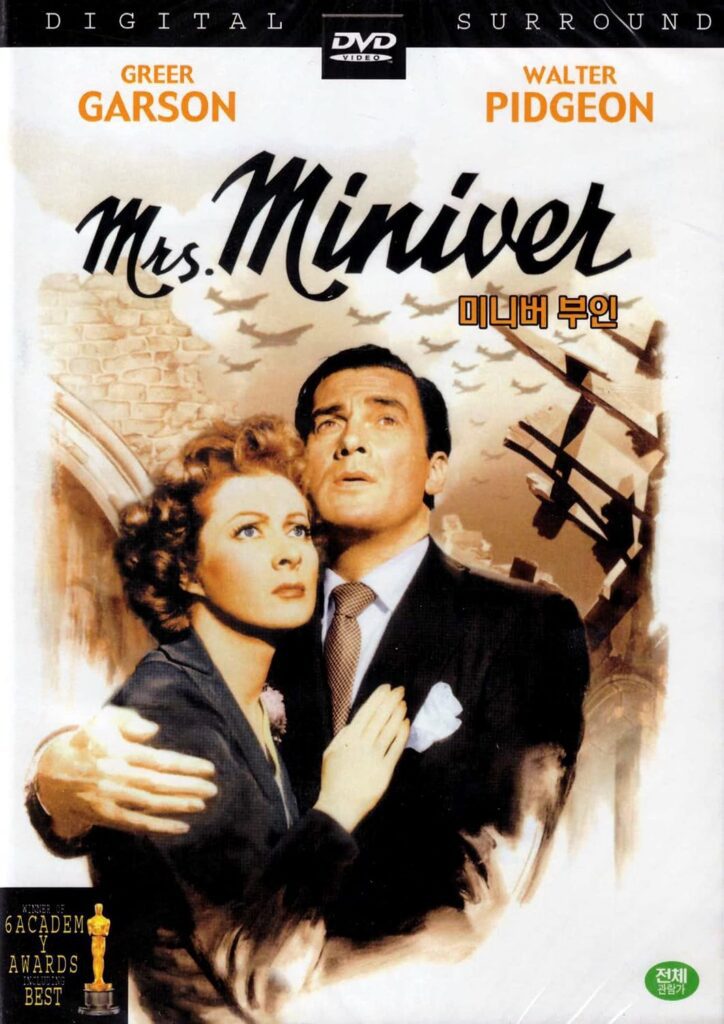
William Wyler’s Mrs. Miniver is a stirring portrait of ordinary British citizens confronting extraordinary circumstances during World War II. Winner of six Academy Awards, including Best Picture, the film combines domestic drama with wartime propaganda, transforming the struggles of one middle-class family into a celebration of national courage. Although its message occasionally overwhelms its storytelling, the picture remains an affecting testament to the resilience of people determined to preserve their way of life.
Buy Mrs. MiniverGreer Garson stars as Kay Miniver, a gracious, resourceful wife and mother living in an English village with her architect husband, Clem (Walter Pidgeon), and their three children. Their comfortable existence revolves around family responsibilities, social engagements, and the small pleasures of everyday life. Their eldest son, Vin (Richard Ney), returns from Oxford and falls in love with Carol Beldon (Teresa Wright), the granddaughter of the imperious Lady Beldon (Dame May Whitty). While the young couple’s romance develops, the escalating war begins intruding upon the Minivers’ peaceful routine.
Clem volunteers for dangerous missions across the English Channel, while Kay confronts the conflict in a more intimate but no less terrifying fashion when a wounded German pilot enters her home. Meanwhile, Vin joins the Royal Air Force, and the family learns that even their quiet village cannot escape the consequences of war. The film’s emotional center lies in these intersecting experiences, showing how national upheaval transforms ordinary domestic concerns into matters of survival.
Garson delivers an appealing, Oscar-winning performance that makes Kay a convincing embodiment of steadfast British resolve. She balances warmth, humor, and quiet determination without reducing the character to a collection of patriotic virtues. Pidgeon provides an equally dependable presence as Clem, conveying the affection and understated partnership that sustain their marriage. Wright brings youthful sincerity to Carol, while Whitty makes Lady Beldon’s gradual transformation particularly effective. Their contrasting characters offer a reminder that shared adversity can overcome divisions of class and temperament.
Wyler directs with a sure hand, allowing moments of domestic comedy and tenderness to establish what the characters stand to lose. The film’s most powerful sequences emerge when familiar routines collide with the realities of war. Kay’s encounter with the German pilot is especially tense, while the destruction of the village church provides a devastating illustration of how conflict reaches beyond the battlefield. Joseph Ruttenberg’s cinematography lends the picture an elegant visual polish.
Nevertheless, Mrs. Miniver occasionally sacrifices complexity for the sake of its patriotic message. Its characters frequently articulate their virtues and convictions with a clarity that feels designed to persuade rather than illuminate. The German pilot is particularly one-dimensional, and the film’s idealized portrait of British society leaves little room for ambiguity. Produced while the United States was at war, the picture deliberately seeks to rally audiences around the Allied cause, and its propaganda is impossible to miss.
Yet the film’s sentimentality is not without purpose. By concentrating on a family rather than military strategy, it gives the enormous conflict a human scale. Its famous church speech, delivered in the aftermath of an air raid, explicitly connects the defense of ordinary people with the defense of freedom itself.
Mrs. Miniver may wear its heart and convictions on its sleeve, but its craftsmanship, performances, and emotional sincerity remain compelling. More than a wartime time capsule, it is an enduring portrait of courage found in everyday life.
