
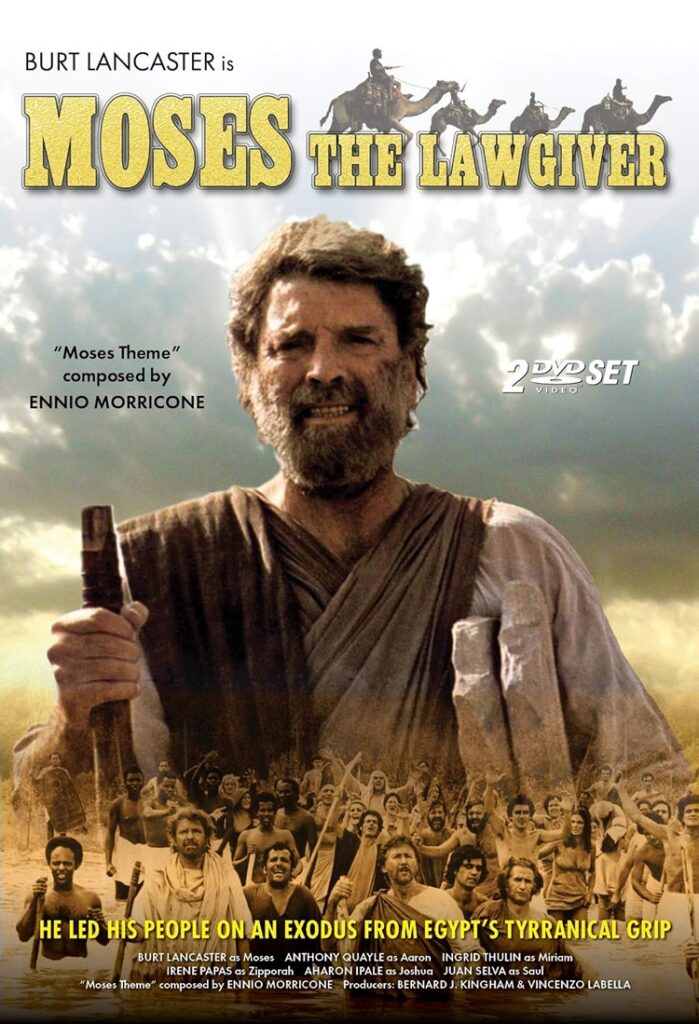
Burt Lancaster is Moses the Lawgiver in the six-part, six-hour TV miniseries that originally aired in 1974. This gritty, Italian-produced retelling of the Biblical life of Moses keeps closer to the source material than the much more grand The Ten Commandments (1956). We witness Moses’ birth, his life, and his death. One might recall all of the rest and ask “did he leave a better world when he died? Enough to base a miniseries on?” Director Gianfranco De Bosio along with producer Lew Grade try to help answer that question with help from horror icon Mario Bava as director of special effects and spaghetti-western staple Ennio Morricone providing the musical themes to this Bible epic.
Buy Moses the LawgiverEpisode one follows his birth to his time growing up as a prince in the Egyptian Pharaoh’s court to the point where he is forced to flee after he kills a man. Here, Moses the young man is played by Willaim “Bill” Lancaster, son of Burt. Episode two sees Burt appear and assume the role of Moses from midlife onward (with patchy, dyed and/or fake beard). It’s here where Moses experiences the burning bush, is called to lead the Israelites, and is summoned back to Egypt to meet with his cousin who is now Pharaoh. Episode three uses decent special effects to take us through the ten plagues of Egypt used by God to break through the doors of Pharaoh’s hardened heart. This episode also highlights Passover, where God spared the Israelites from the final plague of sacrifice before they are set free to wander through the wilderness like lost riders on the storm.
Episode Four finds Pharaoh changing his mind about setting the Israelites free and giving them chase. Moses will lead them to the Red Sea and God will part its waters allowing safe passage for his people and a watery demise to Pharaoh’s army. Episode five is where the story gets a little technical and discusses the laws eventually set down in the books of Leviticus and Deuteronomy. The importance of this episode lies in Moses receiving the Ten Commandments and the people getting restless during his long absence on Mount Sinai which then causes them to create a golden calf to worship via orgies and mad leaping. Episode six, the final episode, finds Moses smashing the tablets in anger and the false god worshippers are punished and killed. It’s also here that the generation of Moses will pass away as the Israelites conquer rival tribes to wrestle away control of the promised land. A promised land Moses will never see.
Moses The Lawgiver is a little weird and cringey (bad eye make-up and wigs with some miscasting) at times but interesting and well acted overall. The cast made up largely of British and Italian actors do a fine job with what they are given. The timeline is a little jumbled but the story is still effective as most of the major events are presented and there are bits of scripture read over some scenes and spoken in others that add authenticity. It’s also nice to hear the meaningful Biblical names of characters used instead of made up names that might be more “pleasant” sounding.
The filming locations in the harsh parts of Israel and Morocco assist in keeping the backdrop real and gritty, as do the tattered, dirty clothes of the Israelites. The sets are realistic in places like the towns and villages where things looked old and lived-in, but the palaces and temples look sparse and cheap, as do the wardrobe of the Egyptians in these places. The special effects aren’t terrible, just lackluster overall. The parting of the Red Sea is saved from disaster through creative cuts that keep the epic event somewhat thrilling. A couple of major points of distraction and cringe is the fact that the key players of Moses and Pharaoh are light skinned, blue eyed, and blond in a region of the world that’s predominantly more bronze and naturally tan colored. The continuity of Moses’ beard isn’t really a thing and it stands out for its fluctuation in fullness and color throughout the series.
Moses The Lawgiver isn’t nearly as lavish a production as The Ten Commandments but it gives a more realistic feel to the locations and wardrobe of the Israelites. It’s a flawed retelling of the Biblical character’s epic hero’s journey but worth a watch for its loyalty to actual scripture.
After its release, Moses producer Lew Grade met with Pope Paul VI, who was so impressed that he suggested Lew make the life of Jesus, an idea that would become Jesus of Nazareth (1977). Jesus of Nazareth would be a more polished and star-studded event. After watching an episode of Jesus, it’s fairly easy to see why that miniseries was more successful compared to Moses The Lawgiver. In the years following Moses, Grade and the production crew seemingly figured out how to keep things real looking but not overly sparse and cheap. Then again, perhaps the story of Jesus simply inspired more backers and money lenders with deeper pockets.
