
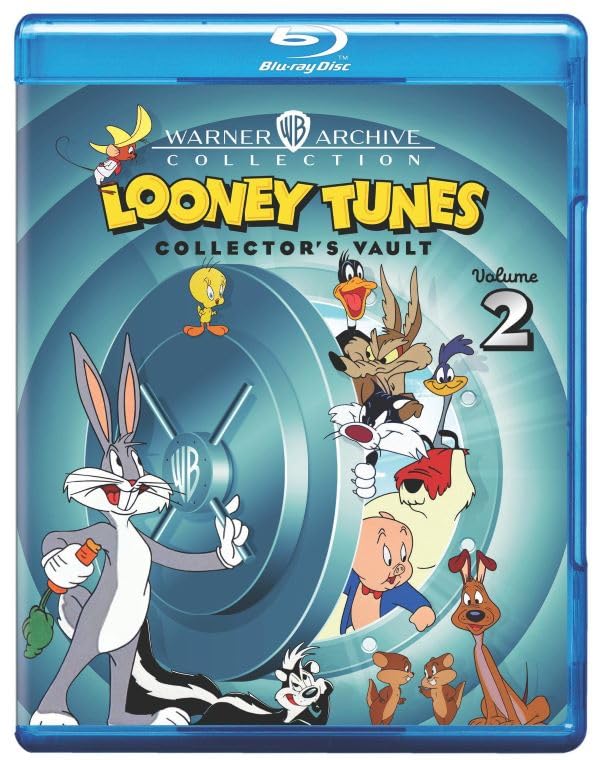
The Looney Tunes: Collector’s Vault Volume 2 is a two-disc set of shorts from 1935 to 1963 with the first disc containing 26 new-to-disc cartoons while the second disc contains 25 newly-restored cartoons. Of the 51 cartoons, 2 are from the 1930s, 23 from the ’40s, 17 from the ’50s, and 9 from the ’60s. The cartoon title is followed by the year of release and its director.
Buy Looney Tunes: Collector’s Vault Volume 2 from MovieZyngIn A-Lad-In His Lamp (1948, Robert McKimson), Bugs finds Aladdin’s lamp and a genie (Jim Backus). Bugs wishes he was in Bagdad and runs from a caliph who wants the lamp. Daffy encounters a crying duckling and a hunter who is not Elmer in Ain’t That Ducky (1945, Friz Freleng). Both Daffy and the hunter are interested in what duckling has in his satchel.
Conrad Cat’s makes his dialogue-free debut in The Bird Came C.O.D. (1942, Chuck Jones). He delivers a palm tree to a theater, finds a magic hat, and plays with it. He battles a little bird that looks like Henery Hawk. The images loses a little sharpness when he rises from orchestra pit. In Bone Sweet Bone (1948, Arthur Davis), Shep the dog has to retrieve what he believes is a dinosaur bone from a bulldog, but his master is mistaken. There are white scratch marks and specks during the final scene inside museum.
Daffy Duck bookends a couple of early animal-themed Freleng cartoons.In Boston Quackie (1957, McKimson), Daffy is a secret agent in Paris that has to transport a briefcase but he loses it immediately. Two baseball-playing roosters compete for a gal in Boulevardier from the Bronx (1936) while Country Boy (1935) is based on Beatrix Potter’s The Tale of Peter Rabbit. The Daffy Duckaroo (1942, Norman McCabe), a black and white short, sees singing cowboy Daffy quit Hollywood and head west. He meets anIndian gal, who is interested in Daffy but she has a boyfriend.
Sylvester appears in Dr. Jerkyl’s Hide (1954, Freleng) as a cat chased into the lab of Dr. Jerkyl by two dogs, Alf and Chester. Before they can rough him up, Sylvester drinks a potion and turns into a monster. Alf is scared and runs off. Chester looks in after potion worn off, and begins to think less of Alf. Foghorn Leghorn is The EGGcitedRooster (1952, McKimson). He has to protect an egg while wife away, and Barnyard Dawg and Henery Hawk work against him in amusing ways. Wile E. Coyote is back after the Road Runner in Fastest with the Mostest (1960, Jones) with both characters breaking fourth wall talking to the audience in the end.
A trio of Freleng cartoons starts with Fowl Weather (1953). Granny leaves Hector Bulldog to protect Tweety. Sylvester makes his presence known quickly. Tweety hides with chickens. There’s a funny role-reversal gag when Hector paints Sylvester yellow and puts him in cage. Sylvester has been making quite a meal out of canaries as I Taw a Putty Tat (1948) opens. His owner orders one more, but Tweety, who is more aggressive than usual, puts a stop to it. The Goofy Gophers take on factory farming when the Ajax Produce Company steals their food in I Gopher You (1954).
I Was a Teenage Thumb (1963, Chuck Jones & Maurice Noble) is based on the Tom Thumb story but doesn’t have a lot of laughs. Little Blabbermouse (1940, Freleng) is one of many who take an overnight tour of a drugstore as the products come to life so it’s a tad odd the short is named after a minor character. Barnyard Dawg steals an ostrich egg and sneaks it under Foghorn, making him think he laid it in Mother Was a Rooster (1962, McKimson). Dawg is a bit cruel to innocent ostrich as he keeps calling it ugly.
Elmer Fudd gets Pests for Guests (1955, Freleng) when he buys a chest of drawers in which the Goofy Gophers hide their acorns. The Rattled Rooster (1948, Davis), who is not Foghorn, tries to scrounge up a morning meal. He eventually tries for a worm, which he soon learns is a mistake. Ralph Wolf and Sam Sheepdog are back at it in A Sheep in the Deep (1962, Jones & Noble). There’s a great gag as they unzip multiple costumes they are wearing, and it has a funny conclusion as end-of-day whistle stops a dynamite stick from exploding.
Barnyard and Foghorn put Kid Banty, the World’s Champion Fighting Rooster to use against one another in Sock a Doodle Do (1952, McKimson). During a snow storm, homeless Tweety knocks on Sylvester’s door in A Street Cat Named Sylvester (1953, Freleng). Sylvester plays with Hector’s injured foot, which he will regret. A couple scenes of Sylvester in the kitchen lose sharpness. Mighty Angelo, “The World’s Strongest Flea,” leaves the circus and for a dog. When a bulldog steals his dog’s pillow, Angelo seeks revenge in To Itch His Own (1958, Jones).
Junior has A Waggily Tale (1958, Freleng) when he dreams about being a dog whose owners are rough on him as he is on dogs. The final Ralph and Sam short, Woolen Under Where (1963, Phil Monroe & Richard Thompson), not only find them working at same meadow, but living together. Zoom at the Top (1962, Jones & Noble) closes out Disc One and has a great ACME Boomerang sequence involving Wile E. and glue.
Jones must have had writer’s block and an impending deadline as Awful Orphan(1949) is a remake of his Little Orphan Airedale (1947), which is a color remake of Porky’s Pooch (1941, Bob Clampett). This third outing sees Charlie Dog wanting to be a pet for Porky. They are paired for the third and final time in Often an Orphan (1949, Jones). Tweety is A Bird in a Guilty Cage (1952, Freleng) that is chased around a department store by Sylvester.
Bowery Bugs (1949, Davis) finds Bugs telling an old man a silly story about how he got Steve Brody to jump off the bridge in July 1886. Porky and his pet, a non-speaking Sylvester, check into a spooky place where only Sylvester can tell there’s Claws for Alarm (1954, Jones), the second of three times this occurred. Later on the the disc, the final time this premise is used occurs during Jumpin’ Jupiter (1955, Jones) with the danger in the form of aliens. Oddly, Porky mistakes one for a Native American. In Crowing Pains (1947, McKimson) Sylvester, who looks slightly different, finds himself on the farm with Foghorn while Henery Hawk seeks a chicken. The rare blending of characters is always a treat to see how they interact.
Viewers can easily see how three different directors handled Bugs in this next trio of cartoons. Frigid Hare (1949, Jones) finds Bugs and Playboy Penguin on the run from a geographically misplaced Eskimo. Hare Remover (1946, Frank Tashlin) casts Elmer as a mad scientist who tries to turn Bugs into a monster. It’s got funny visuals. Willoughby the dog is Bugs’ latest foil in The Heckling Hare (1941, Tex Avery), which is filled with good gags like characters screaming terrified as they fall off a cliff until they save themselves.
The second and last black and white cartoon the set is Hop and Go (1943, McCabe) a one-off of Claude Hopper, a kangaroo. He sounds like Goofy because he is voiced by Pinto Colvig before he returned to Disney. Claude ends up bombing Tokyo, which is rather wild. Dr Jekyll befriends Bugs and takes him home in Hyde and Hare (1955, Freleng), and has quite an effect on Bugs.
Friz Freleng & Hawley Pratt match Sylvester with his frenemies in a pair of shorts. The Last Hungry Cat (1961) has a different feel as the narrator, speaking like Hitchcock, makes Sylvester feel guilty when he thinks he ate Tweety. In Mexican Boarders (1962), Sylvester not only chases Speedy Gonzales but Speedy’s cousin Slowpoke Rodriguez, who is always hungry, putting himself and Speedy in danger.
A Davis trio presents a bookend of Porky shorts. First, Porky uses numerous cats unsuccessfully to take on a Mouse Menace (1946) and then he deals with The Pest That Came to Dinner (1948), which may be Pierre the termite or it could be I.M.A. Sureshot, who is more con man than exterminator. Wellington the dog battles non-romantic, non-speaking Pepé Le Pew,who is more a screwball nemesis like Bugs and Daffy, for a cabin and bed in Odor of the Day (1948).
The next four cartoons are by Jones. In Ready.. Set.. Zoom! (1955), Wile E. tries glue on highway. Of course, he gets stuck when a truck comes along. There’s lots of dynamite, and a good gag where he dresses like female road runner only to get the attention of a lot of coyotes. Scent-imental Over You (1947) is the second Pepe cartoon, though he is unnamed and his mailbox reads called Stinky. A Mexican chihuahua named Fifi puts on a black fur coat and gets some unwanted attention. Followed by two more Roadrunner cartoons, Stop! Look! And Hasten! (1954) has a great gag of a metal wall that pops up in the middle of the road. To Beep or Not to Beep (1963, Jones & Noble) was derived from the Adventures of the Road-Runner TV pilot that wasn’t picked up. It features a series of attempts with a catapult failures.
Wagon Heels (1945, Clampett) is a color remake of his black-and-white short “Injun Trouble” (1938). Porky is a scout for a wagon train heading to California. The great concern is Injun Joe, a huge hulking figure of a man. But what really causes problems is Slappy Moe, a weird blue-skinned hillbilly, who reappears throughout, telling them he knows something he won’t tell…until he does. Wile E. falls off a cliff a number of times in Whoa, Be-Gone! (1958, Jones).
The set concludes with two Daffy cartoons. In Wise Quackers (1949, Freleng), Daffy, too weary to head south, lands on Elmer’s farm where he begs to be Elmer’s slave rather than get shot, Of course, it backfires. Since the National Poultry Show awards the best rooster $5,000, and the best duck $5, Daffy decides to dress up as a rooster in You Were Never Duckier (1948, Jones), However, Henery Hawk comes to the theater to bring home a rooster.
Taken from 4K scans of the original negatives, the video for the cartoons have been given a 1080p/MPEG-4 AVC encoded transfer displayed at an aspect ratio of 1.37:1. The various colors and shades shine, from the softer pastels in the 30s to the bolder hues in the other decades. Blacks are inky in the color and B&W cartoons. Film grain can be seen and above I noted instances of imperfections. The audio is available in DTS-HD Master Audio 2.0 Mono. Dialogue is clear, as are the musical scores and sound effects. The tracks didn’t show signs of age or wear.
There are commentary tracks for:
- Bowery Bugs with Michael Barrier
- The Heckling Hare with Greg Ford
- Mexican Boarders with Ford and Freleng
- Stop! Look! And Hasten! with Ford
- You Were Never Duckier with Eric Goldberg
The Looney Tunes: Collector’s Vault Volume 2 is a great continuation of the series as it offers a balanced mix of cartoons featuring both classic characters and those lesser known that should please diehard fans and those new to the franchise. The new scans are vivid and allow the artwork to shine. Looking forward to Volume 3.
