
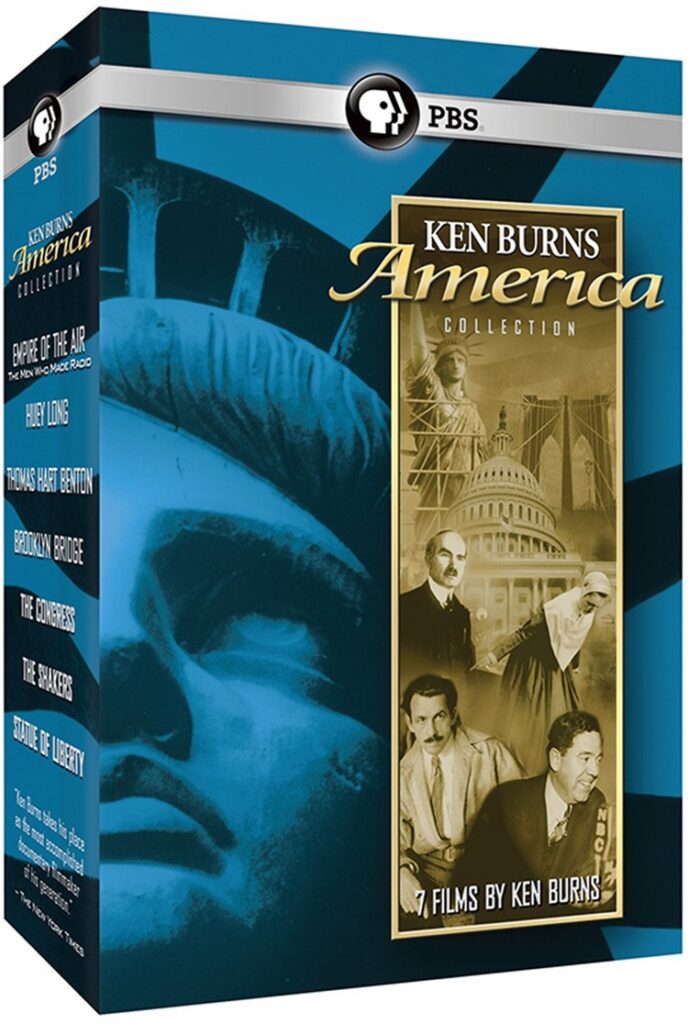
Ken Burns became a household name when his landmark, nine-part documentary The Civil War first aired on PBS in 1990. Narrated by historian David McCullough, the story of the War Between the States is told through excerpts from contemporaneous letters and journals of persons both well-known and unknown read by actors and commented upon by modern authors and historians. But Ken Burns had been making documentaries about American history years before that. His six films prior to The Civil War and one made after make up the seven-DVD set, Ken Burns America Collection, which was originally released September 2004.
Buy Ken Burns America Collection from Movie ZyngBurns made his directorial debut with the Oscar-nominated Brooklyn Bridge (1981) about the creation of the famous New York landmark, which opened on May 24, 1883, and at the time was the longest suspension bridge in the world. Narrated by McCullough, who wrote The Great Bridge: The Epic Story of the Building of the Brooklyn Bridge from which the film was adapted and who frequently served as a narrator of Burns’s work, Brooklyn Bridge uses the same stylistic choices that Burns’s films would become known for.
Moving from the urban to the rural, The Shakers: Hands to Work, Hearts to God (1984) tells about the Christian sect founded in England 1747 that formed in the United States in 1780s after Mother Ann Lee had a revelation that saw her and several followers head across the Atlantic Ocean. Returning to a New York City landmark, The Statue of Liberty (1985) was a massive gift from France in celebration of the centennial of U.S. Independence, which some hoped would inspire their fellow Frenchmen about their own country’s direction away from their king.
Burns also told stories about individual Americans, making biographical films about Louisiana politician Huey Long (1985), whose story was fictionalized in Robert Penn Warren Pulitzer Prize-winning novel All the King’s Men, and Regionalism painter Thomas Hart Benton (1988), who depicted middle America during the Great Depression. Expanding his lens to many individuals, The Congress (1989), one of three equal pillars of American government, highlights major figures who passed through the body and major issues they had to deal with, including the Civil War and the Civil Rights Movement.
The final documentary in the set is Empire of the Air: The Men Who Made Radio (1992), based upon Tom Lewis’s non-fiction book of the same name. Narrated by Jason Robards, the film focused on three American radio pioneers: Lee de Forest, inventor of the audition tube; Edwin Howard Armstrong, inventor of FM technology; and David Sarnoff, leader of Radio Corporation of America.
The same, brief Special Features appear on all discs but Empire of the Air:
- Ken Burns: Making History (7 min)
- A Conversation with Ken Burns (12 min)
Ken Burns is a masterful storyteller and one of the country’s most important historians. Ken Burns America Collection presents compelling stories that showcase what makes America and its citizens unique.
