
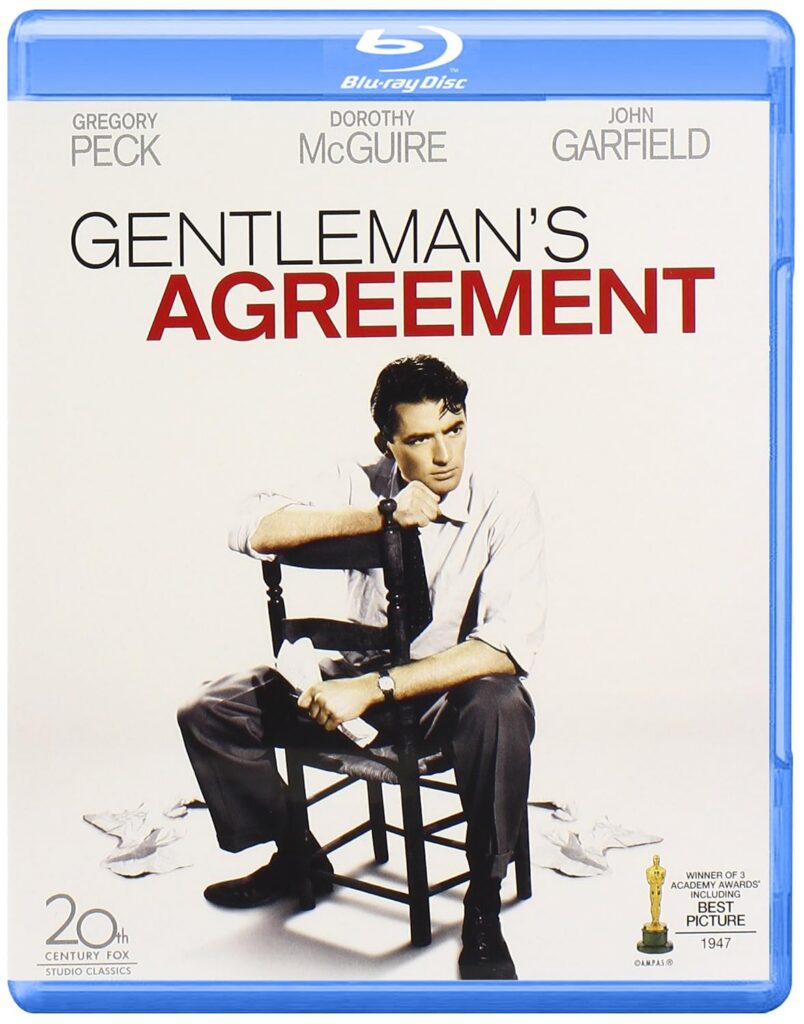
Winner of the Academy Award for Best Picture, Elia Kazan’s Gentleman’s Agreement tackles one of America’s more uncomfortable social realities: antisemitism among people who would never dream of considering themselves prejudiced. Nearly 80 years later, its message remains relevant, even if the film’s earnest approach occasionally gets in the way of its dramatic ambitions.
Buy Gentleman’s AgreementGregory Peck stars as Philip Schuyler Green, a recently widowed journalist who moves to New York City with his young son, Tommy (Dean Stockwell), to take a position at a national magazine. His editor, John Minify (Albert Dekker), assigns him a series of articles examining antisemitism in America. Initially uncertain how to approach the subject, Green hits upon an unusual idea: He will pretend to be Jewish and experience discrimination firsthand.
The experiment quickly exposes an ugly collection of prejudices hiding behind respectable manners. Green encounters landlords who refuse to rent to Jewish tenants, hotels that quietly exclude them, and social circles where acceptance comes with unspoken conditions. Even his budding romance with divorced schoolteacher Kathy Lacy (Dorothy McGuire) becomes complicated when she struggles to confront antisemitism among her friends and family.
Kazan, working from Laura Z. Hobson’s best-selling novel, approaches the subject with admirable seriousness. Rather than concentrating on the most obvious expressions of hatred, Gentleman’s Agreement examines the casual discrimination practiced by supposedly decent people. These are not necessarily individuals who harbor an open hatred of Jews. They simply prefer not to associate with them, employ them, or live alongside them. Their prejudices are dressed up as social convention, which makes them no less damaging.
Peck is an excellent choice for the lead role. His natural decency and understated authority make Green an appealing protagonist, although the character’s moral certainty occasionally borders on self-righteousness. McGuire brings warmth to Kathy, giving her more emotional complexity than the screenplay initially suggests. Celeste Holm, who won an Oscar for her performance as fashion editor Anne Dettrey, provides some welcome personality and sharpness, while John Garfield makes a particularly strong impression as Green’s Jewish childhood friend, Dave Goldman.
The film’s greatest strength is its willingness to challenge the audience rather than simply condemn some distant collection of bigots. Green discovers that discrimination can thrive in the most polished surroundings, perpetuated by people who consider themselves enlightened. One particularly effective sequence involves Tommy experiencing the same kind of exclusion his father has been investigating, bringing the issue out of the adult world of professional and social niceties and into the everyday experiences of a child.
Still, the film isn’t without shortcomings. Its central conceit places a non-Jewish character at the center of a story about antisemitism, leaving Jewish characters largely in supporting roles. Green’s ability to temporarily assume a Jewish identity also simplifies an experience that cannot be fully understood through an undercover assignment. The screenplay occasionally spells out its conclusions with such determination that subtlety is left waiting outside.
Nevertheless, Gentleman’s Agreement is an important, thoughtfully constructed drama that refuses to let respectable society off the hook. Its Oscar-winning reputation is deserved, even if its approach sometimes feels more like a carefully delivered lecture than a fully realized human drama.
