
Greetings and welcome to another edition of Five Cool Things, where I talk about all the cool and interesting things I’ve consumed over the last two weeks. Or in this case, the last four weeks, as I was on holiday and thus unable to write a column two weeks ago.
For this edition, I’m talking about Roger Ebert’s favorite movies, a cool new(ish) horror discovery, Bob Dylan, and a classic Japanese anime. Let’s get started.
The Great Movies by Roger Ebert
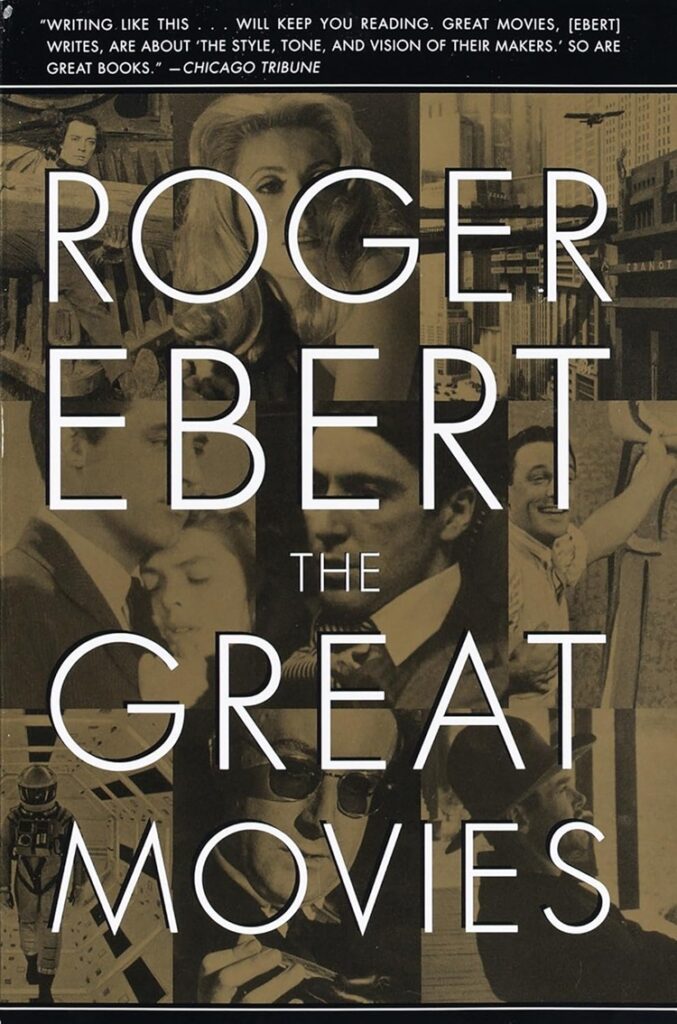
In 2003, Roger Ebert wrote this book consisting of essays on what he considered to be some of the best films ever made. These were different from his regular reviews, which often had to be written on a deadline. They were more thoughtful, more considered. These were films he’d seen many times before and loved. He went on to write three more books in the Great Movies series before he died.
Buy The Great Movies by Roger EbertAll of those essays are now up for free on his website (they have been for years, so this is nothing new). I’ve read most of them, some of them multiple times. Whenever I see a film made during the time Ebert was writing reviews, I immediately search for what he had to say about it.
I suppose a book like this is then superfluous. Why buy the book when all of these essays are available online? Truth be told, my wife found this one at a garage sale and bought it for a dollar. But I find I like it. There is something nice about having all of these essays in something physical.
When I first got it, I would just randomly thumb through it, reading whatever essay I landed on. More recently, I decided to read it from cover to cover, and it was a wonderful experience. The thing for me about Ebert was that he was a good film critic but a great writer. Other critics were better at digging deep into a film’s subtext or themes – they could analyze a film more critically than Ebert, but Ebert had a way with words. Later in life, he would write completely random essays about all sorts of things. Just stuff he was thinking about that had nothing to do with movies, and I loved reading them.
I loved reading these essays, and I have a feeling I’ll be buying the other books in this series, even if I don’t find them at a garage sale.
Double Blind
It is a great time to be a horror fan. Most of the classics are readily available on a variety of streaming services, and high-tech digital cameras have made even low-budget horror films look much more expensive. A24 keeps churning out high-minded, so-called elevated horror, while numerous other studios continue to produce films that just want to scare you. Oh yes, and there are even streaming services like Shudder that are completely dedicated to nothing but horror.
Buy Double Blind Blu-rayNot all of it is good, of course, but that’s always been the case. But sometimes (and increasingly often) you can stumble onto something that was not at all on your radar but turns out to be pretty good. Such was the case for Double Blind for me. There was recently a digital sale where you could get AMC+ for 99 cents a month for two months. I love those types of sales and scooped it up. AMC+ also includes Shudder, so I’ve been binging on lots of horror films lately.
Double Blind is an Irish horror film about a group of people participating in an experimental drug trial that goes horribly wrong. It is a multi-day experiment, and they are all forced into the basement of a large medical-research facility. The drugs give everyone insomnia, and before it is all over, they’ll learn that if they do manage to fall asleep, they will die. Just as the doctor running things realizes the experiment should be shut down, something sets off an alarm, and they are all trapped inside the facility for 24 hours with no way to contact anyone on the outside.
Director Ian Hunt Duffy does a nice job amping up the horror and tension as these poor test subjects try to survive the night. Millie Brady stars as Claire, the eventual and reluctant leader, and she’s quite wonderful. It isn’t the world’s greatest horror film ever made, but it is definitely worth checking out.
Akira
We visited a fun little local bookstore while we were on holiday. I love a good bookstore, especially a local independent one. I’ve seen the beloved anime of the same name several times, so when I found a copy of the manga, I jumped at the chance to read it. Though the book I bought was quite large, it turns out it was only part 1 of 6. Before we left, I bought part 2, and just yesterday I ordered the remaining books from Barnes & Noble. But I’ve not yet received them. I’m sure I’ll be talking about the manga in future additions of Five Cool Things, but for now, I want to return to the film (which I watched again over the weekend).
Buy Akira Blu-rayAkira is a confusing film in some ways. For starters, the main character – the one you see on the poster with the red jacket and cool red motorcycle—is not named Akira. You don’t learn about or even see Akira until much later in the film. The plot is convoluted and dense. It is set 30 years after World War III, which started when a massive explosion happened in the heart of Tokyo. The city has now been rebuilt but is plagued by corruption, crime, and terrorism and is beset by motorcycle street gangs.
During a gang fight, our heroes inadvertently run into a young boy with psychic powers. Somehow these powers transfer to one of the gang members. For the rest of the film, a secret government agency is trying to capture this kid while his powers continue to grow. The rest of the gang runs around wildly looking for their friend and trying to figure out just what the heck is going on. Watching the film, I feel exactly the same.
That’s about as much of the plot as I can describe to you because I’m not entirely sure if I understood what was going on half the time. But I was always completely enthralled. The animation is wild and wonderful, and the story digs deep into science fiction, philosophy, and politics. Akira is widely considered to be one of the greatest anime ever made, and it helped popularize the genre outside its native Japan. You can see its influence on countless media, including The Matrix, Kill Bill, and Stranger Things.
Rorschach by Tom King
In 1986, writer Alan Moore and artist Dave Gibbons created Watchmen, a sort of superhero comic that subverts, interrogates, and plays with the genre in fascinating ways. It is widely considered to be the greatest comic of all time. Neither Moore nor Gibbons retains the rights to the comic, and periodically, DC Comics has created prequels, sequels, and other stories that exist within the same universe. Rorschach is one of those.
Buy Rorschach by Tom KingRorschach was one of the main characters in the original Watchmen comic. You could say he was the protagonist, an anti-hero, a vigilante who sees the world in complete black and white terms, refusing to ever compromise. He also – and consider this a spoiler warning for the original comic – dies at the end. In the 2017 comic Doomsday Clock, a different person picks up the Roscharch mantle.
In Rorschach, written by Tim King, with art by Jorge Fornes, which is set 30 years after the events of Watchmen, the idea of Rorschach has become a symbol for numerous right-wing conspiracy theorists. The book begins with the attempted assassination of a presidential candidate running against President Robert Redford. The attempt fails, leaving the assassins – a comic book artist (who thinks he’s the reincarnation of Rorschach) and a cowgirl sharpshooter—dead. An unnamed detective tried to understand what happened.
As you can probably tell, this is a sequel to Watchmen in name only. The only character from the original story in this one is Rorschach, and that’s not really him. With a few minor tweaks, this could easily be a stand-alone story that didn’t exist in the Watchmen universe. I’ve seen quite a few complaints about that online. There are also plenty of complaints about how, since we already know how the story is going to end (with an attempted assassination leaving two would-be killers dead), there isn’t really any mystery to solve. The story mostly unfolds with the detective talking to people.
And yet, I quite liked it. While this is a tale that didn’t necessarily have to be set in the Watchmen universe, it is interesting to see what Tim King imagines happening to that world three decades after the events of the original story. And the conspiracy that sets everything in motion is interesting and well told. All in all, I think this is a nice addition to the universe.
65 Revisited
In 1967, documentarian D.A. Pennebaker released Don’t Look Back about Bob Dylan’s historic tour of England in 1965. In 2007, he released this film, which is essentially the leftovers from that earlier film. In some ways, it is a counterpoint to Don’t Look Back. That film often shows Dylan at his most caustic, laying into reporters, being sarcastic to fans, and showing deep strains in his relationship with Joan Baez. In 65 Revisited, we see a softer, more playful side to Dylan during this time. There is a wonderful scene inside a clothing shop where he’s trying on a tie and goofing with his entourage, the girl behind the counter, and some fans. We see him several times interacting with fans in a delightfully playful way.
Buy Don’t Look Back (Criterion Collection) Blu-rayAnd then there are the songs. Don’t Look Back famously doesn’t include a whole lot of Dylan actually performing, but here we get several full songs and lots of partial performances. And Dylan in 1965 was absolutely electric. (Even before he went electric!)
Million Dollar Bashers Celebrate Bob Dylan Going Electric
Sixty years ago, Bob Dylan went electric at the Newport Folk Festival and changed the trajectory of his career and possibly rock and roll as we know it. To celebrate this event, an eclectic group of musicians, including folks from Wilco, Sonic Youth, and Luna, plus special appearances from Robyn Hitchcock, John Doe, and others, gathered at the historic Cain’s Ballroom in Tulsa, Oklahoma, to perform the songs of Dylan from that time period.
I was fortunate enough to attend and had an absolute blast. Every musician clearly loved this music, but they weren’t slavish to the original arrangements or performances. They made it their own. We attended the first (of two) shows that night. Most of the musicians have only arrived the previous day for rehearsals. This meant the performances weren’t super polished, but what they lacked in perfectionism was more than made up for by pure joy. I’ve seen better shows, but I’ve never had so much fun.
