
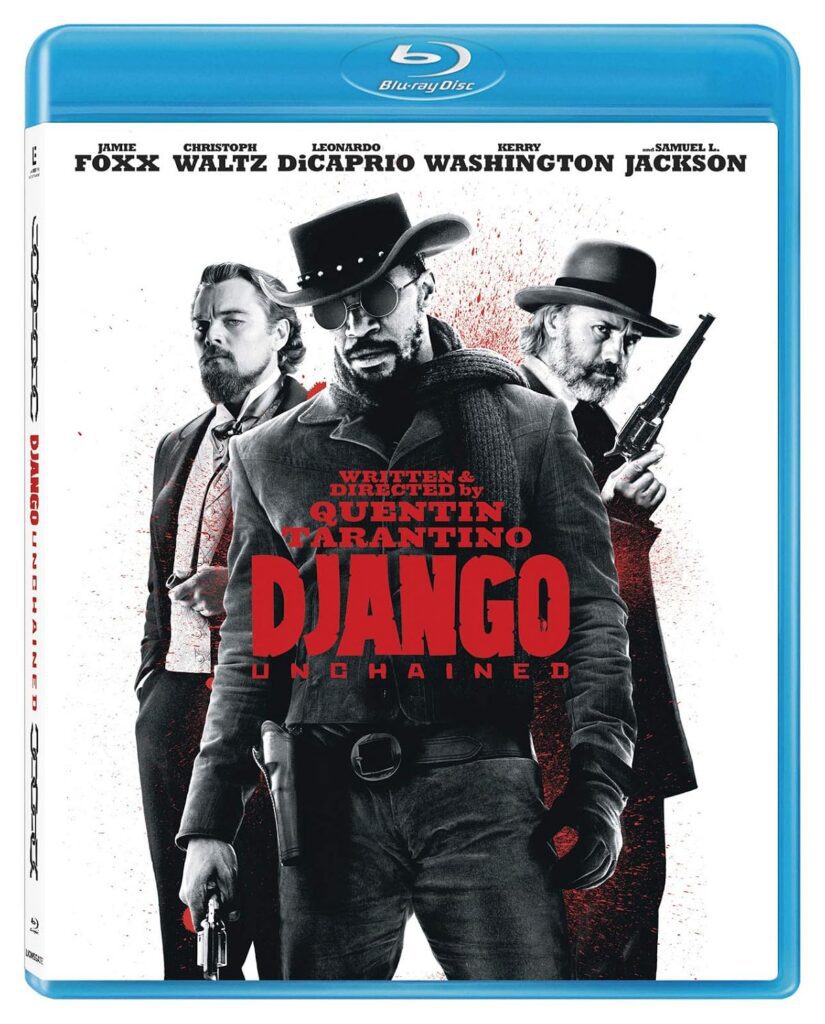
Quentin Tarantino has always been fascinated by the movies that shaped him, and with Django Unchained, he turns that fascination toward the American Western and creates something that feels simultaneously familiar and completely original. Set two years before the end of the Civil War, the film follows Django (Jamie Foxx), a formerly enslaved man who joins forces with eccentric bounty hunter Dr. King Schultz (Christoph Waltz) to track down a group of criminals. Their journey eventually leads them to Calvin Candie (Leonardo DiCaprio), the wealthy and sadistic owner of a Mississippi plantation, where Django hopes to rescue his wife, Broomhilda (Kerry Washington).
Buy Django UnchainedJamie Foxx gives the film a terrific center. Django begins as a quiet, traumatized man, but Foxx gradually transforms him into a confident gunslinger who knows exactly what he wants. There is a satisfying progression to the character, and watching Django acquire the skills and swagger of a Western hero gives the movie much of its momentum.
Christoph Waltz is equally entertaining as Schultz, the German dentist-turned-bounty hunter whose impeccable manners conceal a ruthless efficiency. Waltz won an Academy Award for his performance, and it is easy to see why. Schultz is charming, funny, unpredictable, and morally complicated. His friendship with Django becomes the emotional heart of the movie, giving the increasingly outrageous violence a surprising amount of warmth.
Then there is Leonardo DiCaprio as Calvin Candie. DiCaprio throws himself into one of the nastiest characters of his career, playing Candie with a combination of charm, vanity, intelligence, and horrifying cruelty. Samuel L. Jackson is just as memorable as Stephen, Candie’s longtime house slave, whose loyalty to his master makes him an especially disturbing figure. Jackson plays him with such conviction that even his smallest gestures can feel threatening.
As always, Tarantino is perfectly happy to let a scene run far longer than conventional Hollywood storytelling might permit. Characters talk, joke, argue, threaten one another, and circle around information that the audience already understands. Yet the dialogue rarely feels like filler. Tarantino uses conversation to build tension, and the inevitable eruptions of violence become punctuation marks.
The violence is extreme, stylized, and often deliberately funny, which will certainly not appeal to everyone. Tarantino doesn’t attempt to present slavery with the restraint of a historical drama. Instead, he uses the conventions of exploitation cinema and the Western to construct a revenge fantasy in which an enslaved man gets to become the hero of his own story. The approach is provocative, but it gives Django Unchained a distinctive sense of purpose.
The film is also wonderfully entertaining on a purely cinematic level. Robert Richardson’s cinematography captures both the sweeping beauty of the American South and the grotesque ugliness hiding beneath its picturesque surface. Tarantino’s eclectic soundtrack adds another layer of irreverence, mixing period music with deliberately unexpected modern selections.
For all its excesses, Django Unchained works because Tarantino understands the simple pleasure at the center of the story: Django wants his wife back, and he is willing to go through hell to get her. The movie gives that desire the scale of an epic Western while refusing to behave like an ordinary historical drama.
Django Unchained is funny, brutal, stylish, occasionally shocking, and enormously entertaining. It may be too excessive for some viewers, but that excess is also part of its identity. Tarantino takes the mythology of the Western, places a formerly enslaved man at its center, and lets him ride straight into a story of revenge, liberation, and cinematic spectacle.
