
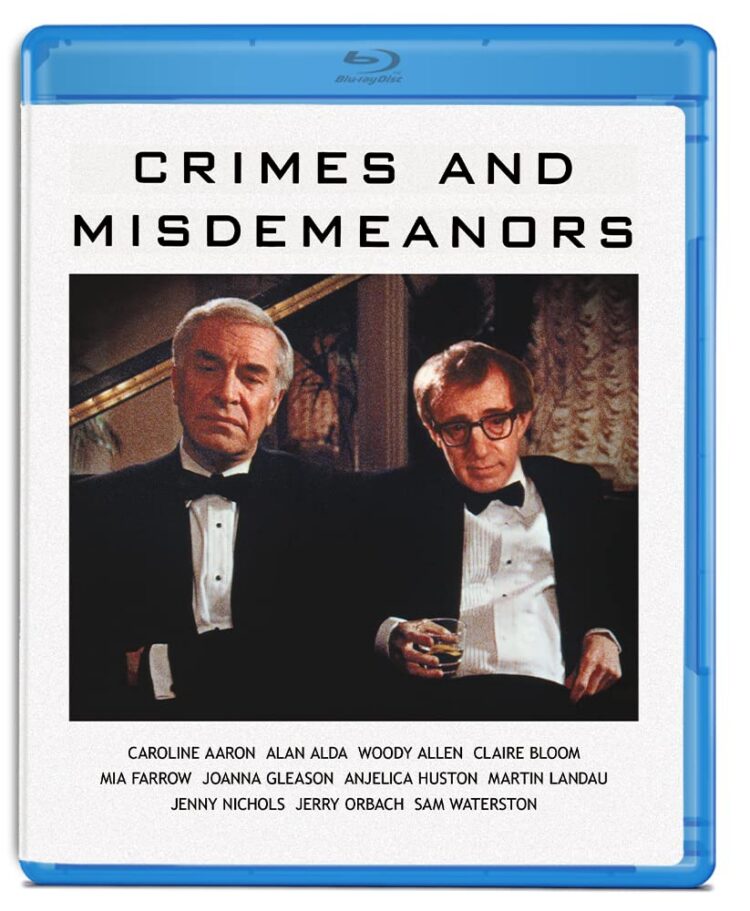
Woody Allen’s Crimes and Misdemeanors is one of his most serious and unsettling films. It is a dark comedy that uses murder, adultery, and moral compromise to examine a question far more disturbing than whether people are good or bad: What happens when there is no punishment for doing the wrong thing?
Buy Crimes and MisdemeanorsReleased in 1989, the film follows two very different men whose lives intersect. Judah Rosenthal (Martin Landau), is a respected ophthalmologist whose carefully constructed life begins to collapse when his mistress (Anjelica Huston) threatens to expose their affair. Faced with the possibility of losing his family, reputation, and professional standing, Judah considers a solution that initially seems unthinkable. At the same time, documentary filmmaker Cliff Stern (Woody Allen), struggles with his own professional and romantic disappointments. The two stories gradually converge, creating an unusually effective contrast between a man who commits an unforgivable act and a man who is obsessed with the moral failings of others.
Landau gives the film its emotional center. His performance captures Judah’s transformation from a frightened man contemplating a terrible act into someone forced to live with the consequences of having committed it. Most importantly, Allen refuses to give the character the conventional punishment that audiences might expect. Judah does not lose everything. Instead, he discovers that he can continue living a comfortable and apparently respectable life.
That is what makes Crimes and Misdemeanors so disturbing. The film rejects the reassuring idea that morality and justice are necessarily connected. Judah expects guilt to destroy him, but over time his conscience becomes quieter. The world around him continues almost exactly as before. Allen’s point is not that morality is meaningless, but that the universe does not necessarily enforce it.
The film’s comedy provides an important counterbalance to its darker material. Allen’s scenes involving Cliff, particularly his disastrous attempts to make a documentary about a despised relative, are genuinely funny. Yet the humor also reinforces the film’s central argument. Cliff is deeply concerned with justice and integrity, but those qualities do not make his life particularly successful. Judah, by contrast, makes an appalling moral choice and emerges from it with his life largely intact.
Allen also deserves credit for resisting easy answers. There are no climactic revelations in which justice arrives at the last moment, and there is no tidy moral lesson. Instead, Crimes and Misdemeanors leaves the audience with an uncomfortable possibility: people may construct their own morality largely because they need to believe that their actions have meaning, even when the world provides little evidence that they do.
The result is one of Allen’s most mature films. Crimes and Misdemeanors is funny without being lightweight, philosophical without becoming completely detached from its characters, and grim without becoming hopeless. Its central ideas about guilt, faith, morality and chance remain unsettling precisely because the film refuses to tell the audience that everything will ultimately work out.
More than three decades after its release, Crimes and Misdemeanors remains one of Woody Allen’s strongest films and one of his most entertaining examinations of human behavior. Its darkest insight is also its most memorable: sometimes the greatest punishment for doing wrong is simply having to live with it—and sometimes, disturbingly, even that punishment disappears.
