
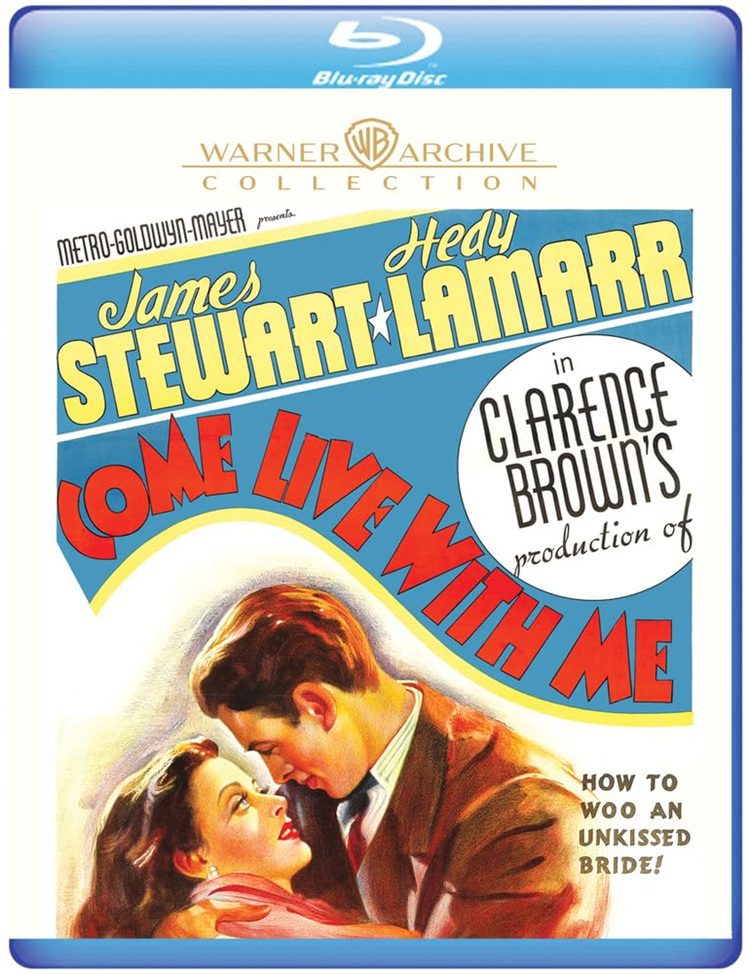
World War II-era films are fascinating to me. Especially those made in America before the USA entered the war. There were loads of war films made after Pearl Harbor and plenty of films that bordered on propaganda, designed to garner support for the war once we entered it. But the films that were made before we officially started to fight are fascinating in terms of what they say about this massive conflict happening overseas and what they don’t say.
Buy Come Live with Me from MovieZyngNaturally, a great many films didn’t say anything at all about the war. Movies are there to entertain, to make us forget the happenings in the real world, after all, but many movies found lots of different ways to talk about it. This is especially true as a great many actors, directors, producers, etc., started to flood into the United States, fleeing the war and persecution from the Nazis. Naturally, many of them (and many people across the country who had nothing to do with the movies) wanted the U.S. to enter the war and help defeat Germany. But it was complicated. There were political powers that didn’t want movies to push for the U.S. to enter the war; the general public wasn’t necessarily interested in getting involved in yet another war over in Europe. Making a pro-war film could get you into trouble. At the very least, it might bomb, making the studios lose a lot of money.
I’m not a film historian, so I might be getting in over my head here. I don’t know all the ins and outs of what Hollywood was doing after Hitler invaded Poland and before the Japanese bombed Pearl Harbor. But I do find it fascinating, and it always colors my viewing of films made during this period.
Come Live with Me was released in January of 1941, just months before the invasion of Pearl Harbor. War was certainly on the minds of the filmmakers. The plot involves a woman who has fled persecution in Europe and is about to be sent back to Austria by immigration forces, where she will almost certainly be executed. But the film never once mentions the war or the Nazis. The closest it gets is a line where she says she grew up in the country formerly known as Austria. Presumably, the audience watching this film in 1941 would understand she was fleeing the Nazis, but it is interesting to me that they never once get specific.
The woman is Johnny Jones, and she’s played by Hedy Lamarr. She left Vienna when her father was exterminated and has been living in New York. She’s actually quite comfortable there as she has some money, a nice apartment, and has been seeing a nice man named Barton Kendrick (Ian Hunter) who runs a publishing house. He’s also married. And not ready to ask his wife for a divorce. Her temporary visa expired three months ago.
A very nice immigration officer pays her a visit. He tells her she is to be deported, and wouldn’t it be nice if she showed up at the office tomorrow? He doesn’t recommend she try to run, but he doesn’t seem to be bothered by the idea. When Kendrick explains the situation to him, the officer suggests that she get married, as that would make her a U.S. citizen. He says he’ll pretend he still hasn’t found her for one week. If he comes back and she’s married, it’s all good; if not, he’ll have to deport her. It is impossible not to compare this interaction to what is currently happening with ICE. Yes, I know this is a movie and not real life, but we could all use a little of this movie magic right now.
Kendrick desperately wants to marry her, but there is no way he can get a divorce and marry her before the week is up. Even a quickie Reno divorce would take six weeks. Resigned to her fate, Johnny takes a walk. She randomly bumps into Bill Smith (James Stewart), a down-on-his-luck writer who has more rejection notices than books written and who is literally down to his last dime. When that gets stolen, Johnny hatches a plan. She’s got money, and Bill is unattached. He needs money, and she needs a husband. Why don’t they make a deal? Johnny reluctantly agrees, but he’s a proud man. He promises he’ll pay her back and breaks down how much money he’ll need to the very minimum – $17.80 per week. That will be just enough for him to survive on.
It will also give him time to start writing again. They say you should write what you know, so Bill starts writing about his current situation. He tells a tale of a woman in trouble who marries a man out of convenience. But then he can’t quite figure out what this woman does when she’s not dropping off the man’s weekly checks. That makes Bill wonder what Johnnie does when she’s on her own. That makes him want to get to know his wife a little better. But she has no interest in that. She has her own life. She’s with Kendrick.
But then circumstances change, and she finally has a chance to marry Kendrick. She asks Bill for a divorce. He says he’ll only do it if she’ll spend some time with him. For it is fine for two strangers to get married, but they ought to get to know each other before they divorce.
I don’t think it really counts as a spoiler to say they eventually fall in love. It is silly to complain about spoilers on an 80-year-old film, but even those watching it in 1941 weren’t surprised that James Stewart and Hedy Lamarr get together by the time the credits roll. The film never tries to get any real drama out of the situation. This is a very relaxed film. It isn’t all that funny either. There are a few good jokes, but they don’t come at you quickly. This isn’t a screwball comedy or a farce. I’d almost call it boring, but Stewart and Lamarr are so good together on screen, I was always interested in what was happening.
Still, it feels very slight. There just isn’t much to it. For me, it would be a solid three-star film, but then, right toward the end, they lean heavily into the romance angle. Smith quotes the Christopher Marlowe poem that lends the film its title, there is some delightful business about the mating rituals of lightning bugs, and they break the fourth wall in a very amusing way, and suddenly I’m completely sold on the film.
Buy Come Live with Me from AmazonWarner Archive presents Come Live with Me with a new 4K restoration from the original negative, and it looks beautiful. Extras include the short films America Preferred, From the Four Corners, and the cartoon Officer Pooch. The first two are propaganda pieces designed to stir up support for the war.
