
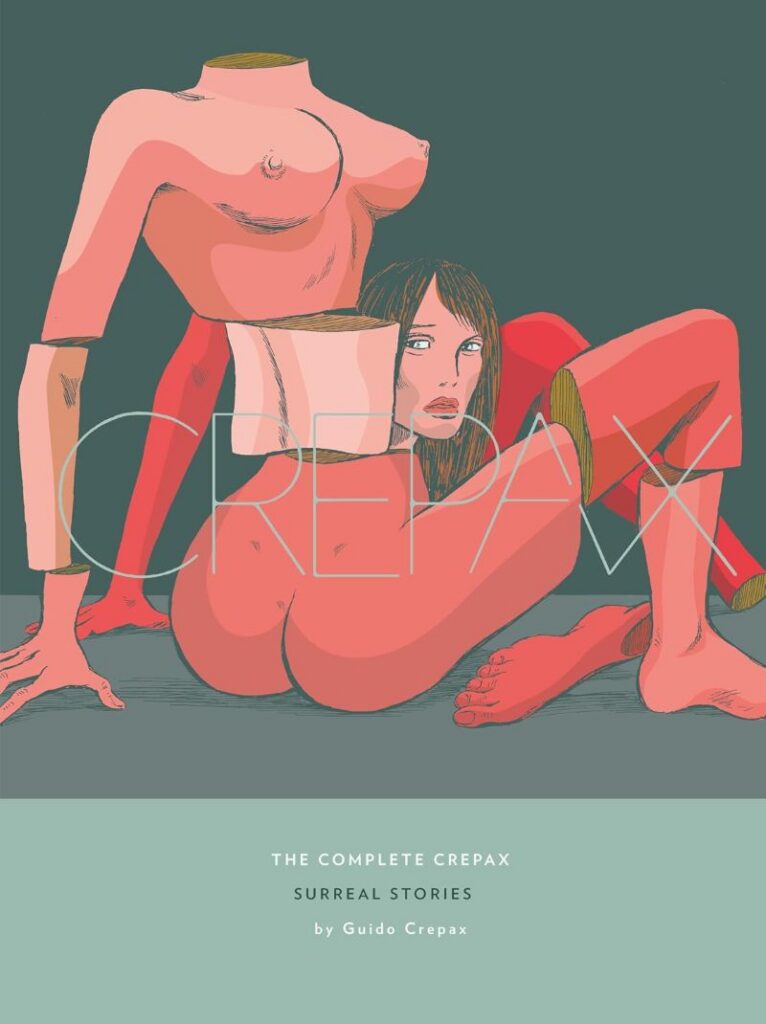
Legendary Italian cartoonist Guido Crepax will always be most closely associated with Valentina, his most famous character, but this volume shines a spotlight on another prominent creation, Bianca. Introduced as a 15-year-old schoolgirl in her debut, she embarks on a mindbending series of adventures crafted over more than two decades. Valentina also drops in briefly, along with Crepax himself in one story.
Buy The Complete Crepax: Surreal Stories: Volume 10The most surprising aspect of this volume’s stories is the expansiveness of the first installment. “Bianca: An Excessive Story” is an apt title, as the tale winds through over 200 pages, representing two thirds of the book’s comic pages. A rarity for its time, the story began in 1968 as a recurring feature in Kent, an Italian lad mag, before being expanded and collected as a standalone graphic novel in 1972. Crepax is in peak form here, with his immaculately supple line and imaginative page layouts offering free rein to Bianca’s unbridled imagination. After a brief introduction at her strict boarding school, the bulk of the tale takes flight into the realm of dreams, with Bianca drifting through sadistic misadventures spanning time and geography.
The dream setting allows Crepax to expose Bianca to all manner of degradations without reproach, as Bianca is shown to be a willing, unbothered participant fully aware of her role in mentally creating her decidedly risque fantasies. It also permits Crepax to abandon all pretense of narrative structure, with no discernible plot or logic to the dreams, with Bianca skipping wherever her stream of unconsciousness takes her next. A later return to the real world attempts to explain how her mistreatment in the boarding school affects her dream scenarios, but the majority of the tale is simply Crepax free associating sexy situations for his nubile star.
The book’s most notable other entry is Crepax’s take on Gulliver’s Travels, here spread across four installments with Bianca cast as a futuristic astronaut who experiences similar adventures on other planets. The plot shows some discipline and structure, even as Bianca’s real-world exploits periodically venture into predictably lascivious directions. Next are two more adaptations: very brief takes on Bergman’s Persona and Fellini’s 8 ½, with Valentina sharing the page with Bianca in both. Crepax appears as himself in the latter, cast as a version of Mastroianni’s director character as he questions his sentimentality and possible artistic repetitiveness in his later years. It’s a brave moment of introspection from the master, even if it’s framed by the film’s plot. However, both film adaptations amount to just that, moments, as they only add up to a few pages each.
The final two brief oddities star Valentina, first in a wordless exploitation dream sequence and then in a “fashion dream” that finds her wandering nude through surreal pages filled with fanciful fashions as she determines that her own skin is her favorite attire. Aside from the final full-color dream, all of the stories are rendered in Crepax’s typical black and white. The book is rounded out by an informative introduction, a collection of scholarly essays about each of the stories, and a biography.
There’s simply no other creator like Crepax, and this series continues to amaze with its sumptuous, oversized presentation of his singular works. As with prior volumes, the stories are presented thematically, not chronologically. While this volume’s stated theme is “Surreal Stories,” and the brazenly bizarre contents certainly qualify, the more obvious theme is Bianca herself, a secondary light to Valentina but a memorable star in her own right.
