
Arguably the greatest humor magazine of the 20th Century, EC Comics’ MAD was such a success it led to many imitators, as seen in The Sincerest Form of Parody. The most notable publisher who tried to capitalize was EC Comics itself. Panic, the “only authorized imitation,” ran for 12 issues from February 1954 to October 1955. Edited by Al Feldstein, who would go on to become MAD‘s editor in 1956 after creator Harvey Kurtzman and publisher William Gaines parted ways, Panic caused friction between within them with Gaines seeing it as a pragmatic business opportunity while Kurtzman was annoyed that Feldstein “just plundered all of my techniques and artists,” as legend has it.
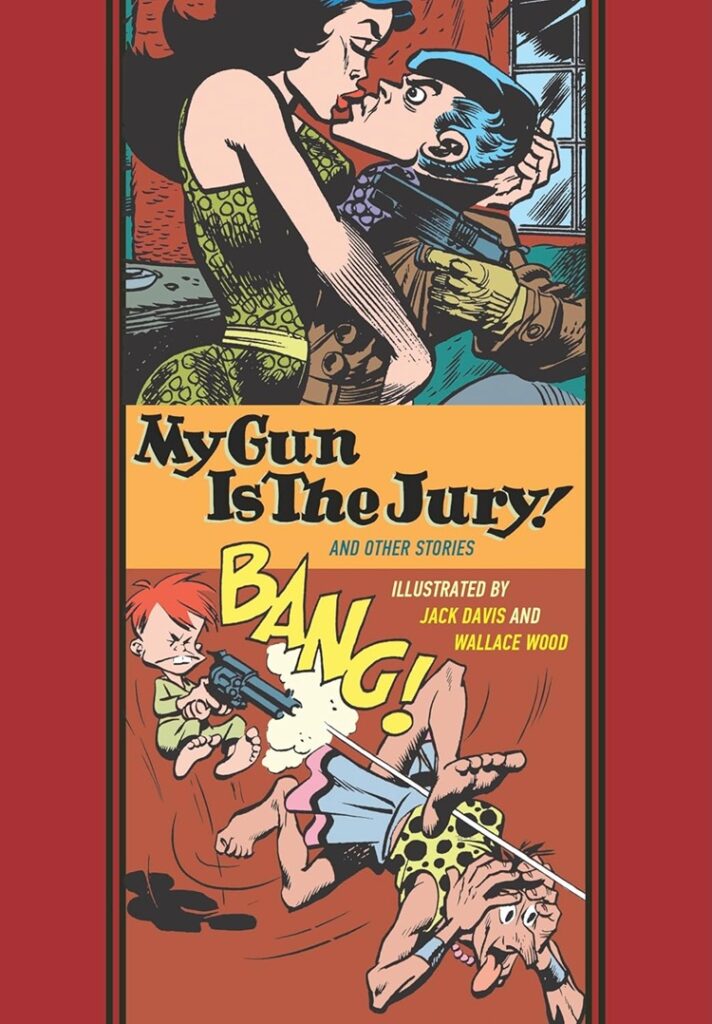
Buy My Gun Is the Jury!…Two of those artists were Jack Davis and Wallace Wood, and their complete Panic stories have been collected by Fantagraphics in My Gun Is the Jury! and Other Stories. The book opens with 16 stories featuring artwork by Davis followed by 11 stories by Wood, including “V-Vampires!,” which was initially created in 3-D and is now available in 2-D “for the first time after 70 years.”
“My Gun Is the Jury!,” which appeared in Panic #1, is notable, according to Thommy Burns and Jon Gothold in their Introduction, for “the distinction of being EC’s first parody of current literature.” It is also notable for getting EC secretary Shirley Norris was arrested after selling what was deemed as indecent literature to a pair of New York City cops. “My Gun…” is a riff on Mike Hammer’s Mickey Spillane, a popular private eye of pulp novels.
The Introduction is invaluable not just for the EC anecdotes but also the annotations. As a Gen X-er many of the references are familiar to me, from the aforementioned Hammer and the plays riffed on in “Come Back, Little Street Car!” but I had no idea who and what was specifically being referenced in the game show spoof in “Strike It Richly!” and its host Worryin’ Hulk. Turns out it was the radio/TV program Strike It Rich and its host Warren Hull, but one needn’t know the specific targets as the humor in Feldstein’s script proves timeless because modern media continues to exploit those who attempt to use it for fame and fortune.
In addition to stories drawn by Davis, there’s a series of pages that play with the jargon from four sports, which is reminiscent of Tex Avery’s cartoon that feature rapid-fire word gags, and “Popular Mecpanics,” a magazine spoof that includes “ads, letters page, classified ads, and news items.” His art features overly expressive characters and panels packed with details. He also gets to play with the styles of classic painters when “Panic Peeks into Some Old Under Paints.”
Wood’s assignments for Panic are almost all movie parodies. His caricatures of Hollywood stars are quite good and stay consistent throughout and across stories. The latter is apparent in two John Wayne movie parodies, “The Quite-A-Man” and “Hindu.” However, I didn’t recognize Jimmy Stewart in “’S a Tragic Air Command.” In addition to the actors, Wood captures setting/location details to further evoke the movies.
My Gun then segues to Wood’s early work at EC on romance and western comics where he was paired with artist Harry Harrison, both inking Harrison’s penciling and sharing the tasks. Gothold returns with another appreciated Introduction for background on these melodramatic stories. The book concludes with a gallery of EC ads, creator biographies, and an essay about EC Comics by Ted White.
My Gun Is the Jury! and Other Stories presents a well-deserved focus on the artistry of Jack Davis and Wallace Wood which shows it takes serious skills to make silly drawing. Kudos to Fantagraphics for preserving this hysterical, historical work.
