
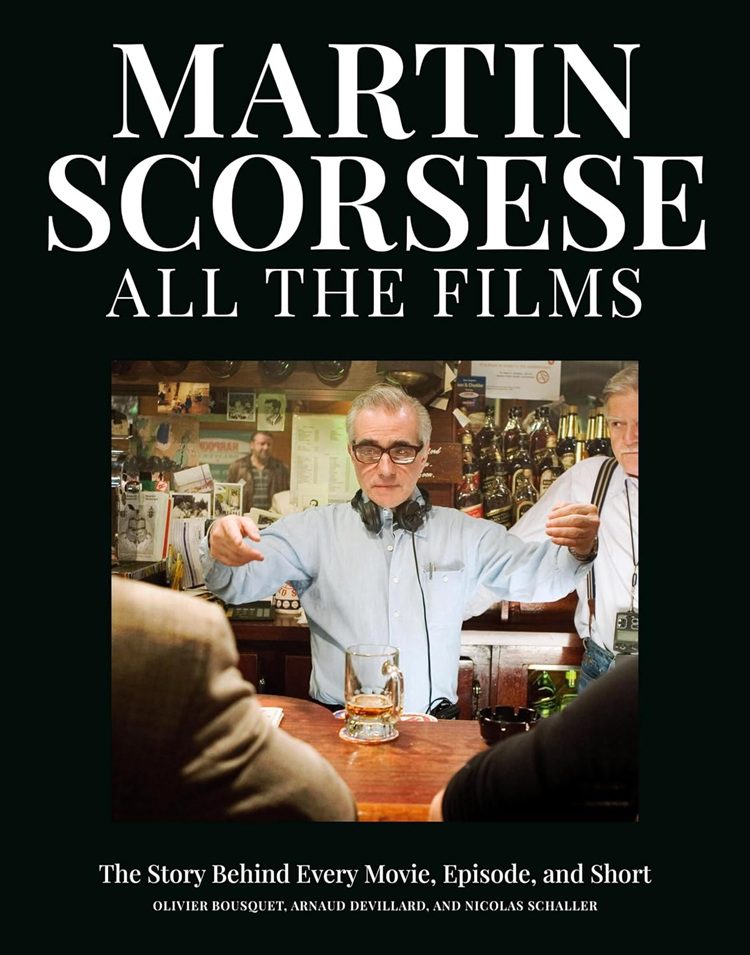
At nearly 2 inches thick, weighing over 4 ½ pounds, and coming in just over 500 pages, Martin Scorsese: All the Films looks like a college textbook. That may sound daunting, but in actuality it’s inviting for those who want to immerse themselves in Scorsese’s filmography. The book presents readers an overview of 50 years of Scorsese’s filmmaking career, starting with “What’s a Nice Girl like You Doing in a Place like This?” (1963), a short he made while he attending New York University’s Tisch School of the Arts, through to his 10-time Oscar-nominated Killers of the Flower Moon (2023). In total, it covers 26 feature films, 17 documentary films, 7 short films, and 4 television episodes.
Buy Martin Scorsese: All the FilmsThe book opens with “Martin before Scorsese 1942-1972,” listing pivotal events like journal entries: the births of his mother Catherine (April 16, 1912) and father Charles (May 8, 1913); seeing his first film in a theater, Duel in the Sun at four years old with his mother (May 8, 1947); and hearing the Rollins Stones’ “(I Can’t Get No) Satisfaction” in the car (1965). It also makes mention his amateur filmmaking and meeting collaborators.
All the Films is broken down by decade, with a specific color used for each one on the pages. Then each project is covered, listing production details, such as dates and credits, and covering topics such as how it originated (“Genesis”), how it was made (“Film and Production”), and how it was received (“Reception”). “Where’s Marty?” details his cameo and trivia is provided “For Scorsese Addicts.”
The authors do a great job with their research, incorporating well-known anecdotes with lesser-known tales that better fleshes out the history to readers. For example with Mean Streets, they tell the famous story about Scorsese showing Boxcar Bertha to director John Cassavetes who told him, “You spent a year of your life making a piece of shit,” which inspired him to make this more personal film, one that he claims not to have realized until “twenty years later[ that] the relationship between Charlie and Johnny Boy was rooted in the one between his father Charles and his uncle Joe,” which seems odd considering Scorsese co-wrote the screenplay.
The authors also reveal how Mean Streets almost became a different film. Producer Roger Corman offered $150,000 if Scorsese would “transpose the action to the Black community to ride the blaxploitation wave that was all the rage.” The producers wanted Jon Voight, Oscar nominated for Midnight Express, to star rather than unknown Harvey Keitel. It’s not clear why “Voight was reluctant to show his face,” as the authors state, nor why he eventually passed on the role, but the lack of detail makes one wonder if someone of Italian persuasion from Marty’s neighborhood got involved.
In addition to specific projects, the book features writing that approaches his filmography from an overview, not limiting itself to the decade it appears. “Portraits” covers four of his most important collaborators; actors Keitel, Robert De Niro, and Leonardo DiCaprio and screenwriter Paul Scharder. “Focus” turns the book’s lens to what was going on away from the sets. “The Movie Brats” is a term applied to filmmakers of “New Hollywood” who were stepping in as the studio system was collapsing. “Marty Business” covers how Scorsese became “a brand in [his] own right” in the 21 century, appearing in commercials and other people’s films. “Motifs” shows Scorsese’s repeated use of visual ideas. For “Hell’s Kitchen,” it describes “a screen filled with flames or bathed in a red halo.” Then goes on to list examples, like his use of fire in Casino, The Aviator, and Shutter Island followed by pictures from various films.
In his Foreword, French filmmaker Nicolas Saada states, “Today, [Martin] Scorsese is one of the most revered filmmakers in the world,” a sentiment I agree with. And although the title of this book is already inaccurate as the director is currently in post-production on his 27th feature, What Happens at Night, that doesn’t make Martin Scorsese: All the Films any less of a great read or of being a valuable resource. It’s a must have for Scorsese addicts.
