
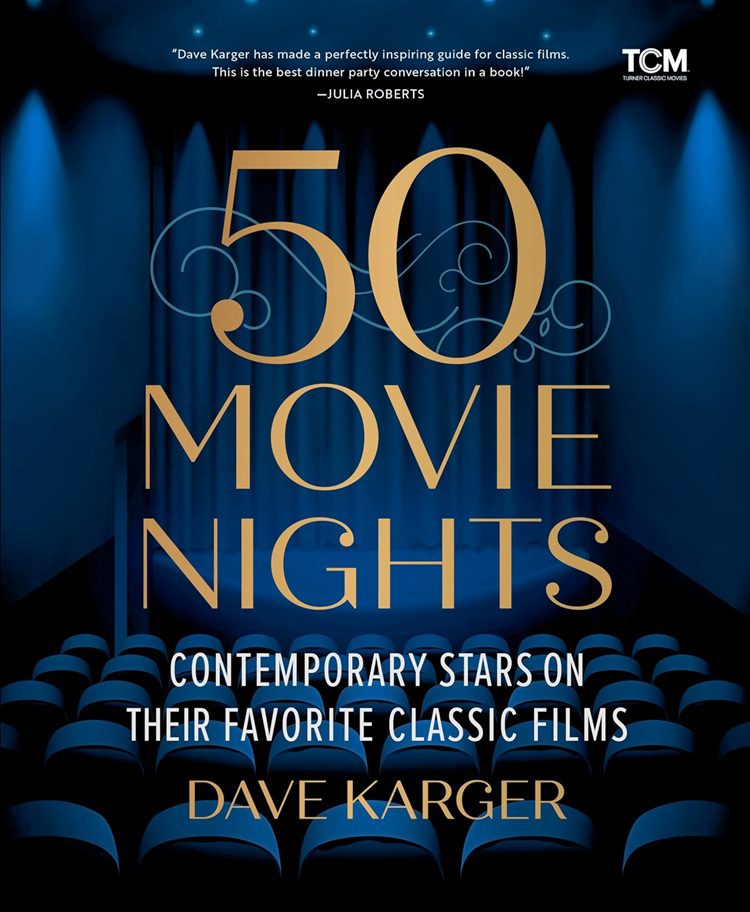
TCM host and entertainment journalist Dave Karger follows up his 50 Oscar Nights where he spoke with 50 Oscar winners about “a momentous night in their show-business careers” with 50 Movie Nights where he speaks with actors and other celebrities about “that one film – the movie that simply is the most meaningful to them.”
Buy 50 Movie NightsIn the Introduction, Karger reveals that film for him is Children of a Lesser God (1986), which he saw “on cable TV in 1987, when [he] was fourteen years old.” He also explains he “gave the subjects no parameters other than that their choices had to be from the twentieth century,” so Andy Cohen’s selection of Almost Famous (2000) just makes the cut. At the other end, John Slattery’s pick of Leo The Awful Truth (1937) is the earliest selection. That may disappoint fans of pre-Code and silent movies initially, but whether one likes the movie selection or doesn’t, or doesn’t even know it, the stories told about the movie and the subject’s relation to it are compelling.
The entries don’t seem to be organized in any particular order, so it starts with Scarlett Johansson and her choice of Easter Parade (1948). After Karger provides a brief introduction of the actress, Johansson talks about how “when [she] was a kid, the movies [she] watched were the movies [her mother] watched when she was a kid.” As someone who also started in the business as a child actress, it’s interesting to read her appreciation of Judy Garland being “allowed to be a grown woman in [Easter Parade]” in contrast to other films like Meet Me in St. Louis (1944), which is fashion designer Bob Mackie’s pick, and The Wizard of Oz (1939), which is Molly Shannon’s pick’s). She also raves about Fred Astaire, Ann Miller, and the scenes she loves. The chapter concludes with “When to Watch,” listing certain times from “somebody who is feeling terrible…and needs to fall in love with something.”
Working through the book, it’s clear it’s not just a movie but also familial connections made with movies that make them so impactful in one’s life. Jason Bateman, Anderson Cooper, and Sterling K. Brown mention their fathers in relation to movies almost immediately. For Carol Burnett, she first saw Singin’ in the Rain (1952) with her grandmother at a second-run theater and showed it to her “grandson when he twelve or thirteen.” When Paul Rudd’s grandparents came to visit, he asked “What movie did they show on the plane?” For director Ava DuVarney, “movies were a way to bond with [her] aunt Denise.”
Naturally, classic films are named, such as Kathryn Han picking It’s a Wonderful Life (1946) and Bryan Cranston picking High Noon (1952), but it’s the unexpected selections I most appreciated, from Laura Linney naming raunchy sports comedy Slap Shot (1977) to international choices like The Battle of Algiers (1966) by Don Cheadle.
The book closes with Sarah Jessica Parker choosing The Way We Were (1973), which helps explain why her Sex in the City character Carrie Bradshaw quotes the movie at the end of Season Two when she tells her ex-boyfriend, “Your girl is lovely, Hubbell.”
50 Movie Nights is a delightful book for those that love movies and love to talk about them.
