
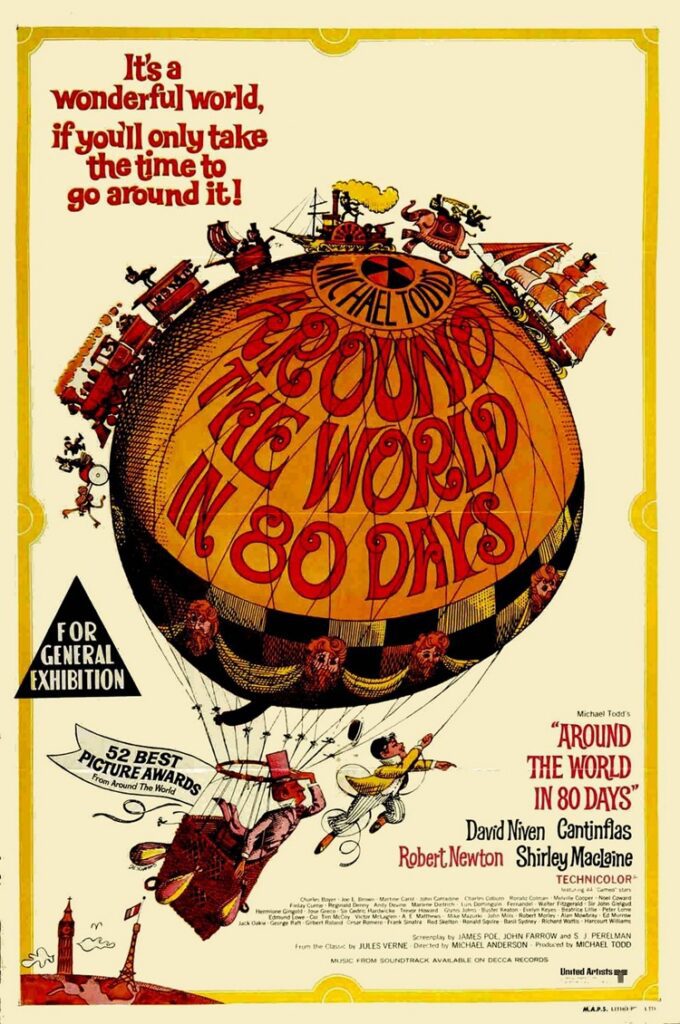
If you ever wondered what would happen if Hollywood decided that a Jules Verne adventure needs to be approximately the size of Rhode Island, Around the World in 80 Days has the answer. Producer Mike Todd’s 1956 adaptation of the classic novel, directed by Michael Anderson, is an absolutely gigantic movie. David Niven plays Phileas Fogg, the proper English gentleman who bets that he can travel around the world in 80 days, while Cantinflas plays his valet, Passepartout, who spends much of the trip wondering what in the hell he’s gotten himself into. They board trains, ships, elephants, and even a hot-air balloon while encountering one obstacle after another.
Buy Around the World in Eighty Days (Deluxe Hardbound Edition)And then there are the cameos. Good lord, the cameos. Frank Sinatra shows up. John Carradine shows up. Buster Keaton shows up. Charles Coburn shows up. Marlene Dietrich shows up. There is also a young Shirley MacLaine. At times, it feels less like watching a movie than watching Mike Todd empty his Rolodex onto the screen. Any next stop on the journey could easily be Bob Hope’s living room.
Some of this is genuinely spectacular. The production is lavish, the cinematography is gorgeous, and there is a real sense of adventure in watching Fogg’s journey unfold. Niven is also perfectly cast. He plays Fogg with such dry, unshakable dignity that the increasingly ridiculous circumstances surrounding him become even funnier. Cantinflas, meanwhile, gets most of the physical comedy and is often the liveliest person on screen.
The problem is that Around the World in 80 Days is simply too much movie. It runs close to three hours, and every one of those minutes can be felt. The episodic structure means that some sections are a lot more entertaining than others, and the movie occasionally seems to confuse spectacle with momentum.
Still, this beast won Best Picture. Not just a nomination: it won. At the 1957 Academy Awards, it took home five Oscars, and beat out Giant, The King and I, The Ten Commandments, and Friendly Persuasion. The trophy may be debatable, but the movie’s appeal is easy to understand. This is 1950s Hollywood putting on the biggest show it can possibly put on, and there’s something wonderfully shameless about that.
The movie is also a useful reminder that spectacle doesn’t necessarily age as badly as expected. Sure, some of the pacing is glacial, and some of the comedy belongs firmly to another era, but the sheer scale of the production remains impressive. There are moments when the movie practically shouts, “Look at this!” And there is plenty to look at. The movie just occasionally makes the audience check the clock, too.
Around the World in 80 Days isn’t a masterpiece, despite that Best Picture Oscar. It’s an oversized, old-fashioned adventure with plenty of charm, some terrific performances, beautiful photography, and enough celebrity cameos to populate its own sequel. It takes far too long to get around the world, but at its best, it’s a pretty entertaining trip. Just pack a lunch.
