
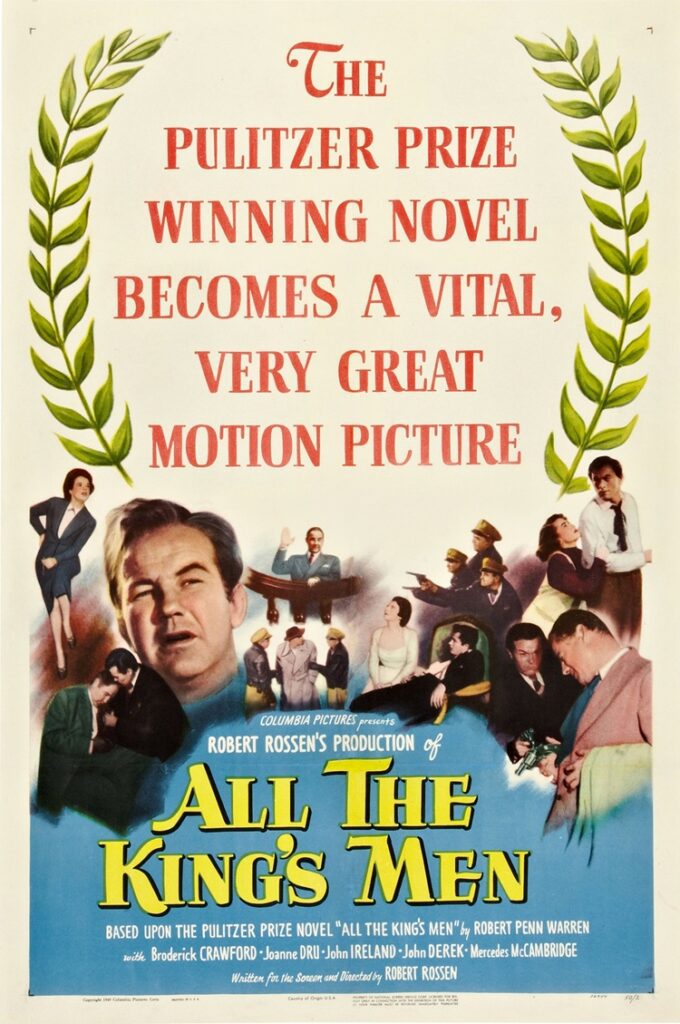
Robert Rossen’s All the King’s Men is a penetrating examination of political ambition, corruption, and the dangerous consequences of power. Adapted from Robert Penn Warren’s Pulitzer Prize-winning novel, the film follows the rise of Willie Stark, an idealistic country lawyer whose crusade against a corrupt political establishment gradually transforms him into the very thing he once opposed. Winner of the Academy Award for Best Picture, this compelling drama remains a powerful portrait of American politics and the compromises that accompany success.
Buy All the King’s MenWillie Stark (Broderick Crawford) begins his political career as an honest, unassuming man determined to improve the lives of ordinary citizens. When the established political machinery manipulates him for its own purposes, he becomes a pawn in a larger game. However, Stark soon discovers that his ability to connect with the common people gives him a formidable weapon. Armed with populist rhetoric and an increasingly ruthless approach to his opponents, he rises to become governor of his unnamed state.
The film chronicles Stark’s transformation through the eyes of Jack Burden (John Ireland), a politically connected journalist who becomes an increasingly uneasy member of the governor’s inner circle. Burden’s involvement offers a fascinating perspective on the moral compromises made by those who benefit from Stark’s power while recognizing its destructive consequences.
Crawford delivers a tremendous performance as Stark, capturing both the character’s magnetic appeal and his growing appetite for control. His imposing physical presence and booming delivery make him a natural political force, but the actor also reveals the insecurity and desperation beneath the bluster. Stark’s transformation is not simply a matter of becoming corrupt. It is a gradual erosion of the principles that once defined him, making his eventual downfall all the more tragic.
The supporting cast is equally impressive. Mercedes McCambridge brings considerable intensity to Sadie Burke, Stark’s fiercely loyal political associate, whose devotion becomes increasingly complicated by her feelings for him. Joanne Dru provides a compelling counterpoint as Anne Stanton, whose relationship with Burden and involvement with Stark expose the personal costs of political ambition. Meanwhile, Ireland offers an effective portrayal of a man struggling to reconcile his journalistic integrity with his own complicity.
Rossen’s direction gives the film a gritty, documentary-like atmosphere that enhances its realism. The stark black-and-white cinematography and shadowy compositions reinforce the moral ambiguity of the story, while the brisk pacing keeps the sprawling political narrative engaging. Rather than presenting corruption as an isolated failing, the film examines how it spreads through institutions and relationships, gradually compromising everyone involved.
Although All the King’s Men was released more than seven decades ago, its depiction of political manipulation, populist appeals, and the abuse of power remains remarkably relevant. Stark’s ability to exploit public frustration while presenting himself as a champion of the people feels particularly unsettling. The film recognizes that corruption rarely begins with a villain announcing his intentions. More often, it begins with good intentions and a willingness to make just one more compromise.
All the King’s Men is a powerful, absorbing drama that balances political intrigue with a deeply human story of ambition and moral decline. Its performances, direction, and incisive examination of power make it one of the most enduring Best Picture winners. Rossen’s film serves as a reminder that the greatest danger of political power may be how easily those who possess it convince themselves they are using it for the greater good.
