
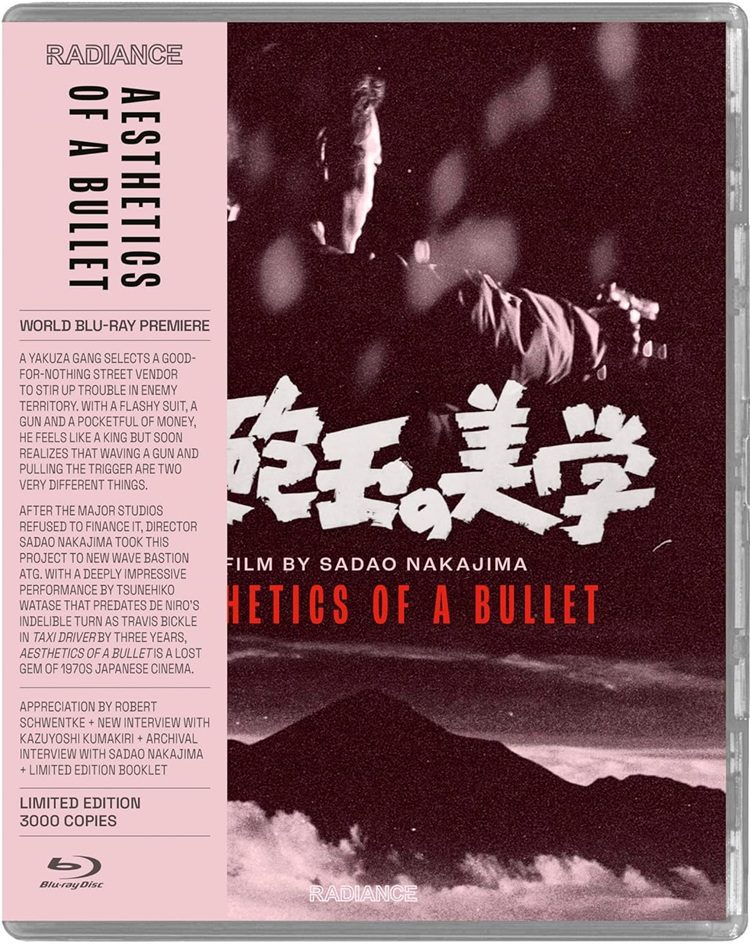
Kiyoshi Koike (Tsunehiko Wasabe) is a schmuck. A big time loser. He used to be a chef, but now he finds himself out on the street trying to sell some pet rabbits to anyone buying. No one is buying. He’s a terrible salesman. While playing mahjong with some friends (losing, badly), one of them tells him he should dump the rabbits and get some dogs. A well-bred dog could have puppies, and he’d make a fortune.
Buy Aesthetics of a BulletHe borrows some money from his sex-worker girlfriend to pay off his gambling debt, but she balks when he asks for more to buy those dogs. She says he is unlucky, that he could never make the dog thing work. She gets a beatdown for that.
Then he gets a phone call. It’s from a yakuza boss. He offers Koyoshi a lot of money and a gun to go into a rival clan’s territory, make a splashy appearance, and shoot his gun off a few times. The boss is a little vague as to why, but Kiyoshi gladly accepts. He gets a nice haircut, buys some fancy suits, and rehearses how he’s going to introduce himself.
He completely reinvents himself. He is the epitome of the mantra, “Fake it until you make it.” He rolls into various nightclubs announcing who he is and who he is with. He insults the clan’s members. At one point he gives a yakuza soldier a beat down. But instead of retaliating, the boss apologizes and gives Koyoshi a knife, telling him he doesn’t care what he does to that soldier.
But here’s the thing. The reason Kiyoshi was given all that money and a gun was because they want him to be a bullet. That is to say, they want him to announce who he is, making a complete ass of himself, and then firing a round off into a wall or something. This will cause the rival gang to kill him, and that will give Kiyoshi’s bosses an excuse for war. A war in which they are sure to win and thus will allow them to take over a new territory.
It isn’t quite clear if Kiyoshi truly understands this or not. But he doesn’t kill that soldier. Instead, he runs and hides out. He does seem to understand he doesn’t have much time left. He becomes increasingly desperate. And strange. And violent. He meets a girl (Miki Sugimoto) who may have been sent to him to keep an eye on him. She’s willing to do anything for him, but he never seems happy. When she has sex with him (and she has sex with him a lot), he just looks angry. Grunting without an ounce of pleasure on his face. Increasingly, he’ll mistreat her, and on their last night together he’ll make her get on all fours and bark like a dog.
At some point, he comes across a woman being gang-raped by three men. He yells at them. Starts a fight with them and brandishes his gun. But he doesn’t really seem that interested in saving the girl, just showing off to the boys. Later, he’ll come across that girl again only to give her some abuse.
Kiyoshi is not a good guy. Honestly, it was a bit hard watching him as the protagonist through this entire film. And the movie doesn’t make him exciting to watch like Henry Hill in Goodfellas or Walter White in Breaking Bad.
The filmmaking is interesting. It starts with a bang. Loud punk music plays over the soundtrack while a montage of images is thrown at us. There are extreme close-ups of people shoving food into their mouths – sauce and cream sticking to their faces. Then we’ll see garbage being shoved into a chute. And then it cuts to a live sex show. Consumerism at its finest. It is punk rock as hell.
The whole movie has a punk attitude. It is angry and passionate. It is loosely structured and haphazardly put together. I dug its energy, but I can’t say I enjoyed it. I had a hard time understanding what was happening half the time. And I never quite understood the why. It is a character study of an awful human who even fails at being interesting.
Radiance Films presents Aesthetics of a Bullet with a nice looking transfer. Extras include the following:
- Newly filmed appreciation by filmmaker Robert Schwentke
- New interview with filmmaker Kazuyoshi Kumakiri
- Archival interview with Sadao Nakajima
- Trailer
- Newly improved English subtitle translation
- Reversible sleeve featuring designs based on original posters
- Limited edition booklet featuring new writing by Olaf Möller and an archival essay on the film
- Limited edition of 3000 copies, presented in full-height Scanavo packaging with a removable OBI strip, leaving packaging free of certificates and markings.
That appreciation by Robert Schwentke is worth watching. He dives deep into the film, the director, and how it fits into Japanese cinema.
While this film didn’t really work for me, this release is a good one and if you are at all interested in the film, this is well worth the purchase.
