
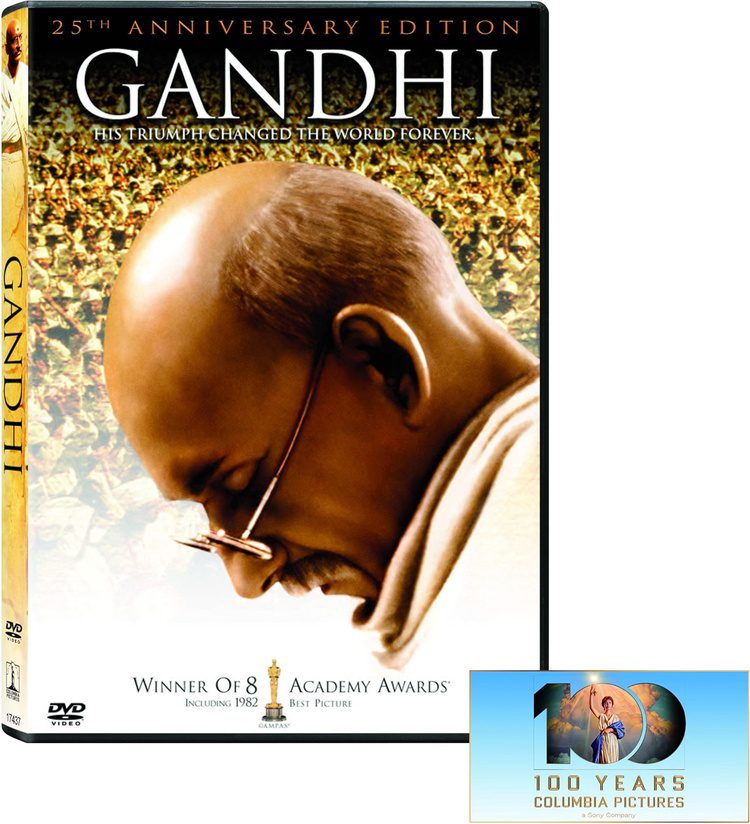
Making a movie about a man who helped change the course of history is no small undertaking. Making one that runs more than three hours without feeling like a history textbook come to life is an even greater challenge. Richard Attenborough’s Gandhi (1982) manages the first feat admirably, even if the second proves a little more elusive.
Buy GandhiBeginning with his early experiences in South Africa, where he first developed his philosophy of nonviolent resistance, the film follows Mohandas K. Gandhi’s emergence as the central figure in India’s struggle for independence from British rule. Along the way, it chronicles his growing influence, his willingness to endure imprisonment and personal hardship, and his determination to pursue freedom without resorting to violence. It is an extraordinary life, and the film gives it an appropriately expansive treatment.
Ben Kingsley delivers a remarkable performance in the title role. His physical transformation is striking, but the real accomplishment lies in the way he captures Gandhi’s quiet conviction, stubbornness, humor, and humanity. Rather than presenting him as an untouchable saint, Kingsley gives us a man whose strength comes from an almost unfathomable commitment to his principles. It’s a performance that anchors the entire production and makes Gandhi’s extraordinary influence understandable.
Attenborough surrounds Kingsley with an impressive supporting cast, including Rohini Hattangadi as Kasturba Gandhi, Roshan Seth as Jawaharlal Nehru, and Martin Sheen as journalist Vince Walker, a fictional character representing the Western press. The enormous ensemble helps convey the international scope of the story, while the production’s attention to historical detail gives the proceedings considerable weight.
The film’s greatest strength is also, occasionally, its greatest weakness. At more than three hours, Gandhi covers an enormous amount of ground, and its episodic structure can make the narrative feel somewhat disconnected. Important historical developments sometimes arrive in rapid succession, while other stretches linger longer than necessary. The sheer number of characters and political developments can also make it difficult to maintain an emotional connection to everything unfolding onscreen.
Still, there is no denying the power of the material. The film’s depiction of the massacre at Amritsar is particularly devastating, and its enormous funeral sequence is an astonishing piece of filmmaking. Attenborough also deserves credit for resisting the temptation to turn Gandhi into a conventional cinematic hero. His commitment to nonviolence was not always popular, even among those fighting for Indian independence, and the film acknowledges the disagreements and frustrations that accompanied his leadership.
Gandhi received 11 Academy Award nominations and won eight, including Best Picture, Best Director for Attenborough, and Best Actor for Kingsley. The recognition was well deserved. This is an ambitious, beautifully mounted production that succeeds in bringing a remarkable historical figure to the screen without entirely losing sight of the complicated world around him.
A little trimming might have made the journey more engaging, but the film’s achievements far outweigh its shortcomings. Nearly four decades after its release, Gandhi remains an impressive cinematic portrait of a man who demonstrated that the pursuit of justice doesn’t always require a fist. Sometimes, it requires considerably more courage to keep your hands open.
