
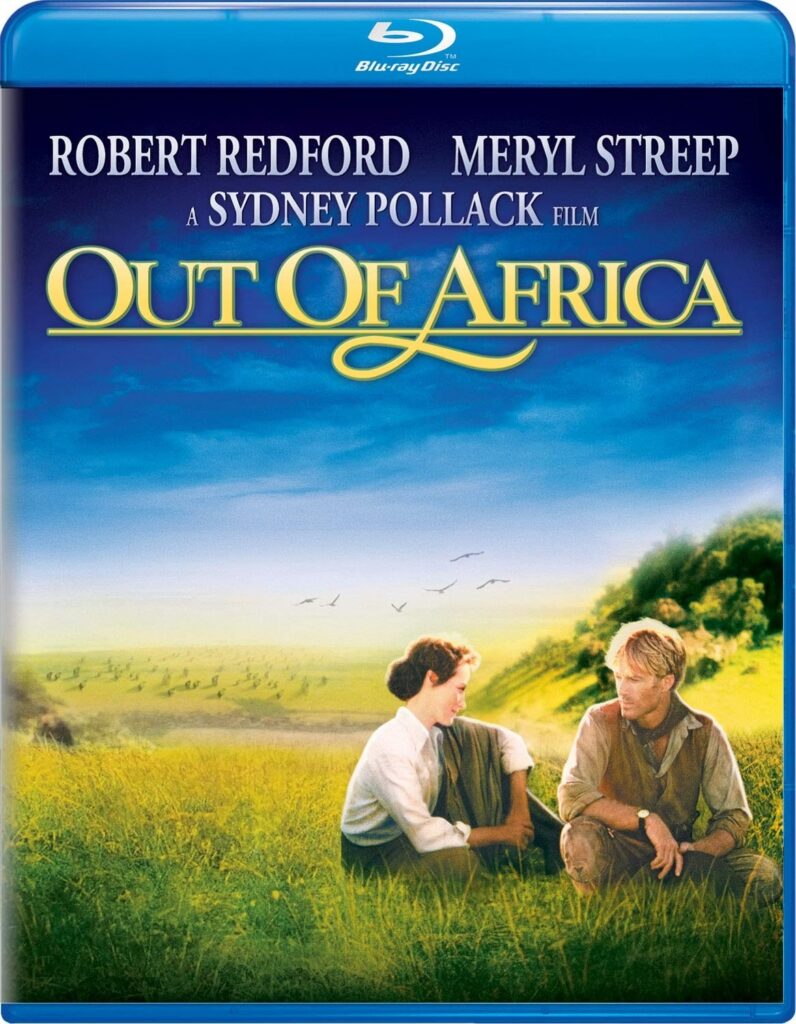
There are movies that sweep audiences off their feet, and then there are movies that sweep them across the African savanna for nearly three hours. Out of Africa, Sydney Pollack’s 1985 adaptation of Isak Dinesen’s autobiographical writings, is certainly an impressive cinematic undertaking. With breathtaking scenery, an evocative musical score, and two major stars at the center of its romantic drama, the film has all the ingredients of an epic. Whether those ingredients add up to an equally compelling movie is another matter.
Buy Out of AfricaMeryl Streep stars as Karen Blixen, a Danish woman who travels to colonial Kenya in 1913 to marry Baron Bror von Blixen-Finecke (Klaus Maria Brandauer). The couple establishes a coffee plantation near Nairobi, but their marriage proves unsuccessful. Karen eventually finds herself drawn to Denys Finch Hatton (Robert Redford), a British big-game hunter whose restless spirit and reluctance to embrace domestic life complicate their relationship. As Karen attempts to build a life in an unfamiliar country, she faces the challenges of running a plantation, navigating colonial society, and loving a man who values his independence above almost everything else.
The first thing that stands out about Out of Africa is its extraordinary visual presentation. Cinematographer David Watkin captures Kenya in all its natural splendor, from expansive grasslands to spectacular sunsets. The film frequently pauses to admire its surroundings, and who can blame it? There are moments when the scenery threatens to become the movie’s leading character.
John Barry’s Academy Award-winning score is equally effective. Its sweeping romantic themes complement the images beautifully, creating an atmosphere of longing and melancholy. The music is so memorable that it occasionally does some of the emotional heavy lifting the screenplay struggles to accomplish.
Streep delivers another impressive performance, bringing intelligence, determination, and vulnerability to Karen. Her character undergoes considerable changes as she confronts disappointment in her marriage and develops feelings for Denys. Klaus Maria Brandauer is also excellent as Bror, portraying a complicated man whose charm doesn’t always translate into admirable behavior.
Redford, meanwhile, is perfectly pleasant as Denys, although the character never becomes quite as fascinating as the film seems to believe. His reluctance to settle down is presented as an appealing expression of freedom, but it can also make him seem emotionally unavailable and frustratingly self-absorbed. The romance between him and Karen has its moments, but the chemistry doesn’t always justify the grand emotional declarations surrounding it.
Perhaps the film’s greatest weakness is its leisurely approach to storytelling. At nearly three hours, Out of Africa has plenty of time to develop its characters, yet much of its narrative feels surprisingly episodic. Relationships develop, hardships arise, and scenes come and go, but the film occasionally seems more interested in preserving its atmosphere than advancing its story.
Still, there is something undeniably appealing about Out of Africa. Its craftsmanship is exceptional, its central performances are strong, and its willingness to take its time gives the story a sense of scale. Even when the narrative loses momentum, there is usually something lovely to look at or listen to.
The film received 11 Academy Award nominations and won seven, including Best Picture and Best Director for Pollack. Its success is understandable. This is filmmaking on an ambitious scale, with technical accomplishments that are difficult to dismiss.
Ultimately, Out of Africa is easier to admire than to love. Its visual splendor and musical grandeur occasionally disguise a rather ordinary romantic drama, but they also make it an experience worth having. A little less scenery and a little more storytelling might have made it a masterpiece. As it stands, it’s a beautiful journey that takes a long time to get somewhere.
