

This Michigan football season is tiring.
Pop Culture Ephemera
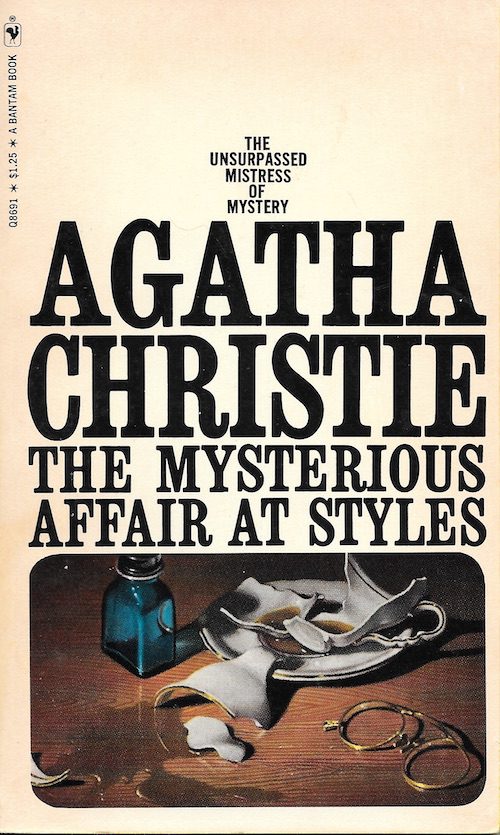
- Agatha Christie – The Mysterious Affair at Styles (1920) (Published by Bantam Books): “Instinct is a marvelous thing. It can neither be explained nor ignored.” I finally got around to Agatha’s first novel and the debut of Hercule Poirot. She sets forth elements of the detective novel that she will still be exploring 55 years later. There is a death from poisoning, there’s a conflict over the will, and there’s the Christie invented “parlor gathering” where Poirot explains everything. This is a decent mystery, but I’m glad it wasn’t my first novel of hers to read. There are more red herrings than in the average story later in her career, but all of the clues that you would need are present. I found the relationship between Poirot and Hastings to be a little more strained than I was used to, even in stories written later this same year. Hastings is still a work in-progress early on, but Poirot has all of the characteristics that would expanded in future stories. I don’t recommend starting with this beginning story (which is unusual if you know me), but once you get a feel for the characters, the story is fun.
- Tommy and Tuppence – “Episode 5” (Britbox) (S.1 E.5) (2026): “Am I really too late?” – Tuppence. The third of the three two-episode stories is more loaded with subtext after the ending of the last episode. The two are having to deal with the fallout of their kiss and the knowledge that Tuppence is planning on going back to the United States with her estranged husband. The death of Aunt Ada was presaged at the end of the last episode. We start with her funeral. Tommy is convinced there is more to Ada’s death. The two end up in a small village following the clues in a painting to find a missing senior citizen, only to happen upon a cold case of missing children from 1989. The episode is adapted from By the Pricking of My Thumbs. The pacing is the only thing I question in this episode. The leads are wonderful, but the slower start could be sped up to get us to the village where we need more time to assess the characters and clues. I really enjoy this series and hope there’s a second season to be had.
- Tears for Fears – “Pale Shelter” (from The Hurting) (1983): “When all I want to be / Is completely in control.” It was actually released in 1982 as a single before The Hurting. Thanks to MTV, I was a fan of the song and prepared to buy the album upon release. There’s so much of this song that defines the New Wave sound as much as any Duran Duran single. There’s a driving guitar over the electronic drums and synthesizers. What really makes the song for me is the bass line that gives the song just a taste of funk. Curt Smith provides the vocals even though Roland wrote the song and lyrics. He lends the perfect gravitas to the moody songs like “Change” and “Mad World.” This song is typical TFF that sounds on the surface like it’s a love song, but when you listen closely, it’s not such a happy relationship (interviews later would have Roland saying it was about his relationship with his parents). It brings me back to wonderful days of discovering new music that excited me. It can still happen today, but it’s rare that it’s ever new music.
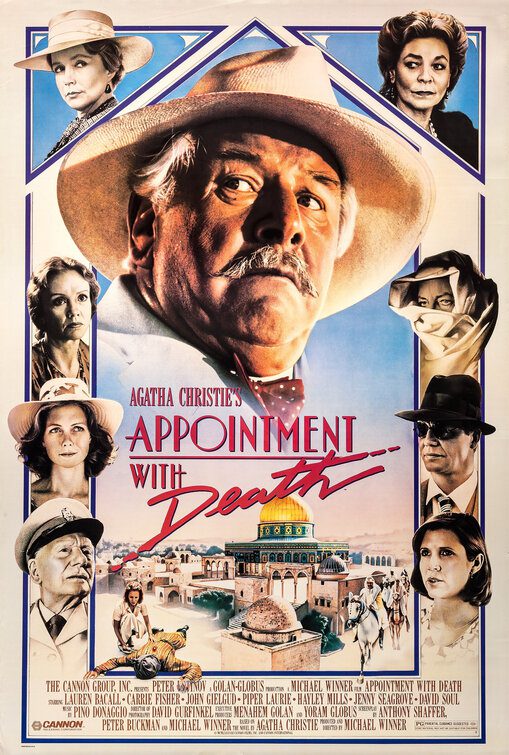
- Appointment with Death (1988) (Directed by Michael Winner): “People like to talk, and in doing so they tell the truth. It puts less of a strain on the memory.” – Hercule Poirot. I had missed Sir Peter Ustinov’s sixth and last appearance as Hercule Poirot when it first came out. This outing does not live up to what I consider some of the definitive Poirot movies like Death on the Nile (1978) and the shining example of Murder on the Orient Express (1974). Lauren Bacall is wonderful as Lady Westholme. Piper Laurie stands out as the heartless, Mrs. Boynton. You can see why she would catch the attention of David Lynch for his upcoming Twin Peaks (ABC). Sir John Gielgud is reunited with Bacall from the Orient Express. The cast is not the issue here. I haven’t read this yet, but it’s a predictable case of a dying patriarch and questions of inheritance. The family travels to Israel after the death of the father to await the final settlement of the will. The plot turns plodding at multiple points in the first two acts. It turns into a combination of a travelogue mixed with predictable dramatic turns. I’m sad that this is how Ustinov ends his Poirot career after offering such wonderful adaptations earlier in his career. I think that what worked in the mid-’70s didn’t translate to a director trying to update the vision for 1988 audiences.
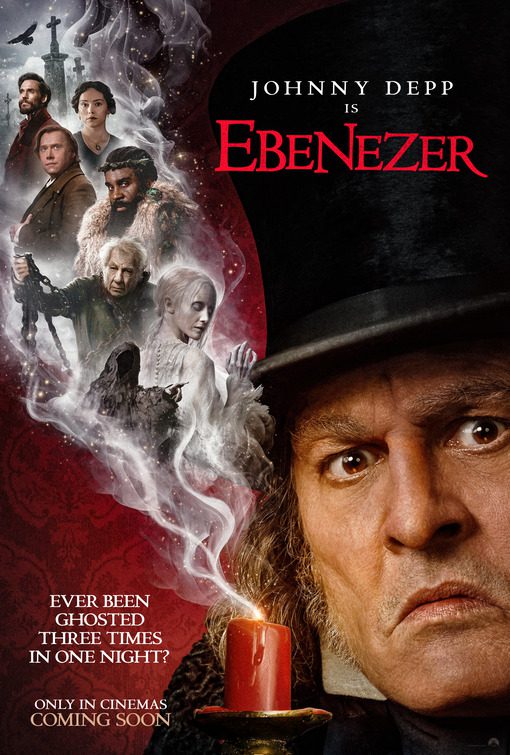
- Ebenezer (2026) (Directed by Ti West): “You go after her! You will regret this moment for the rest of your miserable life!” – Ebenezer. If you go to a film directed by noted R-rated-horror-movie director, Ti West, and your Christmas film has jump scares, I hope you aren’t as surprised as the audience in my showing seemed to be. Who knows how many adaptations of A Christmas Carol that there have been. It’s a challenge to each new version to find a way to make an impact. This one started with an impact just by casting Johnny Depp in his return to the big screen. Many won’t go see this movie on that principle alone.
Filmed in 35MM, the film has a wonderfully unique look, even if overly dark in stretches. The horror elements revolve around the no holds barred approach to the ghosts. I was especially fascinated with the Ghost of Christmas Present and the embodiment of want and ignorance. The ghosts are in fact, the best thing about this film in comparison to other versions. They overshadow Depp’s portrayal of Scrooge. Ian McKellen makes such a good Marley that you want another 30 minutes of that first part of the film. The story leaves out some of the key elements to the theme about money taking away a man’s humanity. There’s a focus on the love story with Belle that’s often left as “she married another man and lived happily ever after.” I didn’t mind the message there, but I think there’s still an importance in 2026 of not letting money overwhelm the focus of our lives. All said, Depp is passable but maybe the weak link in the cast. His story is taking place on a very meta level of overcoming adversity to get back to acting. I left feeling like this film fits nicely into the evolution of the story over the past hundred years on film. I worry that it’s going to be a footnote only because of the Depp casting.
Best of the Rest
- This is an example of an alternative version more than it is a cover. The Tears for Fears “Pale Shelter” song barely had the ink dry when the record company thought it might make a great addition to Paul Young’s upcoming No Parlez album. I had no idea this version existed until the 25th Anniversary release of No Parlez with lots of studio extras that didn’t make the album. It’s an odd anomaly now. I don’t mind the stripped-down acoustic take on the song, but Paul Young’s voice just isn’t right. Maybe I’ve just heard the Tears for Fears version too many times. It’s like hearing an alternative history.
- I really like Chicago’s Dead on TV. Their 2014 cover of Tears for Fears’ “Pale Shelter” just doesn’t do anything for me. It’s okay to try to cover it as a pop-punk song. I can’t explain, but nothing here sounds authentic. I have no doubt that they love the original, but it’s lacking the emotions of the original. My final thought is that some songs have such a connection to the original artist in both tone and sound, that it’s hard to cover with any different take or genre. That’s too bad because I wanted this one to work.
- The Weeknd isn’t an artist that I have a deep knowledge about, but I do know that they have a respect and love of ’80s music. The 2017 single, “Secrets” shows love to Tears for Fears “Pale Shelter” and Romantics “Talking in Your Sleep.” The song has a catchy vibe that’s modern and retro at the same time. The video confuses me. I’m sure that if I saw it without volume, I’d wonder what European perfume this ad was selling. This is the type of funky tune that makes me want to explore the discography a bit deeper.
Sunday Morning Tuneage Flashback
- Sunday Morning Tuneage from 12/5/2010, it was the start of December, which back then meant Buyback and Graduation. Caleb’s basketball team started the season with a close 8-4 victory. On our television, Fringe (FOX) was dying a slow death and leaving Thursdays for Fridays. Community (NBC) was impressing me, and I was looking forward to an Abed Christmas. The list for the week could be interpreted in so many ways. Heck, I even made a Top Ten with eleven entries. I’m going to put two more minutes of thought into it. And I still refuse to define “Non-Traditional.”
My #38 Top TV Show of All-Time was Bewitched (ABC) (1964-1972): I wouldn’t rank this here if I was doing this today. That doesn’t mean it wasn’t a high quality sitcom for a few of the eight seasons. I watched random episodes growing up, but it was when they started airing on Nick-At-Nite that I really learned to love the show. It was the early B&W episodes that sell the show. Once it switched to color, the show wobbled. Once they added a child, it was curtains. Dick Sargent was a downgrade, and I rarely watch his episodes if I happen to be flipping channels. It’s a hard genre to break into the Top 100 these days. I respect the strength of the supporting cast, and the show deserves respect for moving forward the genre.
BEST NON-TRADITIONAL CHRISTMAS SONGS OF ALL-TIME (2010)- 11. Tom Waits – “Christmas Card from a Hooker in Minneapolis” (1978)
- 10. John Denver – “Please, Daddy (Don’t Get Drunk This Christmas)” (1973)
- 9. The Waitresses – “Christmas Wrapping” (1981)
- 8. Alvin and the Chipmunks – “The Christmas Song” (1959)
- 7. The Pogues (w/Kristy MacColl) – “Fairytale of New York” (1987)
- 6. Greg Lake – “I Believe in Father Christmas” (1975)
- 5. James Brown – “Santa Claus Go Straight to the Ghetto” (1968)
- 4. Bob & Doug McKenzie – “Twelve Days of Christmas” (1981)
- 3. The Kinks – “Father Christmas” (1977)
- 2. Harvey Danger – “Sometimes You Have to Work on Christmas” (2004)
- 1. John Denver – “Christmas for Cowboys” (1975)
- BEST NON-TRADITIONAL CHRISTMAS SONGS OF ALL-TIME (2026)
- 11. Oscar the Grouch – “I Hate Christmas” (1975): A song so good that it’s been rewritten and recorded a few different times. Oscar talking about what annoys him about Christmas, including in the video turning a “Noel” into “No”.
- 10. Run DMC – “Christmas in Hollis” (1987): I’m not sure why this didn’t make the original list. It was the surprising star of A Very Special Christmas when the compilation album came out that year. It wasn’t the first or last Christmas Rap, but it sounded like one of their album cuts and not a holiday bastardization.
- 9. Ramones – “Merry Christmas (I Don’t Want to Fight Tonight)” (1989): In Ramones tradition, it’s a two-minute plea to not fight with your partner on Christmas.
- 8. The Darkness – “Christmas Time (Don’t Let the Bells End)” (2003): It’s both a parody of Christmas songs and a send-up of the falsetto heavy metal genre. It wouldn’t be a Heavy Metal Christmas without AC/DC level double entendres.
- 7. Tom Petty – “Christmas All Over Again” (1992): Produced by Jeff Lynne. The first couple versions of A Very Special Christmas were albums to look forward to at the holidays. This was off the second version and is just a damn good Tom Petty song too.
- 6. The Kinks – “Father Christmas” (1977): Today it is probably interpreted as a precocious song of children who want things for Christmas. Put into the context of England of 1977 and the evolution of punk rock in that era, it’s a wildly accurate social statement on Great Britain as much as the holidays.
- 5. Harvey Danger – “Sometimes You Have To Work on Christmas” (2004): A song that captures the spirit of working on a dreary Seattle Christmas Day from a band I really like. It’s not well known, but I keep it in rotation because it resembles the themes and general plot of a story I wrote a decade before the song was out.
- 4. James Brown – “Santa Claus Go Straight to the Ghetto” (1968): It’s got a great message of helping out the poor children at the holidays. It’s also a straight up funky song.
- 3. OutKast – “Player’s Ball” (1993): One of the first times that I had heard of the group was also one of their funkiest beats. It’s not an obvious Christmas song, but the vibe is there. It did debut on a Christmas compilation from LaFace Records.
- 2. The Waitresses – “Christmas Wrapping” (1981): This is what post punk looked like in 1981. It borders on New Wave but combines elements of early rap music. It’s a catchy tune about trying to avoid the Christmas spirit. There have been multiple covers of it, but this original is the best and one I look forward to each year.
- 1. The Pogues (w/Kristy MacColl) – “Fairytale of New York” (1987): I think I originally said this was “barely” a Christmas song. Well, I was wrong. It’s a popular choice for underrated holiday song, but MacColl’s angelic vocals win me over every time. I don’t go a December without making sure I play it.
1976 in Review
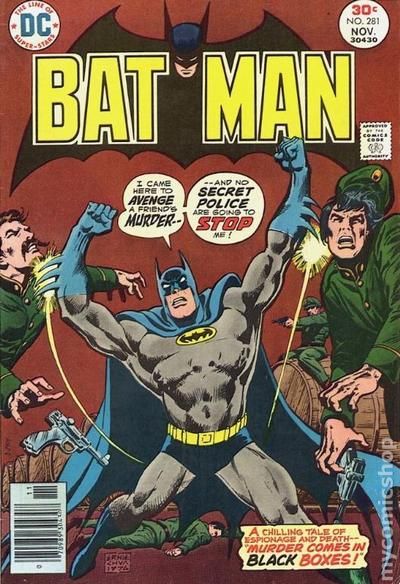
- November – Batman #281 (DC Comics): Cover by Ernie Chan. Written by David Vern Reed. Art by Ernie Chan. This is the first of a two-part story that takes Batman to Budapest to solve a more gritty espionage story. I liked these Reed stories matched with Chan’s darker art. It works well for this Cold War story as opposed to the traditional superhero stories.
- November 17 – The King Tut Exhibit would start a multi-year tour at the National Gallery of Art in Washington D.C. Across seven United States cities from 1976-1979, the exhibit would attract 7-10 million visitors.
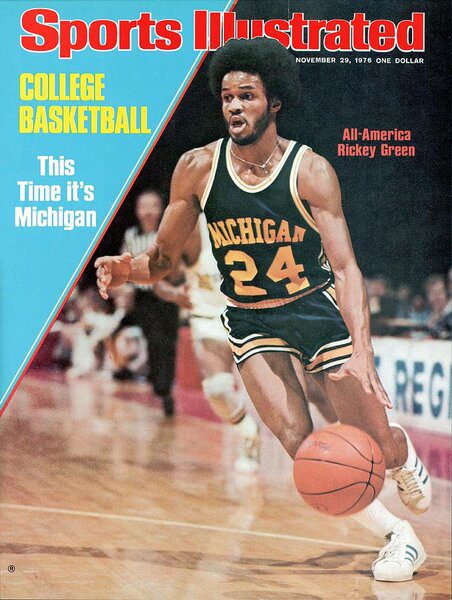
- November 29 – Sports Illustrated. Coming off of a Final Four appearance (where this cover picture was taken), Johnny Orr’s Michigan Wolverines were the consensus No. 1 team entering the season, led by Senior Rickey Green. Michigan would go 26-4 and win the Big Ten title, but they would be upset in the Elite Eight by UNC Charlotte. The eventual champion, Marquette would be featured in this issue with an interview with Al McGuire. Rickey Green would go on to have a 14-year career in the NBA, including for the Golden State Warriors and Utah Jazz.
What the Hell Did I Put in My Mouth?
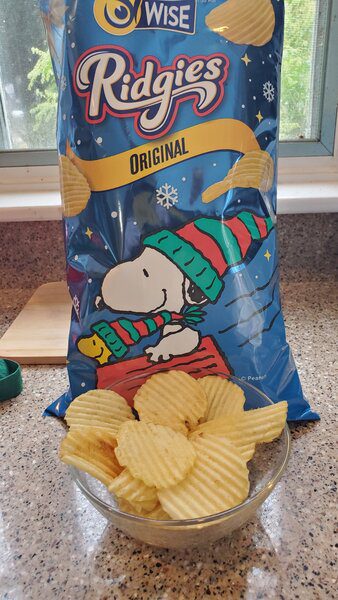
Wise: Ridgies – Original
These “almost Ruffles” were next in the line of “new to me” from Wise Potato Chips. The Snoopy and Woodstock packaging is pretty awesome. The chips are a solid entry into the ridged genre. They might be slightly more salty than the leading competitor, I wasn’t comparing. The point that I wanted to make with these local chips is that while national brands have exploded in price, these chips at 60% the price of other ridged chips are a great bargain.
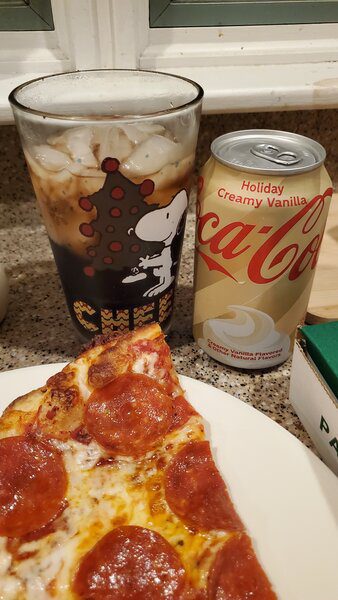
Coke: Holiday Creamy Vanilla
This is what they point to when they say that companies are out of new ideas but not new names. I’m a big fan of Coke and their flavors, and I would be hard pressed to tell you that this doesn’t taste like the Vanilla Coke when it first debuted. There’s a more of a cream soda taste than the current Vanilla Coke, but no matter is cream soda or vanilla soda, this doesn’t break new ground. That said, it’s a good mixer with a little rum and a maraschino cherry.

Keogh’s Truffle and Irish Butter Potato Chips
These “new to me” imported chips gave me a pause after suffering through their Blue Cheese flavor last week. I was even more alarmed at the intense Truffle scent when I opened the bag. I’m happy to report that the flavor is much better than expected. It’s a strong, crispy chip that leans more into the butter flavor than the sweet truffle. That truffle flavor is there as an aftertaste, but it isn’t overwhelming. They are back on my positive side.
“I’ve been here before
There is no why, no need to try
I thought you had it all
I’m calling you, I’m calling you
I ask for more and more” – Tears for Fears
