
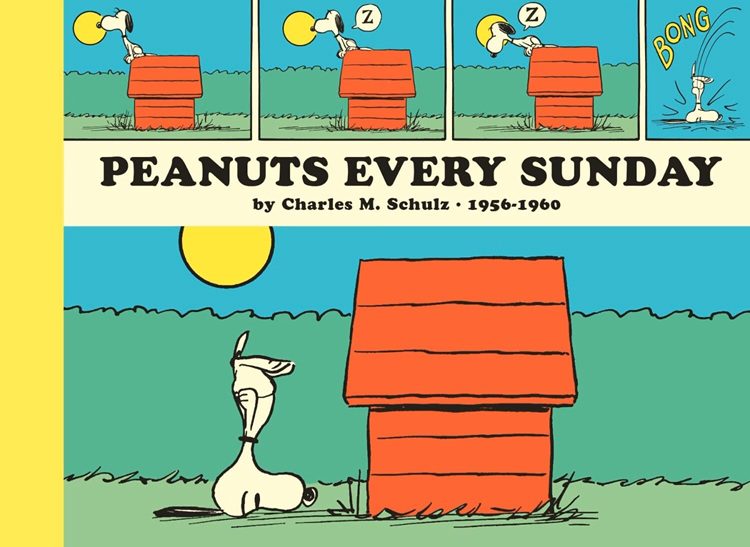
The second entry in the Peanuts Every Sunday series follows the initial book, Peanuts Every Sunday: 1952-1955. The new collection offers five more years of full color Sunday strips. The Peanuts library has always been in good hands with Fantagraphics as publisher. The choice to have the series in an oversized format is not bookshelf friendly, but it makes the reading of the strips highly enjoyable. The first book in the series had Schulz still exploring the format and how to tell his stories. The second volume comes as the popularity was starting to soar, and Schulz was experimenting with the characters while he tried to find the voice that would solidify the characters in the ’60s.
Buy Peanuts Every Sunday: 1956-1960November 11, 1956: The Sunday strips from 1956 don’t feature Charlie Brown as much as the previous few years. The unrequited love of Lucy and Schroeder makes for good, longer Sunday strips. The extended joke of Lucy being excited about something, only to find herself frustrated with Schroeder is predictable but funny. Lucy and Linus take up more of the Sunday strip stories. Linus has evolved from the toddler of previous years to be a symbol of anxiety who needs to find comfort in life (blanket, schoolwork, building blocks, etc.). The November 11 strip has a dancing Snoopy and Linus. Lucy plays the bossy older sister who complains that if Linus continues to dance “You’ll be a nothing.” Linus is great when he has a stoic philosophical response. Here he tells her, “Five hundred years from now, who’ll know the difference?!” Lucy isn’t won over. This celebration of just doing what makes you happy is an undercurrent that’s often overlooked in the strips.
April 28, 1957: This was a year that saw more Sunday strips with Linus and his blanket. Every season gives him a chance to show off his talents that all need him to have the security of his blankets before and afterwards. There is much more Charlie Brown and his activities. We see multiple Sundays with Charlie Brown’s kite-flying exploits. He’s also got multiple strips showing his love for football. The April 28 strip is one of many baseball-related strips that summer. The baseball field is where Charlie Brown has his most optimism but faces his most constant defeats. I love ones like this where Charlie Brown is alone on the pitchers mound during a rainstorm yelling, “Quitters! That’s what you are! You’re all a bunch of quitters!” and in the next frames, Snoopy swims by, leaving Charlie Brown with a “Sigh.” The continued failure on the field just makes him more relatable.
July 20, 1958: This is the first full year where a reader would recognize the characters as they would be for another few decades. The extra panels for the Sunday strips gave Schulz space to include more action shots. That’s why the sports strips were perfect for the 8-10 panels. The biggest evolution was with Snoopy. He was becoming more playful, enjoying Schroeder’s music and developed a rivalry with Linus. On July 20, we see Snoopy in a rare space of just being angry. He isn’t a fantasy character that will dominate the ’60s, nor is he chasing after Linus’ blanket. He is walking down the sidewalk. “I feel mean today!” and ends up walking right through Linus from behind and flipping him over stating “Nobody!” better get in his way. It’ a funny three-panel visual of Linus getting flipped, but it also shows off a side of Snoopy that we won’t see much after this.
May 17, 1959: The year of 1959 doesn’t differ much from what we read in 1958. The evolution of Linus from a baby still a couple of years ago to a full-fledged important member of the ensemble is in full bloom. He isn’t the moral center of the strip like Charlie Brown, but he and Lucy are foils in a way that is unique to siblings. There’s a continuing exploration of Charlie Brown and Lucy’s different philosophical approaches to life, usually through her 5-cent booth. This strip from May 17 has Charlie Brown and Lucy looking at the stars at night. Charlie Brown thinks there is a star out there for him, “And, as I am alone here on Earth among millions of people, that tiny star is out there alone among millions and millions of stars.” I love that it’s followed by a moment of silence as they both look up at the sky until Lucy walks away saying, “It means you’re cracking up, Charlie Brown.” It’s these moments when Charlie Brown has an introspective thought about his existence where Lucy will continue to undercut him. Linus will engage with even deeper interpretations, but it’s this dismissal from Lucy that strikes me as such a real reaction to baring your soul.
September 4, 1960: This new decade will be the pinnacle for most fans of the Peanuts strips. The 1960 Sunday strips have Schulz playing more with the ensemble dynamics, allowing Snoopy more autonomy from the group, and exploring more complex stories within the larger format. Sally is still a baby, but she is starting to find importance to the humor. She won’t peak until the end of the decade and into the ’70s, but you can see it coming. The September 4 Sunday strip is unique for the strips up to this point. It is the completion of a three-week continuity. That was rare in these days to expect just the Sunday readers to keep up with a running joke. On August 21, Charlie Brown is upset that it’s raining out the baseball game. Linus screams “Rain, rain, go away . . . Come again some other day!”, and it stops raining, spooking Linus. The next week on August 28, Linus is explaining what happened to Lucy. They go outside in the rain and he repeats the feat. This time he asks if he has a talent or if he’s a demon. Lucy says it has to be repeated a third time to prove it. The September 4 strip has Lucy and Linus and Charlie Brown waiting for it to rain. Linus is scared. “I’m still afraid people will think I’m some sort of demon . . . I’d hate that.” The moment comes when it starts raining and Linus forgets the wording, yelling “Go go today, rain some way again some day!” and it starts raining harder. I love the repetition of the joke with a slightly different punchline each time. This is masterful storytelling and humor. This summarizes the dynamics of the three main characters. Linus gets nervous when Lucy is yelling and takes his talent and makes the situation worse. Charlie Brown is initially drawn on Linus’ side, then between them as the rain starts, and eventually ends being drawn on Lucy’s side.
This is a wonderful collection that shows off the talents of Schulz as a visual artist and storyteller. Linus and Snoopy go through the most changes over the five years covered in this collection. Linus and his blanket are as cinematic as Charlie Chaplin’s Tramp and his hat and cane. Snoopy becomes more independent, showing the beginnings of his fantasy life, but also developing a personality with more nuances. Charlie Brown as the optimist who continues to fail at baseball, football, and kite-flying is best shown in the action panels of the Sunday strips. These strips are timeless and address the same insecurities we all face today. I can’t wait for the next two releases that will show off the very best of the strip. This release really sets the table.
