
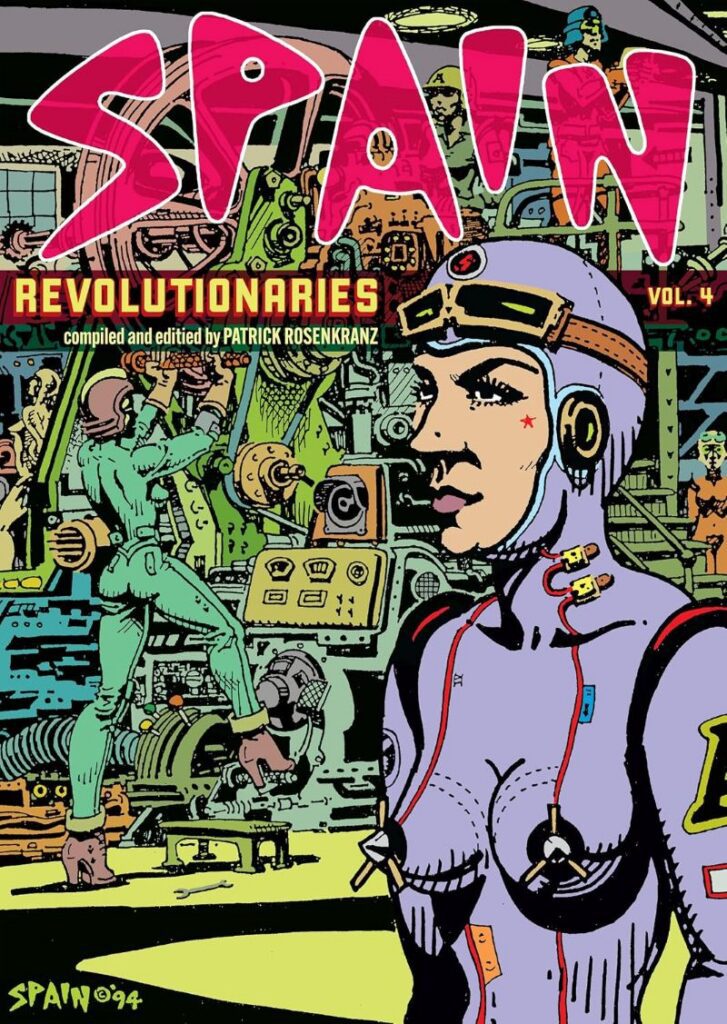
After a nearly six-year pause, Fantagraphics continues their spotlight series on the works of underground comix legend Spain Rodriguez. The fourth volume focuses on Spain’s most politically charged works, displaying his keen attention to pressing social-justice issues of his time that are no less relevant today. The book isn’t all revolution though, with room for a number of his other passions and work for hire. The large assortment of varied material minimizes any true unifying theme, but shows the amazing range of this restless activist and cartoonist.
Buy Revolutionaries: Spain Vol. 4The book begins with a lengthy essay detailing Spain’s pioneering work in smut, a result of the sexual revolution that ushered in the age of raunchy, sexually explicit comix. Only a few of the following pages contain his ribald strips, with the bulk of the section devoted to full-page reproductions of his color covers for Screw magazine.
Another essay takes a look at Spain’s lifelong identification as a Marxist, which leads into the large “Revolutionary Histories” section reprinting his many short comics about freedom fighters and military heroes, including Nestor Makhno and Bernardo Galvez. Only the cover page appears from his full-length graphic novel about Che Rivera, serving as a reminder to search out that excellent work elsewhere. Most of the stories are very short, displaying Spain’s ability to pack a lot of history into small spaces, but there is one exception: a 52-page graphic novella titled Boots that serves as the centerpiece of the entire book.
In Boots, Spain imagines the startling repercussions when an unidentified homeless man is gunned down by gangs on the streets of L.A. Rather than fading into oblivion, the deceased character nicknamed “Boots” becomes a political football exploited by the mayor and newscasters for headline-grabbing rhetoric about gang violence and homelessness. When his showy funeral gives rise to another mysterious media star, the story spirals into a fascinating examination of the evils of stardom, media manipulation, and political gamesmanship, with a touch of the paranormal thrown in for good measure. It’s a startlingly original and thought-provoking work, even if Spain doesn’t quite stick the landing at the end.
The next section details his longtime collaboration with writer and professor Joel Schechter, who engaged Spain for a series of one- to two-page comics about historical Jewish eccentrics and revolutionaries. Many of those comics are reprinted in the book, offering a glimpse at work one wouldn’t normally associate with Spain, a further sign of his versatility. The book closes with a brief look at Spain’s New Age art, including trippy full-page illustrations and two short comics.
While some of the work in this volume is more valuable for its curiosity factor than its entertainment value, the staggering breadth of material makes for a book that feels much greater than its 272-page length. The informative essays also help to paint a fuller picture of Spain’s varied artistic life, always marching to the beat of his own counterculture drum as he helped to smash censorship, push the boundaries of good taste, and educate readers about significant revolutionary figures. Anchored by the Boots novella, the book once again reinforces the impact Spain had on the rise of underground comix and the maturation of the comics industry as a whole, moving it past its bland kiddie-comics roots to the robust spectrum of diverse works available to readers today.
