
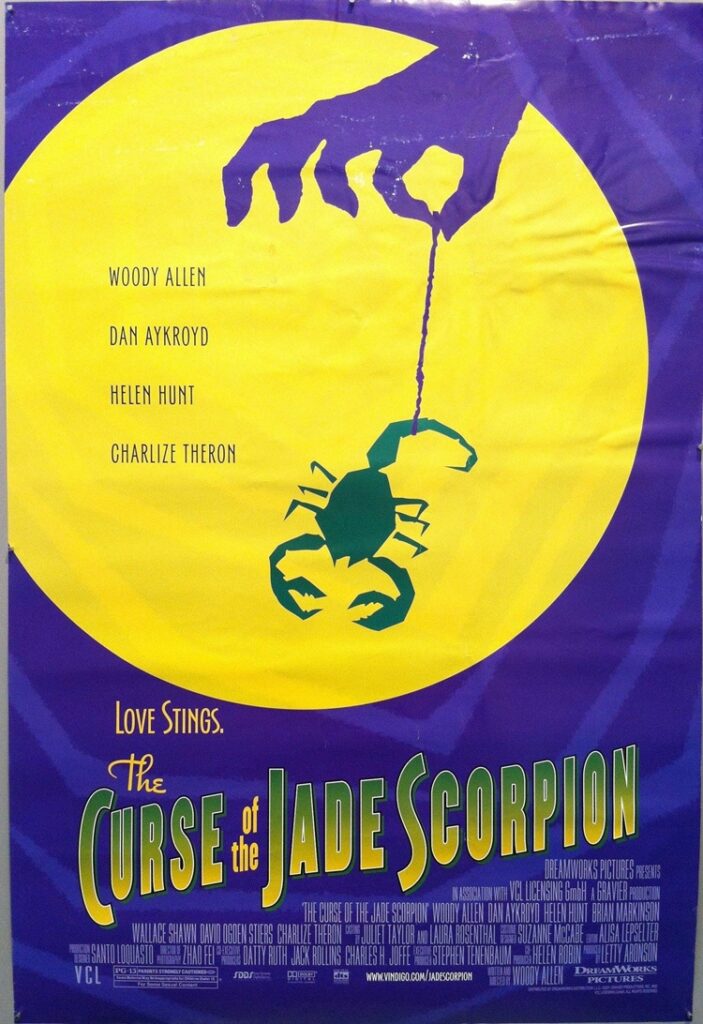
Woody Allen’s The Curse of the Jade Scorpion is the cinematic equivalent of walking into a beautifully preserved 1940s diner, putting a nickel into the jukebox, and discovering that the song playing is pleasant enough but not particularly memorable. Everything looks right, the wisecracks are flying, and there’s even a hypnotist with a jade scorpion. Yet something is missing.
Buy The Curse of the Jade ScorpionSet in 1940, the film stars Allen as C.W. Briggs, a veteran insurance investigator who prides himself on his ability to get inside the minds of criminals. Briggs is less enthusiastic about Betty Ann Fitzgerald (Helen Hunt), an efficiency expert brought into his office to modernize its operations. The two immediately despise one another, engaging in an ongoing battle of insults that gives the movie its best comic energy.
Their mutual hostility takes an unexpected turn when both are hypnotized by Voltan (David Ogden Stiers), a nightclub hypnotist who has discovered a particularly lucrative use for his talents. Under hypnosis, Briggs becomes an unwitting jewel thief, robbing the very homes he has previously helped protect. The mystery becomes a question of whether Briggs can discover the identity of the criminal without realizing that he is the criminal himself.
It is a clever premise, and Allen clearly has affection for screwball comedies and film noir. The production design and costumes are terrific, creating an elegant world of smoky offices, nightclubs, fedoras, and glamorous women. The movie’s visual polish is arguably more successful than its comedy.
Helen Hunt is especially enjoyable. She attacks Fitzgerald’s dialogue with the confidence of a classic screwball heroine, and her verbal sparring with Allen is easily the film’s strongest element. Dan Aykroyd, Wallace Shawn, Elizabeth Berkley, and Charlize Theron round out an appealing supporting cast, with Theron particularly well suited to the movie’s exaggerated femme-fatale role.
The problem is that The Curse of the Jade Scorpion is rarely as funny as it thinks it is. Allen’s dialogue has plenty of familiar rhythms, but the jokes don’t consistently land with the precision of his best comedies. The central romance is also difficult to believe. Allen and Hunt have entertaining antagonistic chemistry, but the movie asks us to accept them as romantic partners without quite establishing why either would fall for the other.
That leaves The Curse of the Jade Scorpion as an agreeable but decidedly minor Allen film. Its pleasures are more atmospheric than comedic, and its elaborate period recreation sometimes feels like a substitute for sharper material. Still, there is something appealing about Allen making a movie this unapologetically devoted to an earlier Hollywood.
The Curse of the Jade Scorpion may not cast much of a spell, but its polished look, appealing cast, and playful premise make it an attractive little time capsule. Occasionally, that’s enough to keep the audience happily hypnotized.
